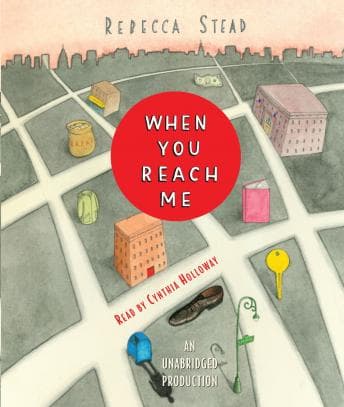

Look, I need to talk about the fact that a middle-grade novel about a sixth grader in 1970s New York just outperformed 90% of the business books in my Audible library. And it did it in four hours and twenty minutes. Four hours. Most business authors can't get to their thesis in that time.
I picked this up because my niece is visiting next week and Jenny suggested I "engage with her interests" instead of, quote, "asking a twelve-year-old about her quarterly goals." Fair. So I loaded up When You Reach Me while prepping banchan for Sunday dinner - hands covered in gochugaru, AirPods in, expecting something cute and forgettable.
I burned the kongnamul.
A Sixth Grader's Operating System Is More Interesting Than Your Startup's
Rebecca Stead does something here that I've watched dozens of founders fail at: she structures a nonlinear narrative where the confusion is the point, and she trusts her audience to be smart enough to follow. Miranda, our narrator, is piecing together mysterious notes that predict the future while simultaneously dealing with the very real collapse of her best friendship with Sal - who just stops talking to her one day after getting punched by a stranger on the street. No explanation. No dramatic blowup. Just... silence.
That hit different. My parents' business relationships in Koreatown worked the same way. People didn't have fallings out. They just stopped coming by. And you had to figure out why on your own.
Miranda's world is small - her mom's obsessive preparation for a game show appearance, the corner sandwich shop where she works the cash register, the school yard where social hierarchies shift daily. But Stead packs every detail with double meaning. The $20,000 Pyramid prep isn't just quirky background color. The laughing man who lives on the street isn't just atmosphere. Everything is load-bearing. By the time the pieces click together, you realize she's been running a structural con on you for the entire book, and the payoff is genuinely - I don't want to spoil it - but it involves A Wrinkle in Time in a way that earns its Madeleine L'Engle obsession instead of just name-dropping it.
Cynthia Holloway: The Narrator Who Knows When to Step Back
Holloway's performance is interesting to evaluate. She doesn't do dramatic character voices - no gruff dad voice, no squeaky best friend. What she does is modulate Miranda's emotional temperature with these subtle tonal shifts that keep you oriented in a story that's jumping around in time. She sounds young without sounding like an adult doing a kid impression, which is harder than it looks. (I've sat through enough client presentations where senior partners try to sound "relatable to millennials" to know the difference.)
Is it a standout, award-worthy performance? Honestly, no. It's clean, well-paced, no weird breathing artifacts or production issues. She makes the nonlinear structure feel natural rather than confusing, which is doing real work even if it doesn't announce itself. But I wouldn't buy this audiobook specifically for the narration. I'd buy it because the story is a precision instrument and Holloway doesn't get in its way.
The ROI Calculation
Here's what I keep coming back to: this book is about a kid learning that you can't control outcomes, that time doesn't work the way you think it does, and that the people you dismiss - the weird kid in class, the homeless guy on the corner - might be the most important people in your story. That's a better lesson than half the leadership books on my shelf, delivered in a quarter of the time.
The beginning is slow. I'll give the critics that. The first thirty minutes feel like setup without clear direction. But Stead is seeding everything you'll need later, and if you bail early, you miss the architecture. Skip to chapter 5? Not this time. This one needs the foundation.
At 2.0x speed, I finished this during one cooking session and a short walk afterward. The pacing holds up at speed because Stead writes clean, tight prose without filler. This is what my parents did instinctively - no wasted motion, every hour counts. Now it has a Newbery Medal.
Who should listen: Anyone who likes puzzle-box stories. Parents looking for something to share with their kids that won't insult either party's intelligence. Adults who read A Wrinkle in Time as kids and want that same brain-tingle. Business people who need a reminder that efficiency isn't the same as effectiveness.
Who should skip: If you need action on page one. If you have zero patience for middle-school social dynamics. If nonlinear storytelling genuinely frustrates you rather than intrigues you.
The Banchan Was Worth Remaking
Bottom line: a four-hour middle-grade novel just made me rethink how I evaluate return on time invested. It's short, it's tight, every element pays off, and it left me sitting in my kitchen staring at burned bean sprouts thinking about free will. Jenny walked in, saw my face, and said "You liked the kids' book, didn't you." I neither confirm nor deny.