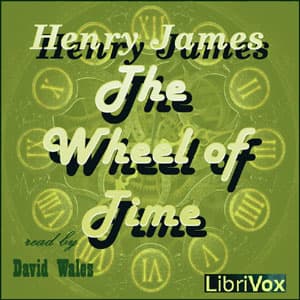

What happens when you pair one of literature's most psychologically complex writers with a narrator who plays it straight down the middle? That's the question I kept turning over during this brief—and I mean brief, under two hours—Henry James novella.
Look, I need to address the elephant in the room first. Yes, this is called "The Wheel of Time." No, there are no Aes Sedai. No magic systems. Just Henry James doing what Henry James does best: taking a deceptively simple premise—plain woman meets handsome but broke aristocrat—and excavating every uncomfortable social truth buried underneath.
The Master's Shorter Form
I'll be honest. I came to this one skeptical. James is known for his doorstop novels, those labyrinthine sentences that my students groan about when I assign excerpts from The Portrait of a Lady. But at just under two hours, this is James in miniature, and there's something almost refreshing about experiencing his psychological precision in concentrated form.
Fanny Knocker—and yes, that's really her name, Victorian literature was a different time—is described as "very, very plain." James doesn't let us forget it. The whole story hinges on this plainness, on what it means to be overlooked in a society that trades in appearances and fortunes. It's the kind of setup that could feel cruel, but James is doing something more interesting. He's watching the wheel turn, watching fate and circumstance grind against human longing.
The prose is vintage James. Interior monologue that spirals inward, sentences that require you to hold your breath and trust he'll land somewhere meaningful. This is why we still read the classics—because James understood something about social performance and hidden desperation that feels uncomfortably relevant. That same tension between appearance and reality runs through Black Beauty, though Sewell approaches it from an entirely different angle.
David Wales and the Neutrality Question
Here's where I'm genuinely torn. David Wales reads this with what I'd call respectful clarity. His enunciation is precise, his pacing consistent. For James's contemplative prose, there's an argument that this is exactly right—that you don't want a narrator showboating over sentences that already demand so much attention.
But.
And this is a significant but.
Some listeners find Wales's approach monotonous, and I can't entirely disagree. There are moments in James where the emotional undercurrent runs deep beneath that formal surface, and a narrator who could find those pockets of feeling—a slight shift in register, a pause that suggests what's unsaid—might have elevated this from a solid reading to something more alive.
I listened to this during a late-night grading session (principal Martinez, I was definitely also reviewing lesson plans), and the steady, unvarying delivery occasionally blurred into the background. Not because it was bad. Just because it was... safe. Wales understands that pause is punctuation, but he doesn't always use it.
Who Should Press Play (And Who Should Skip)
If you're a James completist—and I suspect there are more of us than we admit at dinner parties—this is worth your time. It's a minor work, sure, but minor James still contains more psychological insight than most contemporary fiction manages at triple the length.
New to James? Maybe start elsewhere. The brevity is appealing, but without the context of his larger themes, this might feel like a sketch rather than a complete picture. And if you need dynamic narration to stay engaged, if you want voices that distinguish characters and emotional peaks that register? This probably isn't your entry point. Wales delivers the text faithfully. He doesn't perform it.
The Wheel Keeps Turning
I keep coming back to that title. James is meditating on fate here, on how circumstances spin us into positions we never chose. Fanny Knocker didn't choose her face or her prospects. The handsome younger son didn't choose his birth order or his empty pockets. The wheel turns regardless.
My students would hate this. Too slow, too interior, too concerned with what people don't say rather than what they do. I found myself appreciating it precisely for those reasons. James trusts us to read between his elaborate lines, to feel the weight of social constraint pressing down on every interaction.
The production is clean—no audio issues, no distracting background noise. It's a professional recording of a public domain text, and it delivers exactly what it promises. Nothing more, nothing less.
Would I listen again? Probably not. But I'm glad I listened once, grading papers at 11 PM, letting James's elegant fatalism wash over me while my red pen did its work. Sometimes that's enough.