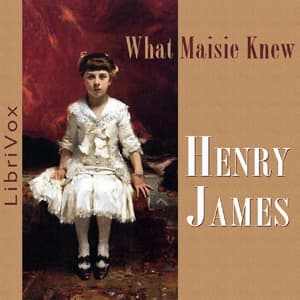

I have a confession. I've been putting off Henry James for years.
Not the reading—I've taught The Turn of the Screw enough times to recite the governess's paranoid ramblings in my sleep. But the listening? James's sentences are architectural marvels, these elaborate Victorian constructions with more subordinate clauses than a legal contract. I kept thinking: how does anyone perform that without making it sound like a tax document?
So there I was, 11 PM, red pen bleeding all over sophomore essays about symbolism in The Great Gatsby (no, Tyler, the green light does not represent Gatsby's favorite color), and I finally pressed play on What Maisie Knew.
The Child Who Sees Everything and Understands Nothing
Here's what makes this novel quietly devastating: James puts us inside the consciousness of a little girl whose parents are, to use the clinical term, absolute disasters. Beale and Ida Farange divorce, and the court—in its infinite wisdom—decides Maisie should shuttle between them every six months. What follows is a parade of new stepparents, lovers, and hangers-on, all of whom use this child as a messenger pigeon for their spite.
But Maisie doesn't understand what she's witnessing. She observes her mother's cruelty, her father's neglect, the strange intimacies between adults who shouldn't be intimate—and she processes none of it the way we do. James captures that peculiar childhood state of absorbing everything while comprehending almost nothing. It's like watching someone describe a crime scene in terms of pretty colors.
This reminds me of what Hemingway said about writing—the dignity of movement of an iceberg is due to only one-eighth of it being above water. James gives us Maisie's eighth. The reader supplies the horror beneath.
Where the Audio Stumbles
Elizabeth Klett reads for LibriVox, and I want to be fair here—volunteer narration is a gift to the audiobook world. But this particular recording presents challenges that even a professional would struggle with.
The character differentiation is... murky. Mrs. Wix and Mrs. Farange blurred together for me more than once, and in a novel where half the drama depends on which awful adult is currently manipulating Maisie, that's a problem. I found myself rewinding, trying to reconstruct who just said what to whom. (Denise asked why I kept muttering "wait, was that the governess or the mother?" during our morning lakefront walk. I didn't have a good answer.)
More troubling: Maisie ages over the course of the novel. She begins as a very young child and ends on the cusp of adolescence. That evolution—which is central to James's project—doesn't quite land in Klett's performance. The voice remains consistent when it should be shifting, growing, gaining the first traces of adult understanding.
The prose deserves to be savored. But here, you're working harder than you should to follow the story.
Why I'm Still Recommending It (With Caveats)
Look, this is a LibriVox recording. It's free. And despite its flaws, it delivers something remarkable: access to a Henry James novel that most people never encounter.
My students would hate this. The sentences are long, the action is psychological, nobody gets murdered or falls dramatically in love. But I love it precisely because James refuses to simplify childhood. Maisie isn't a sentimental Victorian waif. She's a survivor, adapting to each new configuration of adults with an almost unsettling flexibility. By the end, when she makes her choice—and she does make a choice, one that surprised me—you realize James has been building toward this moment of agency all along.
The story of the sensitive daughter of divorced and irresponsible parents has, as one listener noted, great contemporary relevance. That same exploration of family dysfunction plays out in Paris Apartment: A Novel, though with adults still carrying their childhood wounds. I teach kids from fractured homes. I watch them navigate custody arrangements and loyalty tests. James understood something in 1897 that we're still grappling with: children are not property to be divided, and they see more than we think.
Who's This For (And Who Should Skip It)
If you're a James devotee or a student of Victorian literature, stream this. It's free, it's competent, and the source material is extraordinary. Listen at 1.0x—James chose those words, and the rhythm of his prose rewards patience.
But if you're new to James, or if you need crystal-clear character distinction to stay engaged, this might not be your entry point. Consider a professional production, or better yet, read the physical text first. Then come back to this as a companion.
For everyone else: know what you're getting. An eight-hour commitment to dense psychological realism, read capably but not brilliantly, offering one of literature's most haunting portraits of childhood innocence corrupted by adult selfishness.
I finished it at 2 AM. The essays still weren't graded. Worth it.