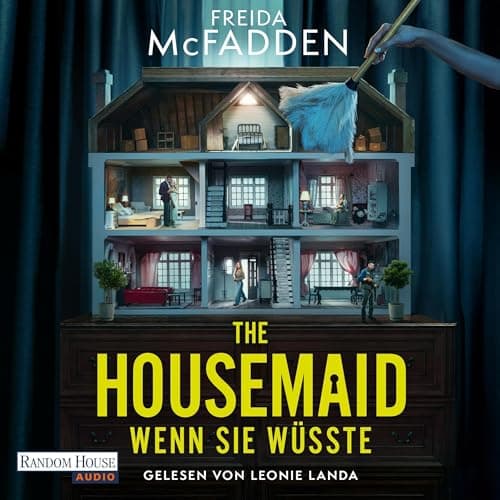

I was shelving returns in the back of the library — the windowless part where the overhead light flickers just enough to make you paranoid — when Leonie Landa whispered something in my ear that made me stop mid-reach. Nina had just turned on Millie, and the shift was so quiet, so controlled, that I actually looked over my shoulder. In a storage room. At 3 PM. Surrounded by large-print romance novels.
This is what good psychological horror does. It doesn't need a jump scare. It needs a voice that knows how to modulate trust.
The Slow Knife Nina Twists
So here's the deal with Wenn sie wüsste — the German audio version of Freida McFadden's The Housemaid — the first half is a patience game. You know something's wrong. Millie knows something's wrong. Nina is clearly unhinged behind her Long Island elegance. But McFadden makes you sit with the gaslighting, the petty destructions, the "did she really just do that?" moments that accumulate like water damage. You don't notice how bad it's gotten until the ceiling caves in.
And yeah, I've seen the complaints. "The first half isn't very thrilling." I get it. If you need a body by chapter three, this book will frustrate you. But that slow build? That's the point. McFadden understands that horror isn't about gore — it's about dread. Nina trashing the house and blaming Millie, the micro-aggressions dressed up as employer authority, the way the power dynamic keeps shifting — it's domestic horror played at a frequency that'll make your skin crawl if you're paying attention.
The twist at the end is what everyone talks about, and they're right to. I won't spoil it, but I will say this: the book essentially restructures everything you thought you understood about who's the predator and who's the prey. McFadden pulled a move that reminded me of what Shirley Jackson used to do — let you build your own assumptions, then show you the trapdoor you've been standing on the whole time.
Landa Plays the Long Game
Leonie Landa does something clever with this narration. She doesn't go big. No theatrical villain voice for Nina, no trembling victimhood for Millie. Instead, she keeps things just slightly off — a too-pleasant tone when Nina's saying something cruel, a careful steadiness in Millie's voice that hints she's holding more back than she's revealing. The narration pulls you deeper into the cat-and-mouse game precisely because Landa refuses to telegraph who's winning.
Is it the most dynamic narrator performance I've ever heard? No. The character differentiation is subtle to the point where you occasionally need a beat to register who's speaking. But for this particular story — where deception is the entire engine — that blurriness works. You're supposed to be uncertain. You're supposed to second-guess.
At 8 hours 45 minutes, the pacing is tight enough that the slow first half doesn't overstay its welcome. I burned through the second half during a late-night session with Shirley (my cat) on my lap, lights off, because apparently I never learn. The psychological tension in those final hours genuinely had me tense. Not scared exactly — more like that feeling when you realize you've been lied to and you're replaying every conversation in your head.
One Thing That Bugs Me
This is an abridged version, and that always makes me twitch. What got cut? The German translation by Astrid Gravert and Renate Weitbrecht reads smoothly through Landa's delivery, but I couldn't shake the feeling that some of the quieter character moments — the ones that make you care about Millie beyond her role in the plot — might have been trimmed. It's a solid listen, but I suspect the unabridged English version breathes a little more.
Shelve It Here
My podcast listeners are going to have opinions about this one. It's not reinventing psychological thriller — it's executing the formula with a precision that most authors in this lane can't match. Every Vow You Break works the same lane and stumbles in a few spots where McFadden doesn't. The twist earns itself. Landa commits to the material without overselling it. And that slow first half? It's doing more work than you think.
If you want a domestic thriller that respects your intelligence enough to let dread build instead of shoving plot twists at you every ten minutes, this delivers. If you need constant momentum, or you're planning to half-listen while folding laundry — skip this version and maybe try the print. This one rewards full attention.
I listened in the dark. Mistake? Maybe. Worth it? Absolutely.