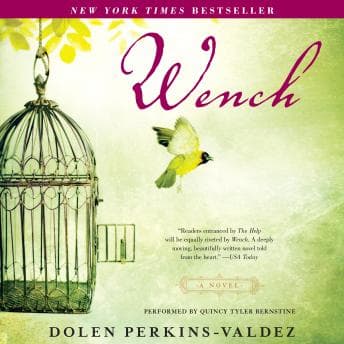

I need to talk about the word "love" and how Dolen Perkins-Valdez made me furious with it.
I was walking the lakefront with Denise last Saturday — one of those rare October mornings where Lake Michigan looks almost forgiving — and I had to stop on the path because this book kept using the word "love" in contexts that made my stomach turn. Not because Perkins-Valdez is doing anything wrong. Because she's doing something devastatingly right. She's forcing you to sit inside the delusion that an enslaved woman can "love" the man who owns her, and she never once lets you get comfortable with it.
The Lie That Feels Like a Love Story
Here's the premise that knocked me sideways: there was a real resort in Ohio — a free state — called Tawawa House, where Southern slaveholders would bring their enslaved mistresses for summer vacations. Just... let that sink in. These men would cross into free soil with women they legally owned, women who could theoretically walk away, and the women stayed. Perkins-Valdez builds her entire novel around that impossible psychological trap.
Four women. Lizzie, Reenie, Sweet, and Mawu. Each one entangled with a white slaveholder in a different way, each one telling herself a different story about what her situation means. And this is where the book got under my skin — because Perkins-Valdez doesn't give you a simple narrative of resistance. Lizzie genuinely believes her master Drayle cares for her. She's had his children. She negotiates within the relationship like it's a marriage. And the novel asks you to hold two truths at once: that Lizzie's feelings are real AND that the entire framework is monstrous.
My students would hate this. I love it.
Because that's what great historical fiction does — it refuses to flatten the past into heroes and villains. I wrestled with that same refusal to simplify in Beneath a Scarlet Sky, where moral compromise under fascism gets rendered with a complexity that would make my AP Lit students deeply uncomfortable. This reminds me of what Hemingway said about writing: "All you have to do is write one true sentence." Perkins-Valdez writes true sentences about women who can't afford to see their own truth.
Bernstine Knows That Silence Is a Sentence
Quincy Tyler Bernstine's narration does something I don't hear often enough: she trusts the quiet. There are moments — particularly when Lizzie is rationalizing Drayle's behavior — where Bernstine lets a beat hang just a fraction longer than you'd expect. The narrator understands that pause is punctuation. She's not dramatizing the horror; she's letting you feel Lizzie doing the mental gymnastics in real time.
What struck me most was how she differentiates the four women not just through voice but through energy. Mawu — the defiant one, the one who keeps plotting escape — gets this forward-leaning urgency. Lizzie's sections feel slower, more measured, almost cautious. It's subtle work. Bernstine isn't doing theatrical accents or wildly different registers. She's modulating something harder to pin down: the emotional temperature of each woman's worldview.
At eight hours and change, this is a focused listen. No bloat. The pacing mirrors the summers at Tawawa — these stretches of deceptive calm punctuated by moments that remind you exactly what these women's lives actually are.
What Perkins-Valdez Is Really Saying
Let's talk about what the author is really saying. Because on the surface, this is a novel about enslaved women and their complicated attachments. But what Perkins-Valdez is actually interrogating is the psychology of unfreedom — how proximity to power gets confused with power itself, how small concessions from an oppressor start feeling like love, how the line between survival strategy and genuine emotion blurs until even the person living it can't tell the difference.
If you loved Toni Morrison's Beloved, this is its spiritual successor in one very specific way: both novels insist that slavery didn't just damage bodies. It colonized the interior life. The capacity to want, to choose, to know what love even means when consent isn't possible.
I kept thinking about this while pretending to read a faculty email chain about standardized testing. (Principal Martinez, I promise I read it eventually.) The book lingered. It's still lingering.
The prose deserves to be savored. Listen at 1.0x. Give it the silence it earns.
Who Gets Assigned This One
This is for readers who want historical fiction that doesn't offer easy catharsis. If you need a clear redemption arc or a triumphant ending, this will frustrate you — and I'd argue that frustration is the point. Readers who loved Edward P. Jones's The Known World or Yaa Gyasi's Homegoing will find familiar moral complexity here. Skip it if you want action-driven plot; this is character-driven and interior, and it moves at the pace of someone slowly realizing the truth about their own life.
Worth pausing the faculty meeting for. Worth pausing a lot of things for.