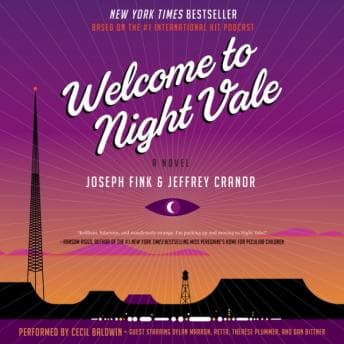
Look, I need to rant about something before we get into this. I have spent years on my podcast explaining to people that horror and weird fiction are not the same thing, that cosmic dread and supernatural whimsy occupy different rooms in the same haunted house, and that conflating them does a disservice to both. And then Welcome to Night Vale comes along and just... smashes those rooms together with a sledgehammer, fills the wreckage with angels that everyone pretends don't exist, and somehow makes it work. I'm annoyed. I'm delighted. I'm annoyed that I'm delighted.
I was shelving returns at the library on a quiet Tuesday — the kind of afternoon where the fluorescent lights buzz just loud enough to feel ominous — and I had this playing through my earbuds. A patron asked me why I was smiling at a cart of picture books. I didn't have a good answer.
The Podcast That Grew Legs (and Tentacles, Probably)
Here's the thing about adapting a podcast into a novel: it almost never works. Podcasts live in fragments. They breathe in the gaps between episodes. Novels demand structure, momentum, a spine. Fink and Cranor clearly understand this problem, and their solution is... interesting. They don't abandon the podcast's fragmented, community-radio-dispatch style. They lean into it. The narrative drifts between Jackie Fierro's pawn shop existential crisis — she literally cannot let go of a slip of paper that reads "KING CITY," and the physical permanence of that detail is genuinely unsettling — and Diane Crayton's increasingly desperate attempts to keep her shapeshifting son from seeking out his deadbeat father.
Both storylines circle the same mystery like vultures, and the book takes its sweet time letting them converge. Does it drag in places? Yeah, honestly, it does. There are stretches where the Night Vale worldbuilding — the faceless old woman who secretly lives in your home, the hooded figures at the dog park — feels less like atmosphere and more like the authors checking boxes from the podcast wiki. Fans will love the references. Newcomers might feel like they walked into a conversation that started three years before they arrived.
But when it locks in — when Jackie's inability to release that paper becomes a metaphor for being stuck at nineteen forever, when Diane watches Josh shift into forms she doesn't recognize and realizes she's losing him in every possible meaning of that word — this understands that horror isn't about gore. It's about dread. The dread of stasis. The dread of change. That same flavor of creeping, ambient dread saturates Darkness Unchained, though it leans harder into the supernatural throat-grab than the existential whisper. The dread of a town that normalizes the impossible until the impossible becomes boring, and the truly terrifying thing is how much that sounds like real life.
Cecil Baldwin Owns This Town
The narrator commits. That's rare. And it matters more here than in almost any other audiobook I can think of, because Cecil Baldwin isn't just performing this material — he is Night Vale's public radio host. He's been voicing Cecil Palmer since 2012, and that history saturates every line. There's a distinction between narrator-Cecil (omniscient, slightly detached, sardonic) and character-Cecil (earnest, confused, weirdly tender), and Baldwin shifts between them with this effortless modulation that you don't notice until you're already deep in it.
Now. I need to be honest. This is not the full-cast production some people expect. Dylan Marron, Retta, Therese Plummer, and Dan Bittner show up for specific characters, and they're good — Retta in particular brings a warmth that the book desperately needs in its middle stretch. But Baldwin carries probably 80% of this thing solo, and if you're coming in expecting a radio drama with sound effects and scoring, recalibrate. It's an audiobook with guest stars. A very good audiobook with guest stars, but set your expectations accordingly.
The style reads like a podcast script at first, and that threw me. Sentences structured for the ear, not the page. But give it an hour — maybe ninety minutes — and your brain adjusts. It starts to feel intentional rather than awkward. Like the book is being broadcast to you.
Who Belongs in Night Vale (and Who Should Keep Driving)
If you're a podcast fan: you already own this. You bought it the day it came out. You don't need me. But if you're podcast-curious and want a gateway, this audiobook is genuinely the best entry point — better than starting at episode one, honestly, because it has actual narrative structure holding the weirdness together.
If you scare easily, skip. If you don't — well, this isn't going to terrify you. It's going to unsettle you in that slow, persistent way where you're fine until 2 AM and then you think about a man in a tan jacket that no one can remember and suddenly you're checking your hallway. Shirley Jackson walked so this kind of American gothic surrealism could run.
If you have zero patience for whimsy, for fiction that insists on being aggressively strange as a philosophical stance — move on. This book will infuriate you. The pacing meanders. The plot is secondary to the vibe. Characters exist in a town where librarians are feral monsters (which, as a librarian, I find both offensive and occasionally accurate).
Broadcast Ends. Static Remains.
My podcast listeners are going to love this, or at least the ones who've been asking me to cover Night Vale for three years will. It's not perfect. The middle sags, the two-mystery structure sometimes feels like neither mystery gets enough oxygen, and the ending reaches for an emotional payoff it hasn't fully earned. But the atmosphere? The bone-dry humor masking genuine existential terror? The way it treats the uncanny as mundane and finds horror in that mundanity?
Finally, horror that respects the genre — even when it's pretending to be a comedy.
Shirley (my cat) was unimpressed. I was... unsettled. In the best way.









