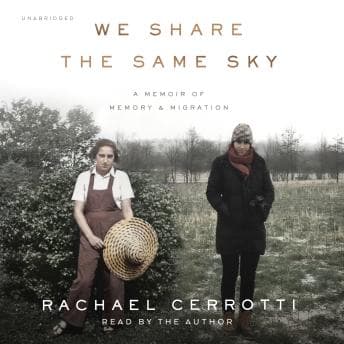

"Hana talked and Rachael wrote."
That line hit me somewhere around hour one, and I had to pause my work because my hands were shaking too much to align anything on the canvas. I was in the middle of a branding project — clean lines, modern font pairings, very sleek, very unemotional — and here's Rachael Cerrotti in my ears telling me about sitting with her grandmother, recording stories that almost didn't survive. Stories that survived because strangers decided to be decent. I set my stylus down. Frida jumped on my desk and sat on my keyboard like she knew.
A Granddaughter With a Tape Recorder and a Mission
This book felt like two memoirs braided into one — and that's both its greatest strength and the thing that might lose some people. You get Hana's story: a Jewish girl staying one step ahead of the Nazis through Denmark, Sweden, finding safety through the kindness of people who had no obligation to help. And then you get Rachael's story: a twentysomething photojournalist retracing her grandmother's path through Europe after Hana passes in 2010, knocking on the doors of descendants of those who sheltered her abuela — sorry, her grandmother. (I keep using that word. It's the only one that feels right.)
The Hana sections are devastating in the way that real history is devastating — not dramatic, not Hollywood, just a girl moving from country to country with her photographs and her will to live. Cerrotti draws from letters, journals, deportation papers, immigration documents. She digitized her grandmother's entire archive, and you can feel the weight of that physical evidence in how she tells it. There's a specificity to Hana's story that kept catching me off guard — the preserved photo albums dating back to the 1920s, the letters waiting to be translated from languages Rachael had to learn.
The Rachael sections are different. More searching, more uncertain. She's grieving and also trying to figure out who she is outside of this inherited history. Some listeners have said the second half — where Rachael's own life takes center stage — doesn't quite match the power of Hana's wartime survival. And honestly? I get that criticism. There's a tonal shift when we move from "my grandmother escaped the Nazis" to "I'm in my twenties figuring out love and loss in modern Europe." The stakes feel different. But I think that's actually the point Cerrotti is making — that grief doesn't care about scale. Losing your grandmother at 22 can restructure your entire world even if she lived to old age, even if she already survived the unsurvivable.
When the Author IS the Narrator and It Actually Works
Rachael narrates this herself, and — okay, I need to be honest. She's not Julia Whelan. She doesn't have that velvet-and-honey thing I usually need. But what she has is something a professional narrator literally cannot fake: she's reading about her own grandmother. Her own grief. Her own obsessive, beautiful, slightly unhinged project to touch the past by sleeping in the same beds Hana slept in, walking the same streets.
You can hear it — the way her voice gets tight when she's talking about Hana's passing, the way it opens up when she describes meeting descendants of the families who helped. There's a moment where she's tracking down someone in Scandinavia connected to Hana's survival, and the recognition between them — between this stranger and this granddaughter — I had to pause again. Not because I was ugly-crying (okay, I was), but because it felt intrusive to listen. Like I was overhearing something sacred.
At 6 hours and 51 minutes, this is a focused listen. Not background-while-I'm-designing material. I tried. I kept having to rewind because I'd miss crucial emotional context while adjusting kerning. This one needs your full attention.
The Part That Would've Made Abuela Cry
Abuela would have loved this one. Not the Holocaust parts — those would have made her clutch her rosary and whisper prayers — but the granddaughter parts. The idea that a young woman would spend her entire twenties chasing her grandmother's ghost across continents because the story mattered too much to let it fade. Abuela understood inherited memory even if she never called it that. Every telenovela we watched together was about someone carrying a secret or a story that shaped generations.
I will say — one thing that bothered some listeners was Cerrotti weaving in her own political views. I noticed it but wasn't put off by it. When your grandmother's entire family was killed by a political ideology, I think you've earned the right to have opinions. But if that's a dealbreaker for you, fair warning.
Who Needs This Book (and Who Should Wait)
If you've ever lost someone and then tried to piece together who they were from what they left behind — the photos, the letters, the objects that outlived them — this will wreck you. If you're looking for a straightforward Holocaust memoir, the dual timeline might frustrate you. If you need polished narration from a trained voice actor, this might feel raw. But that rawness is the whole thing.
My heart. MY HEART. Four crying sessions. Beach Read record still stands, but barely. The closest I've come to that same gut-punch combination of grief and dark humor in a memoir was Thank You for My Service — completely different world, completely different stakes, but that same disorienting feeling of laughing and then immediately hating yourself for laughing.
The Vibes Are Grief-Drenched and Golden
This is a rainy Sunday book. Put your phone in another room. Let the cats judge you while you cry. It earned every minute at 1.0x.







![Steve Jobs [unabridged audiobook] audiobook cover](/_next/image?url=https%3A%2F%2Fcovers.audiobooks.com%2Fimages%2Fcovers%2Ffull%2F9788499923406.jpg&w=1920&q=75)