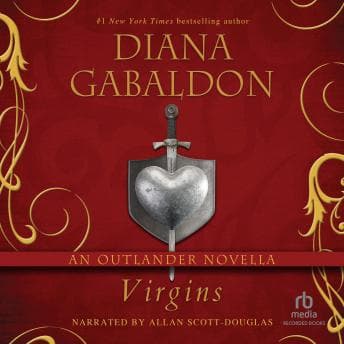

What happens when you strip away Claire Randall, the time travel, the sweeping romance—and just give us Jamie Fraser before he became Jamie Fraser?
I finished grading a stack of Gatsby essays around midnight, my eyes burning from adolescent interpretations of the green light, and I needed something that wouldn't demand too much of me. Three hours felt right. A palate cleanser. What I got instead was something unexpectedly moving—a portrait of grief wearing the costume of an adventure story.
Before the Legend, the Boy
Here's what Gabaldon understands that most prequel writers don't: young Jamie isn't charming Jamie with the serial numbers filed off. He's subdued. Almost depressed. Allan Scott-Douglas captures this beautifully—there's a heaviness in his delivery that tells you this boy is carrying his father's death like a physical weight. The Scottish accent is authentic (obviously, he's a Scot), but it's the emotional register that surprised me. This isn't the confident, witty Jamie of the main series. This is a nineteen-year-old running from grief and running toward anything that might distract him from it.
The friendship with Ian Murray becomes the real center of the story. Both young men are nursing wounds—Jamie's more visible, Ian's more internal—and their dynamic has that particular quality of male friendship where everything important goes unsaid. Scott-Douglas differentiates them clearly: Jamie's voice carries that subdued quality I mentioned, while Ian gets a slightly lighter touch. You can hear the difference in their wounds.
The Narrator Question (And Why It Doesn't Matter)
Look, I understand the Davina Porter loyalists. I do. She's narrated the main Outlander series, and there's something jarring about hearing a different voice for a character you've spent hundreds of hours with. But here's the thing—this isn't that Jamie. This is a different chapter entirely, and Scott-Douglas's interpretation makes sense for the material. His Jamie sounds young in a way that Porter's necessarily can't.
The complaints about the short length? Valid, I suppose, if you came expecting a novel. But three hours is exactly right for what this is: a contained story about two young men, a Torah, a beautiful woman, and the particular kind of trouble that follows young men who haven't yet learned to stay out of it. This reminds me of what Hemingway said about leaving things out—Gabaldon gives us just enough to understand who Jamie will become without belaboring the point.
The Story Beneath the Story
The plot itself—escorting Dr. Hasdi's daughter Rebekah to an arranged marriage while protecting an old Torah—serves mostly as scaffolding for character work. Both Jamie and Ian are drawn to Rebekah (of course they are, they're nineteen and she's beautiful and forbidden), but the story doesn't go where you might expect. The title "Virgins" is doing more work than the obvious reading suggests. These are young men virginal to the world, to loss, to the particular kind of moral complexity that comes with mercenary work.
The prose deserves to be savored. Gabaldon has always been a sentence-level craftsman, and hearing her words performed reminds you why the Outlander series became what it became. That attention to language is something I appreciated in Murder in an Irish Village too, though Carlene O'Connor's Irish setting trades Highland Scotland for contemporary Cork. There's a scene—I won't spoil it—where Jamie's grief finally surfaces, and Scott-Douglas handles it with restraint that makes it land harder. Fellowship of the Ring has similar moments where grief breaks through the adventure, though Tolkien takes a more mythic approach to loss. No histrionics. Just a young man confronting what he's lost.
Who This Is (and Isn't) For
If you've never read or listened to Outlander, this probably isn't your entry point. The emotional weight depends on knowing who Jamie becomes. But if you're a fan curious about the spaces between the main novels—or if you just want a three-hour listen that's smarter than it needs to be—this delivers. Skip it if you need Claire's presence to care, or if slow character work reads as "nothing happening" to you.
My students would hate this. Too slow, they'd say. Nothing happens. They'd be wrong, of course. Everything happens. It just happens quietly, in the spaces between action scenes, in the silences Scott-Douglas knows how to hold.
Worth pausing the faculty meeting for? Absolutely. (Sorry again, Principal Martinez.)
Mr. Williams's Final Grade
At three hours, this is almost a novella in audio form—a literary appetizer rather than a meal. That's not a criticism. Sometimes you want the appetizer. The production is clean, Scott-Douglas is excellent for this particular material, and Gabaldon reminds you why she's been doing this for thirty years. It's not essential Outlander, but it's good Outlander, and there's value in that distinction.
For the Porter devotees: give Scott-Douglas twenty minutes before you decide. The voice grows on you. For everyone else: this is what prequels should be. Not fan service, but genuine character work wearing adventure clothes.