
Look, I have a confession. I've been studying why people are drawn to dark narratives for years, and yet here I am, jogging through Cambridge at 6 AM, listening to a book about vampire-obsessed killers while dodging tourists. The irony isn't lost on me.
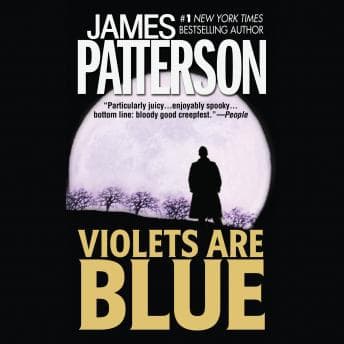
So here's the thing about Violets Are Blue: it shouldn't work. Vampires in an Alex Cross thriller? Patterson taking his grounded detective into supernatural territory? I was skeptical. My research brain was already preparing to catalog all the ways this would fail psychologically. But then something interesting happened—I stopped analyzing and just... listened.
The Dual Voice Experiment
Patterson made a fascinating choice here with the dual narration, and honestly, it's a case study in how voice shapes character perception. Daniel Whitner handles Alex Cross, and he gets something crucial right: Cross isn't just a detective, he's a father first. There's this warmth in Whitner's delivery when Cross interacts with his kids that makes the violence hit harder later. It's contrast theory in action—you care about what he has to lose.
Kevin O'Rourke, though? He's doing something deliciously unsettling with the villains. The Mastermind. The "beautiful psychopaths who play with tigers" (yes, really). His voice work creates this chilling distance that—and I say this as someone who studies criminal psychology—actually tracks with how predatory personalities present. They're charming. They're controlled. They're terrifying precisely because they don't sound terrifying.
Now, some listeners apparently struggled adjusting to the different voices. I get it. Your brain builds expectations, and switching disrupts that. But here's my take: that disorientation? It mirrors Cross's experience. He's being pulled between worlds—the vampire subculture, the Mastermind stalking him, his family. The dual narration isn't a bug. It's a feature.
Where the Psychology Gets Messy (In a Good Way)
Cross exhibits classic hypervigilance patterns throughout this book, and Patterson—whether intentionally or not—captures something real about what it's like when a threat becomes personal. The Mastermind isn't just a criminal. He's in Cross's head. He's taunting him. He's threatening his children. This isn't abstract danger anymore.
What makes Cross compelling is that he doesn't become superhuman under pressure. He makes mistakes. He gets scared. The research actually shows that even highly trained professionals experience cognitive narrowing under extreme stress, and Patterson lets that happen to his protagonist. It's messy and human and—okay, I'll say it—psychologically accurate.
The vampire angle, though? Look, it's weird. I'm not gonna pretend it isn't. Patterson takes us into this netherworld of secret clubs and role-players, and part of me was rolling my eyes. But then I remembered: subcultures built around transgressive identities are real. People do cross lines from performance to reality. The psychology of that escalation—from playing at darkness to becoming it—is actually fascinating territory.
Did Patterson explore it with academic rigor? No. (My dissertation committee would have thoughts.) But he captured the vibe. The seduction of it. Why someone might slip.
The Pacing Problem That Isn't
Some reviews mention pacing issues, and I found myself asking: why does this criticism come up? Here's my theory—this book is doing two things at once. You've got the vampire murders, which are episodic and building toward revelation. And you've got the Mastermind thread, which is personal and slow-burning. They don't always mesh smoothly.
But at 8 hours and 13 minutes? It never dragged for me. I finished my entire week of morning jogs, made three elaborate dinners I ate alone (don't feel sorry for me, I told you), and still wanted more. The production is clean. The tension ratchets up. And that ending—the "awful secret of the Mastermind"—actually surprised me. Which, for someone who reads thrillers like case studies, is saying something.
Who This Works For (And Who It Won't)
If you're a Patterson fan, this is one of the stronger Cross entries. If you like your thrillers with a side of weird? You'll dig it. Commuters, this is perfect—each chapter feels like a complete unit. Patterson's got that chapter structure down to a science—20th Victim uses the same propulsive pacing, though without the vampire detour.
But if supernatural elements in your crime fiction make you twitchy? Maybe skip this one. And if you need your mysteries grounded in pure procedural realism, you might find the vampire stuff too far. That's fair. Not every book is for every brain.
Case Closed (For Now)
Me? I'm already queuing up the next one. My therapist would have thoughts about that, probably. But she's not here, and I've got another jog tomorrow morning.