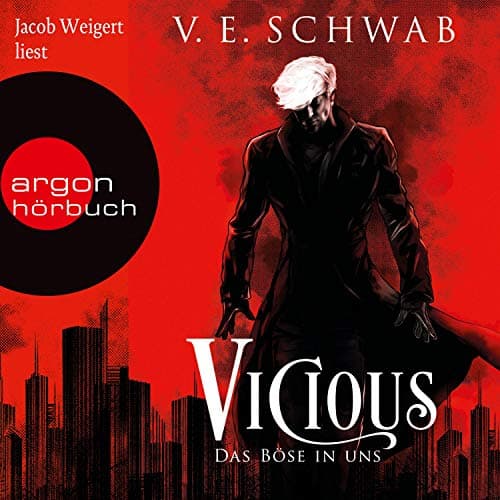

I was three hours into a procedural generation debug session at 2 AM - the kind where your code compiles but produces nothing but a flat plane of identical cubes - when I decided my brain needed something dark and sharp to reset. Schwab's Vicious seemed perfect. Two brilliant, obsessive college students engineering their own superpowers through near-death experiences? That's basically a D&D campaign where both players rolled chaotic neutral and the DM lost control by session two.
And the book delivered. Hard.
Two Villains Walk Into a Thesis Defense
Here's what makes Vicious special: there are no heroes. Victor Vale and Eli Ever start as best friends and academic rivals at a fictional university, and their shared obsession with EOs (ExtraOrdinaries - people who gain powers after near-death experiences) drives them to literally kill themselves in controlled experiments. Victor gains the ability to manipulate pain - amplify it, remove it entirely - while Eli gets Wolverine-style regeneration. The fallout from their experiment kills someone they both care about, and the story fractures into a revenge narrative told across two timelines.
Schwab's nonlinear structure is genuinely clever here. You're jumping between "ten years ago" and "last night" and "three days from now," and the puzzle-box assembly of how Victor ended up in prison and why Eli became a self-appointed executioner of other EOs keeps you hooked. The magic system is chef's kiss - it's not flashy comic book stuff. Powers are trauma-shaped, personal, limited. Victor doesn't shoot lightning. He touches you and makes you feel like every nerve is on fire, or he takes your pain away and you'd do anything for him. That's creepy. That's good.
My D&D group would love this because it reads like a campaign where the moral alignment chart got thrown in the trash. Victor is a sociopath who genuinely cares about a twelve-year-old girl he rescued. Eli is a charming golden boy who's decided God wants him to murder everyone with powers (except himself, conveniently). There's no one to root for in the traditional sense, and Schwab doesn't flinch from that. That morally untethered quality reminded me of Crown of Midnight, which also commits hard to making its protagonist genuinely dangerous rather than just edgy. At maybe 10 hours, it's lean - no padding, no bloated worldbuilding chapters. Just two smart, broken men circling each other.
Jacob Weigert and the Flatline Problem
Okay. So. The elephant in the room.
I picked this up instead of writing my thesis, and honestly the narration almost pushed me back to it. Almost. Jacob Weigert's delivery is... flat. Not "understated-cool" flat, not "deliberate monotone for effect" flat. Just flat. The dialogue between Victor and Eli should crackle with tension - these are two geniuses who hate each other with the intimacy that only former best friends can manage - and instead it comes across like someone reading meeting minutes. There's a scene where Victor confronts Eli after a decade of imprisonment that should be electric, and Weigert delivers it with the same energy as the descriptive passages about walking down a hallway.
I've seen other listeners call for this narrator's head, and while I won't go that far, I get it. Steven Pacey walked so other narrators could run, and Weigert is sitting in a chair. When you've got a book this sharp - this dependent on the poisonous charm of its two leads - you need a narrator who can sell the difference between Victor's cold calculation and Eli's warm-blooded righteousness. I didn't get that distinction here. Both men sounded like the same guy reading aloud, which undercuts the entire dynamic.
I bumped the speed to 1.25x around hour four and it actually helped - the slightly faster cadence added some urgency that the natural delivery was missing.
Who Gets Powers and Who Gets Bored (And Who Should Skip)
If you love morally grey characters and want a superhero deconstruction that's closer to Watchmen than Marvel, this story is for you. Skip it if you need a narrator who can match the intensity of the source material - or if flat vocal performances pull you out of a story entirely. This German audiobook edition makes you work for it. The source material is a 5/5 for me. The audio experience drags it down significantly. You're getting a fantastic book filtered through a performance that strips away most of its personality.
If you can read German and have access to the print version, go that route. If audio is your only option, crank the speed, listen during something that keeps your hands busy (I coded through most of it), and let Schwab's plotting carry you through the vocal flatlands. The story is worth the effort. The narration is the near-death experience you have to survive to get to the good stuff on the other side.