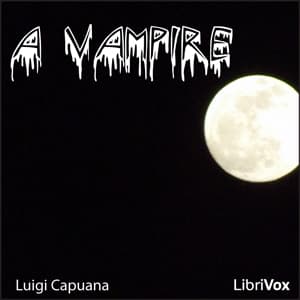

So I expected a Dracula knockoff. I really did. A 36-minute Italian vampire story from the late 1800s - what else could it be? I was chopping onions for a chana masala at 9 PM on a Tuesday, figured I'd knock out something short before bed. And then Luigi Capuana did something I genuinely did not see coming: he wrote a psychological horror story disguised as a vampire tale.
Let me back up.
The Monster Isn't What You Think It Is
Capuana was part of the Italian Verist movement - basically literary realism with teeth. And you can feel that in every line of this story. There's no Gothic castle. No caped figure descending on a helpless maiden in the traditional sense. Instead, the "vampirism" here operates more like a case study in psychic parasitism. The protagonist exhibits classic symptoms of what we'd now recognize as emotional or psychological drain - fatigue, wasting, a slow erosion of self that maps disturbingly well onto abusive relationship dynamics.
I found myself asking: why does this still feel so modern? Because Capuana understood something that a lot of contemporary horror writers forget - the scariest thing isn't the supernatural entity. It's the inability to name what's happening to you. The protagonist knows something is wrong. The people around them know something is wrong. But the framework to explain it keeps slipping away, and that ambiguity is where the real dread lives. Dark Horses operates on that same principle — the horror isn't what you can see, it's the creeping sense that the people closest to you can't see what you see, and that gap is where the story lives.
At 36 minutes, this is barely a novella. More like a long short story. But Capuana packs a surprising amount of psychological specificity into that runtime. There's a moment where the afflicted character's deterioration is described in such clinical, almost medical terms that it reads less like Gothic fiction and more like a 19th-century physician's case notes. This is a fascinating case study in how the Verist movement applied its commitment to observational realism even to supernatural material - and it works.
Erin O'Rourke's Double Duty
Here's the interesting thing: Erin O'Rourke both translated and narrated this piece. That's a level of intimacy with the text that you don't often get. And you can hear it. The pacing choices feel deliberate - not someone reading words on a page, but someone who wrestled with which English phrase best captured a specific Italian construction and then performed the result of that decision.
That said, I have to be honest about the limitations. This is a LibriVox recording, which means volunteer production. The audio quality is functional, not polished. There's a slight room-tone inconsistency that you'll notice if you're wearing good headphones. O'Rourke's delivery is measured and controlled - appropriate for the material's clinical undertone - but it occasionally tips from "restrained" into "flat," particularly during what should be the more emotionally charged passages in the story's back half. For a piece this short, those moments matter proportionally more.
The translation itself, though - psychologically, this tracks. The word choices feel careful. Capuana's original Italian apparently has this quality of detached observation even when describing horrific events, and O'Rourke preserves that tension between what's being said and how coolly it's being said. My therapist would have thoughts about characters who describe their own destruction with this kind of emotional distance.
Who Should Bother With a 36-Minute Italian Vampire Story
Honest answer? This is for a very specific listener. If you're into the history of horror as a genre - how we got from folklore to Stoker to modern psychological horror - this is a missing link you probably haven't encountered. If you study how different cultures process the vampire myth (and there's real research on this, the anthropological literature is wild), Capuana's Italian Verist take is genuinely different from the Anglo-Gothic tradition.
But if you want scares? If you want atmosphere dripping from every sentence? This is too short and too restrained for that. It's an intellectual exercise wrapped in a horror premise. I loved it for what it is. But I'm also the person who reads DSM case studies for fun, so calibrate accordingly.
The Case File, Closed
I finished this before my masala was done simmering. Standing in my kitchen, wooden spoon in hand, genuinely surprised that a 19th-century Italian writer had just given me a better understanding of psychic vampirism as metaphor than most modern self-help books manage. The research actually shows that narratives about energy-draining relationships predate our clinical vocabulary for them by centuries. Capuana knew. He just called it something else.
Worth 36 minutes of your life? Absolutely. Worth paying for? That's harder. It's free through LibriVox, and for a free recording of an obscure but psychologically sharp piece of Italian horror fiction, you could do much worse.