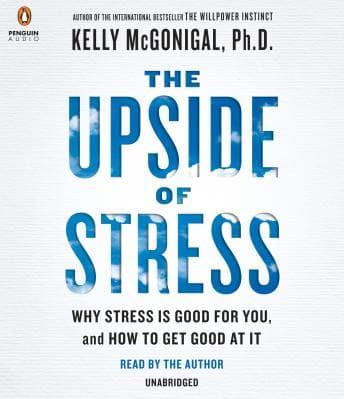

Everyone told me this book would change my relationship with stress. Honestly? I was skeptical. I've read enough self-help that could've been blog posts to fill a data center, and "stress is actually good for you" sounded like the kind of counterintuitive TED talk hook that falls apart under scrutiny.
I was wrong. Mostly.
The Reframe That Actually Compiles
I started this one at 5:45 AM after a rough on-call night — production alert at midnight, root cause analysis until 2 AM, alarm at 5:15. I was the exact target audience: someone drowning in cortisol, half-convinced that my job was literally killing me. And McGonigal opens by basically saying "hey, that belief? That stress is killing you? THAT belief might be the thing that's actually harmful." She cites a University of Wisconsin study tracking 30,000 adults over eight years where people who experienced high stress AND believed stress was harmful had a 43% increased risk of dying. But — and here's the kicker — people who experienced high stress but didn't view it as harmful had LOWER mortality than people who reported relatively little stress.
That's not motivational fluff. That's a statistically significant dataset that made me sit up straighter on a packed Caltrain car. I've been burned before by books that dress up thin premises in impressive-sounding numbers — Art of Thinking Clearly is decent on cognitive bias but ultimately felt like a listicle that got a spine — so it meant something that my skepticism actually stayed quiet here.
The core framework is essentially a mindset intervention: your physiological stress response (racing heart, sweaty palms, tunnel vision) can be channeled into a "challenge response" that actually improves performance, or a "tend-and-befriend response" that strengthens social bonds. She walks through the biology — oxytocin release during stress, how your cardiovascular profile literally changes based on whether you perceive a threat vs. a challenge. The science actually holds up, or at least she presents the studies with enough methodological detail that my BS detector stayed quiet.
What I really appreciated: she doesn't pretend chronic, grinding, no-escape stress is secretly wonderful. She distinguishes between stress that has meaning attached to it and stress that's just suffering. That distinction matters. My 2 AM production outages are stressful, but they're connected to something I chose, something I care about building. That's different from stress caused by, say, poverty or abuse, and she's careful about that line — more careful than most pop-psych authors.
Author-Narrated: The Double-Edged Sword
McGonigal narrates her own book, and this is one of those cases where it genuinely works. She's a Stanford lecturer, so she knows how to explain things clearly without that condescending "let me simplify this for you" energy that some academics bring to audiobooks. There's a warmth to her delivery — she sounds like she's talking to a smart friend, not performing for an audience. When she shares personal stories (her own crisis of confidence after learning that her earlier pro-stress-reduction messaging might have been harmful), you can hear actual vulnerability, not the rehearsed kind.
That said — this is not Ray Porter. The pacing is steady and even, which is perfect for 6 AM comprehension but means there aren't a lot of dynamic shifts. At 1.5x she sounds perfectly natural. I bumped to 1.75x during a few of the longer exercise sections where she walks you through reflection prompts, because those hit different when you're standing on a moving train and can't exactly journal.
The chapters are genuinely long and dense. Each one introduces multiple studies and concepts, and in audio format, there were moments where I lost the thread of which study she was referencing. This is more of a structural issue with the book itself than the narration — it would benefit from shorter chapters or clearer audio signposting between sections.
The Blog Post Test
Here's where I'll be honest: this book is longer than it needs to be at 8.5 hours, but it's NOT a blog post stretched into a book. There's real depth here. The section on how stress can enhance learning — specifically how the stress hormones released during difficult experiences actually strengthen neural pathways for future similar challenges — gave me a completely different mental model for on-call rotations. (I literally texted Kevin: "our brains are basically doing adaptive load balancing and stress is the training data." He responded with a thumbs up emoji. Romance isn't dead.)
But some sections feel repetitive. The "stress is enhancing" message gets reinforced from so many angles that by hour 6, I was like, okay, I'm converted, can we move on? A tighter 6-hour version would've been a 4.5-star book.
Perfect For: Commute, Gym, Walks. Skip For: Bedtime.
If you work in tech, healthcare, teaching, or any high-stress field and you've internalized the "stress will kill you" narrative — this book is a genuine mindset shift backed by actual data. It's not toxic positivity. It's not "just think happy thoughts." It's a practical reframe with exercises you can actually use.
Skip if: you're dealing with trauma-level stress and need clinical support, not a mindset book. McGonigal would probably agree with that assessment.
The ROI on This Audiobook Is...
Three commutes, one genuine perspective shift on my relationship with work stress, and a framework I've already used twice during incidents. The ROI on this audiobook is high — not because it eliminated my stress, but because it gave me better mental tooling for processing it. Think of it as upgrading your error handling from "panic and crash" to "log, learn, recover."
I finished this on a Friday morning and walked into standup feeling weirdly calm about our Q4 deadline. Correlation isn't causation, but I'll take it.