
"The LORD sees the heart." Somewhere around the second hour, Barbara Rosenblat delivers that line with the weight of a woman who has been discarded, deceived, and left to rot in her father's house — and I had to stop walking. Just stood there on the lakefront path like a weirdo while joggers swerved around me, because Rosenblat made me feel the full force of what it means to be invisible in your own story.
Let me back up.
A Genesis Side Character Gets Her Own Stage
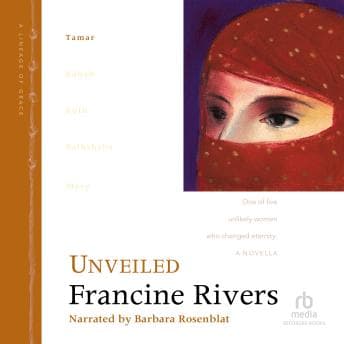
If you've read Genesis 38, you know Tamar's story. It's one of those passages Sunday school teachers skip — deception, levirate marriage obligations, a woman disguising herself as a prostitute to secure justice from her own father-in-law. It's messy and uncomfortable and deeply human. Francine Rivers takes those handful of biblical verses and expands them into a four-and-a-half-hour novella, filling in the emotional architecture that scripture leaves to our imagination.
And here's what surprised me: Rivers doesn't sanitize it. She leans into Judah's cowardice, his grief, his self-serving rationalizations. She builds Tamar not as a victim or a schemer but as a woman operating within a system that has no interest in her survival. This reminds me of what Hemingway said about writing — the dignity of movement of an iceberg is due to only one-eighth of it being above water. Rivers gives us the seven-eighths beneath. Tamar's patience, her calculation, her faith that the God of these Hebrews might actually see her when His own chosen people won't.
But I'll be honest — the criticism that this is "thin and padded" isn't entirely wrong. At 4 hours 20 minutes, there are stretches where Rivers circles the same emotional territory. Tamar's isolation, her waiting, her grief — we feel it early, and then we feel it again, and again. The prose deserves to be savored in places, but in others you can feel the novella straining to fill its frame. I kept thinking about how this would read as a 90-page story versus a 4-hour listen. The audio format actually helps here, because Rosenblat's conviction carries you through passages where the text alone might lose you.
Rosenblat Treats Every Line Like It Matters (Because She Believes It Does)
Let's talk about the narration, because it's doing heavy lifting. Barbara Rosenblat approaches this material with absolute sincerity — every line gets the full dramatic treatment. The narrator understands that pause is punctuation. She doesn't differentiate characters with wildly distinct voices the way some performers do, but that's not really what this story needs. What it needs is someone who can make you feel the difference between Judah's public righteousness and his private shame, and Rosenblat does that through tone and pacing rather than vocal tricks.
There's an intensity to her delivery that treats Tamar's situation as genuinely earthshaking — which, if you believe in the lineage argument Rivers is making, it is. This woman's story threads directly into the ancestry of Jesus. Rosenblat narrates like she understands the stakes of that claim.
That said, the relentless dramatic weight can feel a bit much in quieter passages. Not every domestic scene needs to sound like a turning point in salvation history. A few lighter touches would've given the ear some relief. But I'd rather a narrator who cares too much than one who's just collecting a check.
Who This Is Really For (And Who Should Start Elsewhere)
If you loved Anita Diamant's The Red Tent, this is its spiritual successor — but from a firmly Christian theological perspective. Diamant reimagines biblical women through a feminist literary lens; Rivers reimagines them through a lens of grace and providence. Different projects, but the same impulse: these women were more than footnotes. That impulse — digging beneath a story to find what the official version buried — is something I keep chasing in other books too, and it's part of why the tight, relentless plotting of Eye of the Needle stuck with me even though it's about as far from biblical fiction as you can get: both are fundamentally about what happens when one person knows something everyone else has decided not to see.
If you're coming to this as a Rivers fan expecting something on the scale of Redeeming Love, recalibrate. This is a novella. It's intimate, focused, and necessarily smaller. It's the first in the Lineage of Grace series — Rahab, Ruth, Bathsheba, and Mary follow — so think of it as an opening movement, not a symphony.
My students would hate this. I love it. Not because it's perfect, but because it does something genuinely interesting: it asks you to sit with a story you think you already know and realize you never actually listened to the woman at the center of it. At 1.0x speed, on a cold Tuesday evening with the lake doing that silver thing it does when the sun's going down, that felt like enough.
The Assignment
Worth your time if you're interested in biblical women's stories or if you want to hear what thoughtful faith-based fiction sounds like when it doesn't flinch from the hard parts. At under five hours, it's a low-commitment listen — but at full price, it's a tough sell when it's really a novella with some padding. Catch it on sale or through your library app, then decide if you want the rest of the series.