
What happens when a thriller hinges on silence - literal silence - and the audiobook narrator has to carry that weight alone?
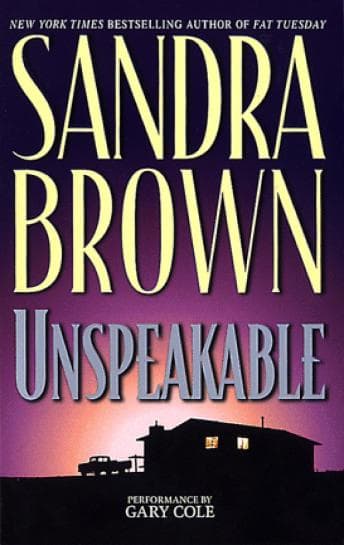
I was shelving returns at the library on a Saturday afternoon, earbuds in, half-listening to Unspeakable while organizing the suspense section (the irony wasn't lost on me), and I realized I'd stopped moving. Just standing there between the stacks, a copy of Mary Higgins Clark in one hand, completely locked into the moment where Jack Sawyer shows up at Anna Corbett's ranch. Not because it was shocking - Sandra Brown telegraphs that arrival from chapter one - but because John Henry Cox does this thing with his voice where Jack's quiet, measured tone carries a current of something unresolved underneath. That got me.
But let me be honest about the full picture here.
The Silence That Should've Been Louder
The premise is genuinely smart for audio. Anna Corbett is deaf. Her son David is her connection to the hearing world. You've got an escaped convict, Carl Herbold, cutting a violent path back to Blewer County, Texas, where Anna lives on a ranch she's barely keeping afloat. And then there's Ezzy Hardge, a retired lawman whose unsolved case has been eating him alive for decades. Brown weaves these threads with her usual efficiency - she knows how to structure a countdown to confrontation, and the chapters alternate between characters in a way that builds genuine tension.
But here's where the audiobook version gets complicated. Anna's deafness is central to the story's dread. She can't hear someone approaching. She can't hear a warning. That vulnerability is unspeakable in the most literal sense, and in print, I imagine it works beautifully because your own silence as a reader fills the gap. In audio, Cox doesn't quite find a way to make that silence feel dangerous. He reads Anna's sections with warmth and sympathy, which - fine, she's sympathetic. But I wanted to feel the absence. I wanted the pacing to slow, the air to get thin. Instead, her scenes move at the same clip as everyone else's.
Carl Herbold, on the other hand? Cox commits there. His Herbold has this flat, almost bored quality to his cruelty that's way more effective than scenery-chewing would've been. When Herbold talks about violence, Cox delivers it like someone discussing what to have for lunch. That understated read is chilling and it's exactly the kind of narrator choice that separates decent from good.
The David Problem (And the Static Problem)
I need to talk about David, Anna's young son. Cox voices him with this high-pitched, whiny register that - look, I get it. He's a little kid. Kids are high-pitched. But there's a difference between "child voice" and "voice that makes you want to fast-forward every time the kid speaks." David is supposed to be endearing and vulnerable. What Cox gives us is grating. Every time David appeared, I felt the tension Brown had built just... deflate. It's a real problem because David is in a LOT of this book.
And then there's the audio quality itself. I noticed crackling and static throughout my listen - not constant, but frequent enough that during quieter moments (the ones that should've been tense), I was distracted by what sounded like a recording made too close to a space heater. For a 13-hour commitment, that's not acceptable. It pulled me out of scenes that needed immersion.
Brown Does What Brown Does (For Better and Worse)
If you've read Sandra Brown before, you know the formula: damaged-but-decent man, strong woman in danger, a villain with a grudge, simmering sexual tension that eventually boils over. Unspeakable hits every beat. The romance between Jack and Anna has real tenderness to it - Brown gives them a scene where communication happens through touch and gesture rather than dialogue, and it's genuinely affecting. That's Brown at her best, finding intimacy in constraint.
But the plot? Pretty predictable. Jack's mysterious past isn't that mysterious. Herbold's trajectory is exactly what you'd expect. Ezzy's redemption arc is the most interesting thread because it's the messiest - a man confronting the cost of obsession when he's already paid it - but Brown doesn't give him quite enough room to breathe. The pacing drags in the middle third, where Brown is setting up chess pieces she's already shown us, and Cox's steady, unhurried delivery doesn't inject urgency where the text needs it.
This isn't horror - it's romantic suspense - but I listen to enough thrillers to know when one is playing it safe. Unspeakable has the ingredients for something genuinely dark, especially with the deafness angle, but Brown pulls punches. The violence is there but sanitized. The dread is suggested but never fully realized. Born in Death manages that balance better — the darkness actually lands, and the procedural tension doesn't let you off the hook the way Brown does here.
Who Needs This (And Who Can Pass)
Sandra Brown completists will find enough here to stay satisfied. If you like slow-burn romantic suspense with a clear villain and a protective-stranger setup, this delivers that. Cox is a genuinely pleasant narrator for most of the book - his voice has this warm, Southern-adjacent quality that fits rural Texas. But if you're coming to this for thriller-level tension, or if a child character voice that grates on you is a dealbreaker, manage expectations.
I listened in the dark for the final act. Not because it's scary - it's not - but because the confrontation earns your attention even if the road there was bumpy. Shirley (my cat) was unimpressed. I was... engaged enough. Not terrified. Engaged.
Shelve It Under "Competent, Not Essential"
Sandra Brown knows her craft. Cox knows how to tell a story. But the audio quality issues, the David voice, and a predictable plot keep this from being the version I'd recommend. If you're curious, borrow it. If you're a Brown fan, you probably already own it. If you want a thriller that uses disability as a genuine source of dread rather than set dressing? Keep looking. The bones are here. The execution just doesn't quite get there.