
What happens when the one person who knows everything about you starts forgetting who you are?
I started this audiobook during Sophie's nap time on a Tuesday and finished it five days later sitting in my car in the garage, crying. Not the cute single-tear kind of crying. The ugly, mascara-running, hope-no-one-looks-in-my-car kind. So. Fair warning.
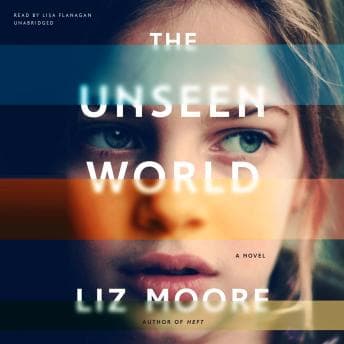
Liz Moore's The Unseen World hit me somewhere I wasn't expecting. I thought I was getting a story about computers and a quirky genius dad. And I did get that. But what I actually got was a story about watching someone you love disappear piece by piece, and the desperate scramble to hold onto who they were before it's too late.
The Gut-Punch I Didn't See Coming
Ada Sibelius is homeschooled by her father David, a brilliant computer scientist who's basically her whole world. She goes to work with him at his lab every day. She's socially awkward in that way that makes your heart hurt a little. And then—slowly, then all at once—David's mind starts to go.
I have to be honest. The Alzheimer's stuff is hard. Really hard. I lost my grandmother to dementia three years ago, and there were moments in this book where I had to pause and just... breathe. Moore doesn't soften it. She shows you what it looks like when someone's memories become unreliable, when they can't recognize the people they love most. It's brutal and tender at the same time.
But here's the thing—this isn't just a sad book about losing someone. It's also a mystery. David had secrets. A whole hidden past that Ada never knew about. And as she grows up (the book spans decades), she becomes determined to figure out who her father really was. The mystery kept me hooked even when the emotional stuff got heavy.
Lisa Flanagan Nailed It
Okay, so I'd never listened to Lisa Flanagan before this, and now I'm kind of obsessed? Her voice has this warmth that made me feel like I was being told a story by a really good friend. She does Ada at different ages—young, awkward Ada and adult, still-figuring-things-out Ada—and both feel real.
The character voices are distinct without being over-the-top. David sounds exactly like you'd imagine a brilliant, eccentric professor would sound. The colleagues at the lab each have their own flavor. Flanagan conveys emotion without overdoing it. When Ada is confused and scared, you feel it. When she's determined, you feel that too.
Now, I will say—there are some technical passages about coding and early computer science that are a little dense in audio format. I found myself rewinding a couple times during the AI and programming discussions. Not because the narration was unclear, but because my brain was also tracking whether Sophie was actually asleep or just pretending. (She was pretending. She's always pretending.)
If you're not super into tech stuff, you can kind of let those parts wash over you. The emotional core of the story doesn't depend on understanding the technical details.
Built for the 47-Pause Lifestyle
At 14 hours, this is definitely a commitment. But it's the kind of book that rewards patience. The pacing is slow in places—this isn't a thriller, it's a literary family saga that unfolds over years. There are moments that drag a little in the middle when Ada's trying to piece together clues from old files and letters. But then Moore will hit you with a scene that makes you understand exactly why you're here.
I listened at my usual 1.25x and it worked fine. Flanagan's delivery handles the speed bump well.
This book survived my 47-pause lifestyle (school pickup, toddler meltdown, someone needs a snack, someone else needs a different snack) and I never felt lost when I came back. That's high praise in my world.
Who's This For?
If you love character-driven stories about complicated family relationships, this is your book. If you're interested in early AI and computer science history woven into a personal narrative, you'll find that fascinating. If you need a good cry and want it to feel earned, this will deliver.
But—and this is important—if you're currently dealing with a loved one's cognitive decline, maybe wait. Or at least know what you're getting into. It's handled with care, but it's not easy.
If you need plot-driven action and fast pacing, this might frustrate you. It's a slow burn. The mystery unfolds gradually. The payoff is emotional, not explosive. That same slow-building emotional weight is what made After You: A Novel stick with me for weeks afterward.
Three Rom-Coms and a Cozy Mystery Later
Would I listen again? Honestly? Probably not soon. Not because it wasn't good—it was beautiful and devastating and I'm so glad I listened to it. But I need some time before I could go through that again. I'm going to need at least three rom-coms and a cozy mystery before I'm ready for another emotional gut-punch of this magnitude.
But I will absolutely be recommending this to my book club. If I ever have time for book club again. (I don't. But theoretically.)