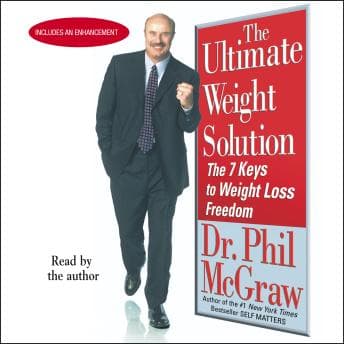

"Get real about your weight." That's the line Dr. Phil drops somewhere around the first hour, and honestly, it's the thesis statement for the entire six hours. I was chopping onions for a chana masala — tears already flowing, so why not add some emotional reckoning about food habits to the mix — when I started this one. And I'll say this: Phil McGraw knows how to command a room. Even when the room is my tiny Cambridge kitchen at 9 PM on a Tuesday.
Here's the thing. I picked this up because I'm genuinely interested in the psychology of eating behaviors. Emotional eating, self-sabotage patterns, the way people use food as a coping mechanism — this is fascinating territory from a behavioral psychology standpoint. And Dr. Phil, to his credit, has 30 years working with overweight patients. He's not nobody. The book frames weight loss around seven "keys" — things like right thinking, healing feelings, managing your environment — and structurally, it's a decent framework. The research actually shows that cognitive-behavioral approaches to weight management do work better than pure calorie counting. So the bones are there.
But here's where I found myself asking: why does this book exist in audio form in the way it does?
When the Therapist Becomes the Lecture Hall
Dr. Phil narrates his own book, and look — he's got presence. That deep, authoritative Texas drawl carries a certain "sit down and listen to me" energy that works for self-help. He's clear, he's direct, he doesn't mumble or rush. But author-narrated self-help has a specific problem: it can tip from coaching into preaching really fast. And Dr. Phil crosses that line more than once. There's a section — track 15, I think — where he's talking about CD-ROM and PDF tools that apparently accompany the book, and it felt like listening to someone read a product manual. In an audiobook. That I paid for. The disconnect between "powerful behavioral change guide" and "please visit our website for supplementary materials" is... jarring.
Psychologically, this doesn't track as a pure audio experience. Some of the content — the food plans, sample menus, the step-by-step behavioral exercises — really needs to be in front of your eyes. You can't meal-plan by ear. I found myself rewinding sections not because they were profound, but because I was trying to mentally transcribe information that belongs on a printed page.
The Repetition Problem (Or: Haven't I Heard This Before?)
This is a fascinating case study in the self-help genre's biggest weakness: repackaging. A lot of what Dr. Phil presents here — manage your triggers, restructure your environment, address emotional eating, set realistic goals — isn't wrong. It's solid, evidence-based advice. But it's also advice that existed in a dozen other books before this one and in hundreds since. One listener put it perfectly: "There was absolutely nothing new in this book." And I get it.
The protagonist of any self-help book is the reader. And the reader exhibits classic hope-frustration cycling — you pick up the book wanting transformation, you get information you've encountered before, you feel deflated. Dr. Phil's framing as a seven-key system gives the illusion of a novel structure, but the keys themselves are fairly standard cognitive-behavioral interventions dressed in Dr. Phil's trademark tough-love language. If you've read anything by Judith Beck, or even skimmed the behavioral sections of a decent introductory psych textbook, you've seen this material before.
What makes it worth something? Honestly, the delivery. Some people need to hear a confident voice tell them to stop making excuses. Dr. Phil is extremely good at that specific thing. If you respond to that authoritative, no-nonsense coaching style — and millions of people clearly do — this might be the version of these ideas that actually sticks for you. My therapist would have thoughts about why we sometimes need a stern father figure to tell us what we already know, but that's a different paper. The actual psychology of why we seek out emotionally authoritative voices — and what it says about our early relationships — is something Adult Children of Emotionally Immature Parents excavates with far more clinical honesty than Dr. Phil ever gets close to here.
Who This Actually Works For (And Who Should Keep Walking)
If you're new to the psychology of weight management and you want a structured, accessible introduction delivered by someone who sounds like he genuinely believes in what he's saying — this could be useful. Genuinely. It's motivating background for a gym session or a long drive. But if you've already read two or three books in this space, you're going to be frustrated. The six-hour runtime is mercifully short, but even so, the repetition within the book itself (not just between this and other books) makes it feel longer.
Also — and I can't stress this enough — the supplementary materials issue is a real problem. This book was clearly designed as a print-first experience. The audio version loses something when it references worksheets and food plans you can't see.
My Clinical Note
Dr. Phil understands human nature well enough to know that people buy weight loss books for hope, not information. And this book delivers hope competently. But competently isn't the same as uniquely, and in a genre drowning in options, "not bad" is a hard sell at full credit price. Listen to it at the gym if it shows up on your streaming service. Don't lose sleep — or a credit — over it.