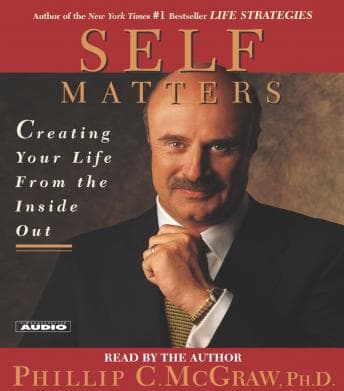

So here's the thing — I went into this expecting to be annoyed. I'm a researcher who studies how people construct identity through narrative, and Dr. Phil is... well, Dr. Phil. The man who turned psychology into daytime television soundbites. I figured this would be six hours of "Get real!" dressed up as self-help.
I was half right. But only half.
I was chopping onions for a chana masala — the kind of elaborate weekend cooking project where I need something in my ears that won't distract me from knife work — when I started this. And honestly? The first hour almost lost me. The pacing is glacial. Dr. Phil reads his own work the way he delivers his TV monologues: slow, deliberate, with dramatic pauses that feel designed for commercial breaks that never come. It's six hours, but it feels like eight.
But then something shifted. Somewhere around the discussion of what he calls your "authentic self" versus your "fictional self" — the version of you that got shaped by what he terms the ten defining moments, seven critical choices, and five pivotal people in your life — I put down the knife and actually listened.
When the TV Psychologist Accidentally Does Real Psychology
Here's what surprised me: the framework isn't terrible. The research actually shows that identity formation is heavily influenced by key autobiographical memories and relationship patterns. McGraw's "ten defining moments" concept maps loosely onto what narrative psychologists call self-defining memories — those vivid, emotionally charged recollections that become the scaffolding of your life story. He's not citing McAdams or Singer, obviously. This isn't an academic text. But the bones are there.
The protagonist exhibits classic pop-psychology limitations, though. (Yes, I just called Dr. Phil a protagonist. He narrates himself as a character in this book constantly — the tough-love Texan who's going to shake you awake. It's a deliberate persona choice, and honestly, it's a fascinating case study in how authority figures construct credibility through self-mythology.)
What works: the journaling exercises. Several listeners mentioned that if you actually do the work — sit down, write out your defining moments, map your critical choices — the book delivers. I found myself asking: why does this structured reflection exercise feel more useful coming from Dr. Phil than from the dozens of more academically rigorous workbooks I've read? And I think the answer is disarmingly simple. He's direct. "Stop lying to yourself" isn't elegant, but it's effective.
What doesn't work: the repetition. McGraw circles the same points like a helicopter parent hovering over a playground. You'll hear the same concept repackaged three different ways in thirty minutes. On TV, that's fine — viewers tune in at different points. In an audiobook you're listening to linearly? It's padding.
Dr. Phil Reading Dr. Phil: A Performance Review
Let me be honest about the narration: this is a man who is very good at talking at you and significantly less good at talking to you for six consecutive hours. His delivery is clear — I never missed a word, even over sizzling onions. And there's a motivational weight to his voice that I grudgingly respect. He believes what he's saying. You can hear it.
But monotonous? Yeah, sometimes. The cadence doesn't shift enough between conceptual sections and the more personal, reflective exercises. It all comes at you in the same tone — like getting a pep talk from a football coach who doesn't realize the game ended two hours ago. I'd genuinely recommend bumping this to 1.25x speed. It tightens up his delivery and cuts the runtime to something more reasonable.
This is not an audiobook for bedtime. You'll either fall asleep from the pacing or stay up spiraling about your life choices. Neither is restful.
Who Needs This (And Who Should Run)
If you're someone who's never really examined why you make the choices you make — if you've been running on autopilot and you need someone to grab you by the shoulders and say "wake up" in a Texas drawl — this book has genuine utility. The framework is accessible. The exercises are practical. And sometimes accessible and practical beats theoretically sophisticated.
If you've already done serious therapeutic work, read Brené Brown, or spent any time with actual narrative psychology research? You'll find this surface-level. Not wrong, exactly. Just... introductory. Like taking Psych 101 when you've already published in the field.
Psychologically, this doesn't track as a complete framework for identity reconstruction. It's more like a starting point — a flashlight, not the full excavation. But I've seen worse flashlights. Dan Harris takes a similarly skeptical-person-reluctantly-converted arc in 10% Happier, and honestly pulls it off with more self-awareness — worth reading if you want the flashlight and the excavation.
My Therapist Would Have Thoughts About This Book
Dr. Phil wrote a book about finding your authentic self, and then narrated it in the exact same persona he uses on television. There's an irony there that I'm not sure he intended, but I genuinely appreciate. The book is better than its reputation suggests, worse than its ambitions promise, and exactly what you'd expect from the man who made psychology feel like a contact sport. I didn't love it. But I didn't throw my phone across the kitchen, either. For Dr. Phil, that's high praise from me.