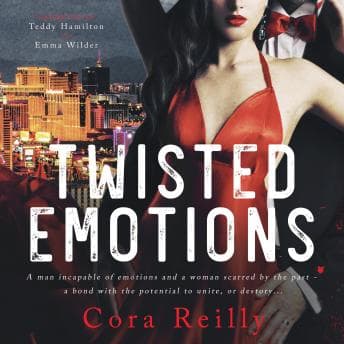

What does it actually look like when someone who can't feel emotions tries to love someone who feels everything too much?
I've worked with patients in psych holds who present flat - no affect, no visible emotional response. And I've worked with trauma survivors whose nervous systems are so overloaded that every sensation is turned up to eleven. So when I tell you that Cora Reilly's setup for this arranged marriage between Nino Falcone (the genius sociopath who processes the world like an equation) and Kiara Vitiello (the woman hiding deep scars behind duty and terror) actually landed for me? That means something. The emotional architecture here isn't just "broken man meets broken woman." It's more specific than that - it's about two people whose damage is fundamentally incompatible on paper, and watching them figure out a language that works anyway.
When the Clinical Meets the Romantic
Look, I'm not the target demographic for mafia romance. I know this. Carlos knows this. My coworkers who see me rolling my eyes at Grey's Anatomy definitely know this. But I started this one during a stretch of nights where three of my four shifts were brutal - the kind where you walk to your car at 0700 and your hands are still shaking a little. I needed something consuming enough to pull me out of my own head on the drive home.
And Nino's POV sections? They hit different when you've spent your career reading people's vitals and expressions to figure out what they can't tell you. Teddy Hamilton does this thing with Nino's internal narration where it's cold and analytical - almost clinical - but there are these moments where his voice drops into something softer, like Nino himself doesn't realize he's feeling something. It's subtle. It's the vocal equivalent of watching a patient's heart rate spike on the monitor when their face stays completely blank. Hamilton captures that disconnect between what Nino thinks he is and what he's becoming, and it's genuinely well done.
Emma Wilder carries Kiara's sections with this raw, exposed quality - you can hear the fear and the determination fighting each other in her delivery. When Kiara is navigating the early days of the marriage, Wilder's voice has this guarded tightness that slowly - slowly - loosens as trust builds. The dual narration format works here because these two characters literally perceive the same moments differently, and hearing those contrasting perspectives through different voices makes the emotional gap between them feel real.
This Is Not How the Camorra Works (But I'll Allow It)
Okay. Do I believe the Camorra operates like a slightly more violent version of a corporate merger with arranged marriages brokered over espresso? No. Am I going to fact-check the Italian organized crime elements the way I'd fact-check a medical scene? Also no. Because that's not what this book is trying to be. It's using the mafia framework as a pressure cooker for intimacy - forced proximity, no escape, life-or-death stakes for vulnerability. And within those genre rules, it plays fair. Trouble with Honor uses a similar pressure-cooker setup with its own constrained heroine, though it leans lighter on the darkness if you want to test the arranged-circumstances trope without the mafia weight.
What I will say is that the power dynamics are handled with more care than I expected. Kiara isn't passive. She's strategic. She's surviving in a system designed to crush her, and her agency comes through in the choices she makes within impossible constraints. As the eldest daughter in a Filipino family where "just do what's expected" was basically a lifestyle - yeah, I felt that in my chest. The way Kiara negotiates between duty to family and self-preservation? My mom would love this. (She still thinks I should've been a doctor, but she'd absolutely devour this book and then deny it.)
The Slow Burn That Actually Earns Its Fire
The pacing is slow burn in the truest sense - not dragging, but building. At eleven and a half hours, there's room for these characters to breathe, to circle each other, to make mistakes. Nino's gradual realization that his "lack of feelings" might be more complicated than he thought unfolds across hours, not chapters. And when the emotional payoffs come, they land because you've been sitting in the tension.
Carlos asked why I was crying in the car. I blamed allergies. It was 7:15 AM in Phoenix in the middle of a heat wave. He didn't buy it.
Content warnings are real here - violence, abuse history, explicit sexual content. This is dark romance territory and it doesn't flinch. If that's not your lane, respect your limits.
Night Shift Prescription
If you're a mafia romance reader, this is apparently the fan favorite of The Camorra Chronicles series, and honestly I get it. If you're new to the subgenre (like me), it's a surprisingly solid entry point because the emotional core is strong enough to carry you through the parts where you're squinting at the organized crime logistics. The dual narration elevates what could've been a standard arranged-marriage setup into something with genuine emotional weight.
Perfect for that post-shift decompression when your brain needs to process feelings that aren't yours for a change. Night shift approved.