
What if the most dangerous character in English literature isn't the one holding the cutlass — but the one smiling at you while he does it?
I've been teaching Treasure Island to freshmen for fifteen years, and every single year I walk into the same trap. I assign it thinking it's a straightforward adventure story, something to ease them into Stevenson before I spring Jekyll and Hyde on them in spring. And every single year, by chapter fifteen, some kid raises their hand and says, "Wait — do we actually like Long John Silver?" And that's the moment I know Stevenson still has teeth.
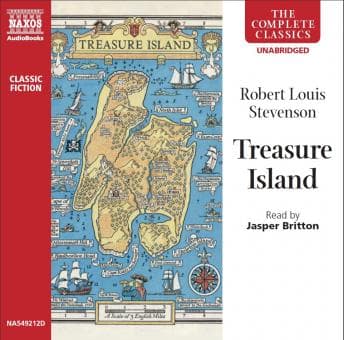
I finished Jasper Britton's narration last Sunday morning, walking the lakefront with Denise while she did her half-marathon training and I did my "keep up for the first mile then pretend to stretch" routine. Six hours and seventeen minutes. The November wind off Lake Michigan felt appropriate — this is a book that smells like salt air and bad decisions.
Silver's Voice Is the Whole Con
Here's what surprised me: Britton doesn't play Long John Silver as a pirate. He plays him as a politician. There's this warmth in his delivery, this avuncular steadiness when Silver is talking to Jim that makes you understand — viscerally, in your gut — why a teenage boy would trust this man with his life. Britton's Silver sounds reasonable. He sounds like the kind of guy who'd help you move apartments and remember your birthday. And that's terrifying, because you already know what he is.
Most adaptations — movies, radio plays, the cartoon with the cat — they give Silver this growling pirate voice from minute one. Britton refuses to do that. His Silver shifts so gradually from friendly to menacing that you can't point to the exact moment it happens. It's the audio equivalent of a frog in slowly boiling water. By the time you realize what's happening, you've already been charmed. This reminds me of what Hemingway said about prose — the dignity of movement of an iceberg is due to only one-eighth of it being above water. Britton keeps seven-eighths of Silver's menace beneath the surface.
And the character differentiation is genuinely impressive. Billy Bones gets this hoarse, paranoid rasp — a man who's been looking over his shoulder so long his voice has permanently tensed up. Blind Pew is high and reedy and cold. But Jim Hawkins — and this is the clever part — Jim sounds like a kid. Not a theatrical child-voice, just a slightly breathless quality, an eagerness that makes you remember this is a boy narrating events he barely survived.
Why Six Hours Is Exactly Right
At 6:17, this is practically a novella by audiobook standards. My students would be thrilled. (They consider anything over 200 pages a human rights violation.) But the brevity is the engine of the whole thing. Stevenson doesn't waste a single scene. The pacing is relentless — the apple barrel sequence, the stockade siege, the one-on-one confrontation on the island — and Britton matches that energy without ever rushing. He understands that pause is punctuation. There's a beat after Ben Gunn's first appearance, this tiny moment of silence that lets the weirdness of this marooned, half-mad man settle in before the story barrels forward.
I listened at 1.0x, obviously, because the prose deserves to be savored. Stevenson wrote sentences that snap like a ship's rigging in wind, and speeding through them would be like fast-forwarding through a jazz solo. You'd get the notes but miss the music.
The Book Your Students Already Know (But Haven't Actually Read)
Here's my annual frustration as an English teacher: every kid knows pirates. They know treasure maps, peg legs, parrots, "X marks the spot." What they don't know is that all of that comes from this book. Stevenson essentially invented the pirate story as a genre in 1883, and everything since — from Peter Pan to Pirates of the Caribbean — is just rearranging his furniture. Listening to Britton's version, stripped of all the cultural barnacles, you hear the original thing clearly again. It's leaner and darker than you remember. The violence is quick and ugly. People die badly. Jim kills a man and barely processes it.
My students would hate the prose style. I love it.
If you loved Kidnapped or The Count of Monte Cristo, this is their scrappier, faster cousin — less baroque, more knife-fight-in-a-dark-room. It's also a perfect gateway to the Victorian adventure tradition if you've been meaning to get into it but keep bouncing off Dickens. Though I'll admit, when I want that same sense of dread creeping into an adventure story from a completely different angle, Seven H.P. Lovecraft Stories scratches a similar itch — darkness dressed up as something else entirely. (No shame. I bounce off Dickens sometimes too. Don't tell my department chair.)
Who Walks the Plank, Who Gets the Gold
This version is ideal for family road trips — the story moves fast enough to hold younger listeners, and Britton's voice work is clear enough that you won't lose anyone to mumbled dialogue. It's also perfect for that friend who keeps saying they want to "read more classics" but finds the idea intimidating. Six hours. One narrator who clearly loves the material. No excuses.
Skip this if you need moral complexity served on a platter. Stevenson trusts you to figure out the ambiguity yourself. Also skip if you've somehow never encountered a pirate story and want your first one to be revisionist or postmodern. This is the original. It plays it straight. The genius is in how straight it plays it.
Worth Pausing the Faculty Meeting For
Britton's Treasure Island reminded me why I got into this racket in the first place. Not the teaching racket — the reading racket. The one where you pick up a story that's been alive for 140 years and feel it breathing. The narration doesn't just serve the text; it reveals layers I'd stopped noticing after a decade and a half of teaching it. I'm genuinely going to play clips of Britton's Silver for my freshmen this spring, right before that kid raises their hand and asks the question that makes this book immortal.
Forty-seven podcast listeners and a classroom full of teenagers who'd rather be on TikTok. That's my audience. But stories like this — they don't need a big audience. They just need someone willing to listen at the right speed.