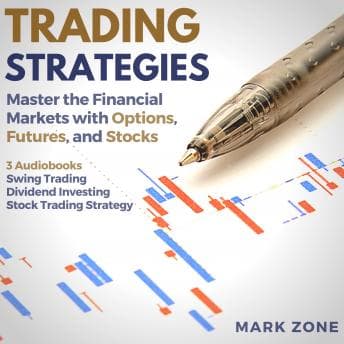

This is three books duct-taped together into a 9-hour audiobook that promises to make you rich. I was already suspicious.
I grabbed this during a Sunday meal-prep session because Kevin's been talking about dividend investing and I figured I'd either learn something useful or have ammunition to roast his stock picks. What I got was... somewhere in between, leaning heavily toward the "could've been a blog post" end of the spectrum. Three blog posts, technically.
Three Books, One Credit, Zero Depth
So here's the deal. This is a bundle - swing trading, dividend investing, and stock trading strategy - packaged as one audiobook. The format is basically Trading 101 → Trading 102 → Trading 103, each running about 3 hours. And look, for someone who has genuinely never opened a brokerage account or heard the term "moving average," there's a baseline level of useful terminology coverage here. Mark Zone walks through the basics: what a stock is, how options work, what swing trading means versus day trading, how dividends compound over time.
But here's where my BS detector starts blaring. The description promises "precious tips" that "only an insider or a professional trader usually knows." No. What you get is the kind of information you'd find in the first three results of a Google search for "how to start trading stocks." Risk management gets a surface-level treatment - calculate your risk-reward ratio, don't invest money you can't afford to lose, diversify. True? Yes. Insider knowledge? Come on.
The swing trading section was the strongest of the three, actually. It at least attempts to walk through specific entry and exit strategies, discusses support and resistance levels, and gives you a framework for thinking about chart patterns. The dividend investing section felt padded - there's only so much you can say about buying stable companies with consistent payouts before you're repeating yourself. And the stock trading strategy section tries to cover everything from crypto to futures and ends up covering nothing with any real depth.
Alexander Penny Does His Best With What He's Got
Alexander Penny's narration is clean and clear - I'll give him that. His delivery is steady, professional, almost textbook-narrator energy. Which is appropriate because this basically IS a textbook. He doesn't stumble over financial terminology, and his pacing is consistent enough that I could follow along at 1.75x while chopping onions without missing concepts.
But here's the thing - there's no personality in the delivery. When you're listening to business/finance content, you need either (a) genuinely compelling ideas that carry themselves, or (b) a narrator with enough energy and charisma to make basic concepts feel urgent and important. Penny lands in this professional-but-flat zone where I kept zoning out during the more repetitive sections. Not his fault - the material doesn't give him much to work with. It's like asking someone to dramatically read a Wikipedia article. He's competent. The material is the bottleneck.
The ROI on This Audiobook Is... Questionable
Here's my real issue. At 9 hours, this asks for a significant time investment. I debug distributed systems for a living - I understand the value of foundational knowledge before you build anything complex. But this audiobook operates in a weird middle ground where it's too surface-level for anyone who's spent even a weekend researching investing, and potentially dangerous for true beginners because it makes trading sound simpler and more accessible than it actually is.
Lines like "start making big money in no time" in the description set off every alarm I have. Trading is not a get-rich-quick scheme, and while the actual content is more measured than the marketing copy, it still glosses over how many retail traders lose money. The risk management sections exist, but they feel obligatory rather than emphasized.
I kept comparing this to something like "A Random Walk Down Wall Street" or even the Bogleheads' guide - books that give you a genuine framework for understanding markets, not just a checklist of terms and basic strategies. Those books changed how I think about my 401k. This one just... listed things at me. Rich Dad Poor Dad at least has the decency to build a coherent worldview around its oversimplifications - I came away with something to argue with, which is more than I can say here.
Who This Is Actually For (And Who Should Run)
If you have literally never encountered financial markets before, don't want to read, and need someone to define "bull market" and "bear market" for you in audio form - okay, this serves a purpose. It's a glossary with some strategic scaffolding.
Skip this if: you've read even one decent investing book, you have any experience with a brokerage app, or you're expecting actionable strategies beyond the basics. And definitely skip if you're looking for this to replace actual financial education or - god forbid - professional advice.
Perfect for: background listening while doing something else. Skip for: anything requiring actual engagement.
Not Worth the Commute Time
I finished this across one Sunday cooking session and a Monday morning commute, and by Mountain View I was already wishing I'd queued up literally anything else. Three hours of this would've been fine as a podcast episode. Nine hours is padding. Kevin, if you're reading this, your dividend picks are still bad and this book wouldn't have helped.