
I was halfway through making my mother's rajma recipe — the one that takes three hours and requires you to babysit the pressure cooker like it's a toddler — when Asa Jackson's narrated chapters started making me forget about the dal soaking on the counter. There I was, wooden spoon in hand, genuinely unsettled in my own kitchen at 2 PM on a Saturday. That's not nothing.
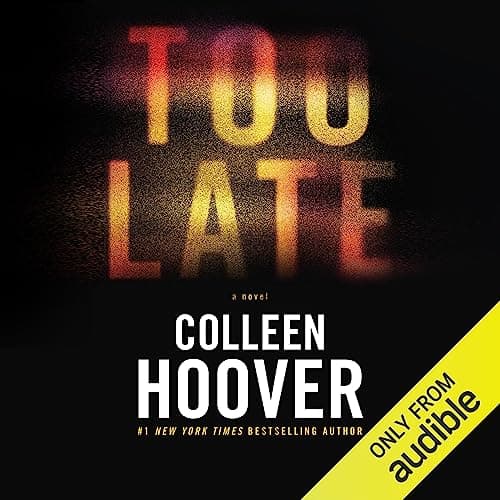
Colleen Hoover's Too Late is a fascinating case study in how far a reader (or listener) will follow an author into uncomfortable territory when the psychological hooks are sharp enough. And make no mistake — the hooks here are sharp. Just not always clean.
Asa Jackson Is a Clinical Textbook With a Pulse
Let me be direct: the reason to listen to this audiobook is Asa. The protagonist exhibits classic narcissistic personality patterns — the love-bombing, the surveillance disguised as devotion, the escalating need for control when his supply (Sloan) shows any sign of autonomy. What makes this character compelling isn't that Hoover invented something new. It's that she committed to the ugliness of it. Asa doesn't get softened by a tragic backstory that excuses his behavior. He's a drug trafficker who believes his obsession is love, and the book doesn't flinch from showing you the gap between those two things.
The narrator handling Asa's chapters — and this is the real win of the audio format — delivers this low, almost intimate register that crawls under your skin. It's the voice of someone who genuinely believes they're the hero of their own story while doing monstrous things. Psychologically, that tracks. The scariest people aren't the ones who know they're villains. They're the ones who think they're lovers. I kept thinking about how Betrayal of Anne Frank operates on the same unsettling principle — the most damaging figures in that cold case investigation are the ones who constructed elaborate self-justifying narratives around their choices.
Sloan, by contrast, is harder to assess. Her motivations are rooted in economic dependency and her brother's care needs, which the research actually shows is one of the most common reasons people stay in abusive situations. So the foundation is solid. But the execution sometimes flattens her into a vessel for suffering rather than a person navigating suffering. The female narrator's performance compounds this — there's a flatness in the emotional register during moments that should be escalating. I found myself asking: why does Sloan really stay beyond the financial explanation? The book gives reasons. The audio doesn't always sell them.
Three Narrators, Two and a Half Successes
The three-narrator setup is ambitious for what is essentially a dark romance-thriller hybrid. Ryan Gray, Maxine Mitchell, and Joe Arden split the duties, and the result is uneven in an interesting way. Asa's chapters have this coiled intensity that makes you lean in even when you want to pull away. Carter's chapters — the undercover DEA agent, our supposed salvation figure — are solid but feel like they belong to a slightly different, more conventional thriller.
And then there's Sloan's narration. Look, I struggled with it in the first couple of hours. There's a disconnect between the gravity of what's happening to this character and the vocal delivery, which sometimes reads as detached rather than dissociative. Those are different things. Dissociation as a trauma response would've been a brilliant performance choice — flat affect as a survival mechanism. But it doesn't feel intentional. It feels like the narrator is reading the words rather than inhabiting the psychology. By hour five or so, I adjusted. But those early chapters nearly lost me.
The choice to include an epilogue AND an epilogue to the epilogue is... a choice. My therapist would have thoughts about this character — specifically about whether Hoover's need to tie up every thread actually undermines the emotional weight of what came before. Sometimes the most psychologically honest ending is the one that doesn't reassure you.
Where the Seams Show
Here's my issue, and it's a Hoover-specific issue that I've been chewing on since Verity: she understands the architecture of obsession better than most commercial fiction writers, but she sometimes prioritizes shock value over psychological coherence. There are scenes in Too Late involving graphic violence, sexual assault, and drug use that are genuinely disturbing — content warnings are absolutely warranted here — but a few of them feel calibrated for impact rather than character truth. When Asa does something terrible, I want to understand the internal logic that makes it inevitable for him. Sometimes I get that. Sometimes I get spectacle.
The pacing drags in the middle third, where the love triangle dynamics settle into a pattern: Sloan sneaks time with Carter, fears Asa's discovery, rinse, repeat. The tension should be ratcheting up but it plateaus. At 10 hours and 19 minutes, this book could've been leaner — probably 8 hours would've been tighter without losing the psychological depth.
But when it works? It really works. Asa's internal monologues are genuinely chilling because Hoover writes his self-deception with a specificity that suggests she's studied how abusers construct their narratives. That's the part of this book I respect.
Case File, Closed (For Now)
This is a book that wants to disturb you, and it mostly succeeds — though sometimes through blunt force rather than precision. The audio format amplifies both the strengths (Asa's narrator is genuinely unsettling) and the weaknesses (Sloan's vocal flatness undercuts her arc). If you've read Verity and wanted Hoover to go darker, this delivers. If you wanted her to go smarter, it's about 70% of the way there.
Listen if you're drawn to dark psychology, coercive control dynamics, and narrators who can make you uncomfortable in broad daylight. Skip if graphic depictions of abuse and sexual violence are dealbreakers, or if a slightly uneven multi-narrator performance will pull you out of the story.
I finished the rajma. It was fine. I forgot the salt, because I was too busy thinking about the psychology of coercive control. So I guess the book did its job.