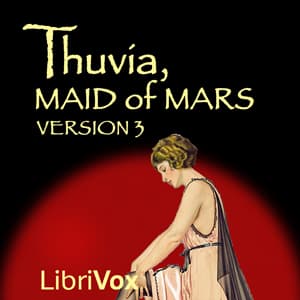

What happens when the greatest swordsman on Mars has a kid, and that kid falls for the one woman he absolutely cannot have?
I was supposed to be working on my thesis. Instead, I found myself three hours deep into Barsoom at 2 AM, eating cold pizza and listening to Edgar Rice Burroughs spin a tale of interplanetary political intrigue that would make any D&D campaign jealous. Look, I'm not proud of my choices, but I'm not sorry either.
The OG Planetary Romance (Before It Was Cool)
Here's the thing about Burroughs—the man basically invented the science fantasy genre. This is book four of Barsoom, and instead of sticking with John Carter, we're following his son Carthoris and the titular Thuvia. Smart move. Carthoris has inherited his father's fighting prowess but lacks his protagonist armor, which makes the stakes feel more real.
The plot is classic pulp: Thuvia gets kidnapped by Astok of Dusar (a real piece of work), Carthoris gets framed for it, and suddenly three Martian nations are on the brink of war. At just over five hours, Burroughs doesn't waste time. The pacing is relentless—you're barely catching your breath from one sword fight before the next political betrayal drops.
And the world-building? This is Sanderson-level stuff for 1916. Burroughs introduces Lothar, a city of psychic warriors who can project phantom armies. Phantom. Armies. My D&D group would absolutely steal this for our next campaign. The magic system (or "science," as Burroughs insists) operates on consistent rules—the Lotharians' projections can kill but cannot be killed, which creates genuinely clever tactical problems. Last Wish: Introducing the Witcher pulls off similar world-building wizardry with its magic system—Sapkowski makes the rules feel lived-in rather than explained, which is exactly what Burroughs does here.
Mark Nelson Carries the Weight
This is a LibriVox production, so you're getting volunteer work here—but Mark Nelson is clearly not messing around. His narration is clean and steady, and he treats the material with respect rather than camp. For a story with names like "Kulan Tith, Jeddak of Kaol," that's no small feat. The man doesn't trip over Burroughs' invented Martian vocabulary, which honestly impressed me more than it should have.
Is it Steven Pacey? No. Steven Pacey walked so other narrators could run, and Nelson is doing a solid jog here. The character differentiation isn't going to blow your mind—you won't always instantly know who's speaking without context—but for a single narrator handling this many alien princes and princesses, it works. The production is bare-bones (no music, no effects, pure LibriVox), but the audio quality is crisp.
Where It Shows Its Age
I'd be lying if I said this holds up perfectly. Thuvia spends a lot of time being a prize to be won rather than a character with agency. She's brave when the plot needs her to be, but mostly she exists for men to fight over. It's 1916—I'm not surprised, but I noticed. If you're coming from modern fantasy with complex female leads, adjust your expectations.
The prose is also... dense. Burroughs loves his descriptions. If you don't like info-dumps, this isn't for you (but you're wrong). The progression is satisfying once you accept that you're reading pulp adventure, not literary fiction. This is popcorn—really good popcorn, but popcorn.
Who Should Strap On Their Radium Pistol
This is for you if: you love old-school adventure, you're curious about the roots of planetary romance, or you need something to listen to while procrastinating on important life responsibilities (I see you, fellow grad students). It's also free—LibriVox, baby—so the barrier to entry is literally just your time.
Skip it if: you need complex characters, can't handle dated gender dynamics, or want your sci-fi with actual science in it. Also skip if you haven't read the first three Barsoom books—you'll be lost on the political situation and won't care about Carthoris's parentage.
Worth Raiding Lothar For
Five hours. That's basically nothing. I listened to this instead of writing my thesis, and I regret nothing. For a free audiobook of a foundational sci-fi text with competent narration, you could do so much worse. It's not going to change your life, but it might make your commute feel like a journey across the dead sea bottoms of Barsoom. And honestly? That's enough.