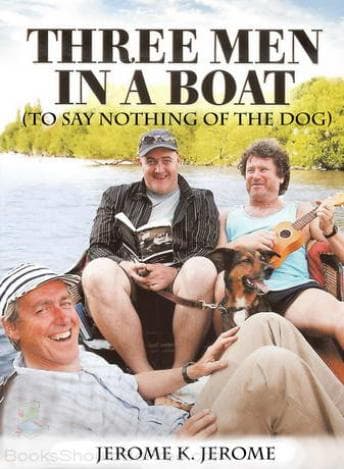

I was walking the lakefront with Denise last Saturday — one of those rare May mornings in Chicago where the lake is flat as glass and the joggers haven't ruined it yet — when Jerome K. Jerome made me laugh so hard I startled a man walking his golden retriever. The man gave me that look. You know the look. The "this person is either unwell or listening to something" look. I was listening to something.
Three Men in a Boat is 135 years old. Let that sit for a second. Published in 1889, before cars, before flight, before anyone decided meetings needed PowerPoint presentations. And it is — I'm not exaggerating — funnier than ninety percent of what passes for comedy writing today. Jerome wrote what was supposed to be a serious travel guide about the Thames, and what came out instead was the first modern comic novel. The digressions, the tangents, the way he'll start telling you about packing a suitcase and end up delivering a five-minute treatise on the universal human inability to find the butter — this is the DNA of every comedian you love. Monty Python owes this man royalties.
The Funniest Book Your Students Have Never Heard Of
Here's what surprised me, coming back to this after maybe fifteen years. Jerome isn't just funny. He's structurally funny. The famous scene where the three friends try to open a tin of pineapple without a tin opener — it builds like a jazz solo. Each escalation is more absurd than the last, and Jerome knows exactly when to pull back and let the silence land. There's a passage where he describes Harris falling into a trout stream and emerging convinced he's dying, and the narrator's complete indifference to his friend's distress is so perfectly timed it could be a Buster Keaton routine. The humor isn't dated because it's not topical — it's observational. Jerome is watching human beings be ridiculous, and human beings haven't changed.
But between the comedy, Jerome slips in these quiet passages about the Thames at dusk, or the history layered into the riverbank villages, and they're genuinely beautiful. There's a stretch where he imagines the ghosts of Saxon kings watching the modern boats pass, and for about three minutes you forget you're listening to a comedy. That contrast isn't an accident — you need the quiet to make the loud funny. Jerome understood that instinctively. The serious passages make the jokes funnier. The jokes make the serious passages land harder.
The man imagining Saxon ghosts is also the man who can't find the butter. That is the whole trick of this book, and Jerome pulls it off without breaking a sweat.
Adrian Wallwork and the Art of the Dry Read
Here's where I have to be honest about working with limited information. Adrian Wallwork's narration isn't widely discussed, and I couldn't find detailed critical analysis of his performance. What I can tell you from six hours and twenty-six minutes of listening: he reads this straight. Dry. Almost deadpan. And for Jerome, that's a legitimate choice — arguably the right one. The humor in this book lives in the gap between what's happening (chaos, incompetence, a dog who won't stop barking) and the narrator's tone of polite English understatement. Wallwork doesn't mug for laughs. He trusts the text.
Does it always work? Not entirely. There are stretches — particularly the historical digressions about Hampton Court and Magna Carta — where a bit more vocal variety would've helped carry me through. The three main characters (J., Harris, and George) could use slightly more differentiation; I occasionally lost track of who was speaking in the dialogue-heavy scenes. At six and a half hours, it's a comfortable listen, but Wallwork's steady register means you need to bring your own energy to the longer descriptive passages.
The comedy lives in the delivery, which is why I listened at 1.0x, obviously — Jerome's sentence rhythms are part of the joke. He'll set up a clause that sounds like it's heading somewhere dignified and then drop you into absurdity. Speed that up and you lose the timing.
Who This Is Really For (And Who Should Keep Walking)
If you loved P.G. Wodehouse, this is its spiritual ancestor. If you've ever wondered where Douglas Adams got that tone of cheerful cosmic bewilderment — it started here, on the Thames, with three idiots and a fox terrier named Montmorency. If you teach literature and you're tired of explaining to teenagers why old books matter, play them the pineapple tin scene. It won't convert all of them. But it'll convert some.
Skip it if you need plot. There is, technically, a plot — three men go on a boat trip — but Jerome treats it the way I treat faculty meeting agendas. As a suggestion. On the Come Up is the opposite in that sense — every chapter pulls the plot tighter — so if you're someone who needs that forward momentum, that one's worth knowing about. The book is almost entirely digression, and if that frustrates you, six hours will feel like twelve.
A 135-Year-Old Book That Still Earns the Listen
Old books don't stick around because some curriculum committee keeps them on life support. This one is still here because a man in 1889 wrote about trying to scramble eggs on a houseboat and it's still the funniest thing you'll hear all week. The audiobook isn't a definitive performance — I suspect there are versions out there with more theatrical narration — but it's a solid, respectful reading of a book that deserves to be heard aloud. Jerome wrote for the human voice. You can feel it in every sentence.
Denise asked me what I was laughing at on that walk. I tried to explain the bit about the cheese. She said, "You're such a nerd." She's not wrong. But she also asked me to send her the link.









