
I was making dal makhani at 9 PM on a Tuesday — the kind of elaborate, slow-simmered comfort food my mother would approve of — when the audiobook hit the 10:03 timestamp and the auditorium doors locked. I put down the wooden spoon and didn't pick it up again for forty minutes. The dal burned. I didn't care.
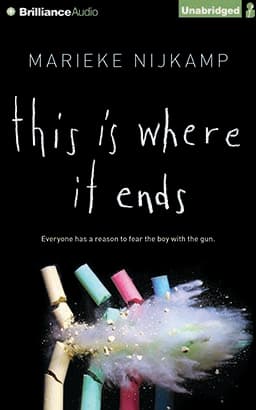
Marieke Nijkamp's This Is Where It Ends is, structurally, a psychological pressure cooker. Fifty-four minutes of real-time school shooting, told from four perspectives: Autumn, the shooter's sister; Tomás, who's outside and desperate to get in; Claire, a JROTC student trying to organize an escape; and Sylv, Autumn's girlfriend trapped in the auditorium. The concept is brutally simple. And that simplicity is what makes it work — and also, honestly, where some of its cracks show.
The 54-Minute Experiment in Real-Time Terror
Let me be clear about what Nijkamp does right: the temporal structure is psychologically sound. Crisis situations collapse time. Minutes feel like hours. By anchoring each chapter to a specific timestamp — 10:05, 10:08, 10:12 — she replicates the hyper-awareness that trauma survivors describe, that awful clarity where you notice absurd details because your brain is trying to process the unprocessable. The research actually shows that people in acute stress states often report time distortion, and Nijkamp captures both sides of it: the agonizing slowness inside the auditorium and the frantic urgency outside.
What makes the characters compelling is their divergent trauma responses. Claire goes into action mode — classic fight response, consistent with her JROTC training. Tomás exhibits approach behavior, running toward danger for his sister. Sylv freezes, then connects, seeking safety through relationships. Autumn dissociates, caught between love for her brother and horror at what he's become. These aren't random. They track with actual crisis psychology. Nijkamp understands that people don't become heroes or cowards in emergencies — they become more intensely themselves.
But — and here's where my inner researcher gets twitchy — the shooter himself, Tyler, is where things get psychologically thin. We get his motivations in fragments: loss, rage, a sense of entitlement over his sister's life and choices. The protagonist exhibits classic externalized blame patterns, sure. But Tyler reads more like a composite profile than a person. I found myself asking: why does Tyler really choose this moment, this method? The book gestures at answers without fully committing, and for a story that's otherwise so precise about its timeline, the psychological architecture of its antagonist feels underfurnished.
Seven Voices for Four Perspectives (Plus Everyone Else)
Seven narrators for a six-hour audiobook is ambitious. Amy McFadden, Brittany Pressley, Kate Rudd, Lauren Ezzo, Nick Podehl, Scott Merriman, and Whitney Dykhouse each take rotating chapters, and the effect is something like a documentary — each voice a different witness testimony. As the shooting intensifies, the emotional delivery ratchets up in a way that feels earned rather than performed. The pacing shifts are subtle but effective: the chapters inside the auditorium move slower, heavier, while the outside chapters have a clipped urgency.
What I noticed — and this is a production choice I genuinely appreciated — is that nobody is doing Voice Acting with capital letters. No melodramatic gasps. No theatrical sobbing. The restraint actually intensifies the horror. When Lauren Ezzo's voice goes quiet during a particularly devastating moment near the auditorium exits, the silence hits harder than any scream would have. It's the audio equivalent of a still camera holding on a face.
That said, with seven narrators and limited runtime, some voices don't get enough space to fully differentiate. By the midpoint I had a clear sense of the four leads, but the supporting characters occasionally blurred. This is a fascinating case study in the limits of full-cast narration for short-form content — at just over six hours, you're constantly resetting your ears.
Who This Is For (and Who Should Prepare Themselves)
Content warning, and I'm not being casual about this: the book depicts a school shooting in real time. Violence against teenagers. If that's a line for you, respect it.
For everyone else — if you study crisis psychology, narrative structure, or you're someone who needs fiction to process the incomprehensible reality of gun violence in American schools, this is worth your time. It's not exploitative. Nijkamp treats the subject with gravity. But don't expect a mystery about why. This isn't a whodunit. That same insistence on centering the people around the protagonist — rather than the protagonist themselves — is what makes Auggie & Me so psychologically rich: R.J. Palacio understood that the most revealing case study isn't always the one at the center of the room. It's a what-happens-to-everyone-else story. And psychologically, that's actually the more interesting question.
(My therapist would have thoughts about the fact that I listened to a school shooting audiobook while cooking my mother's comfort food recipe. I'm choosing not to examine that too closely.)
The Case File, Closed
At 6 hours and 18 minutes, This Is Where It Ends asks a lot emotionally for a relatively short listen. It won't give you a satisfying psychological portrait of a shooter — and maybe that's the point, maybe Nijkamp is arguing that understanding isn't the same as explanation. The four surviving perspectives are where the real psychology lives, and they're strong enough to carry the book. Not perfect. But honest. And in this genre, honesty matters more than craft.
The dal, by the way, was unsalvageable. Some things you can't save once you stop paying attention. Nijkamp knows that too.