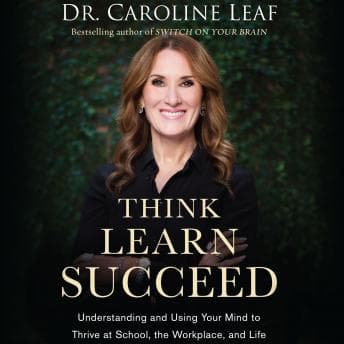

"Your mind is like a quantum computer." That's roughly hour two, and it's the moment I pulled my AirPods out, looked at the ceiling of my hotel room in Denver (delayed flight, nothing else to do), and said out loud: "Is it though?"
Look, I wanted to like this book. I really did.
The 45 Minutes of Actual Signal
Bottom line: Dr. Caroline Leaf has some genuinely useful frameworks buried in here. The 5-Step Switch on Your Brain Learning Program - basically a structured metacognition loop of gather, reflect, write, revisit, teach - is solid. My parents didn't call it metacognition when they drilled Korean vocabulary into me at the kitchen table every night, but the principle tracks. Active recall, spaced repetition, deliberate processing. This is established cognitive science, and Leaf packages it in a way that's accessible.
The Gift Profile concept - that each person has a unique cognitive processing style - is also interesting, if a bit underdeveloped in audio format. You really want the physical book or workbook for the self-assessment portions. Listening to someone describe a quiz you can't take is like watching someone else eat dinner.
The key takeaway is worth the listen. The other 7 hours? Not so much.
Where the Neuroscience Gets... Creative
Here's my problem. Leaf positions herself at the intersection of neuroscience and faith, which is fine - I grew up in a Korean church, I'm not allergic to biblical references. But the way scientific claims get woven together with spiritual assertions creates this weird credibility smoothie where you can't tell which ingredient is which. She'll cite a legitimate study on neuroplasticity, then leap to claims about thought literally restructuring your DNA, and you're left wondering if you missed a step or if she skipped twelve.
I've sat in enough McKinsey presentations to know when someone is doing the "cite one real study, extrapolate wildly" move. It's effective rhetoric. It's not great science communication.
At 2.0x speed, the repetition was still noticeable. The same core ideas - thoughts are real, mindset matters, you can rewire your brain - get recycled across chapters with slightly different framing. By hour five I was checking the progress bar more than I'd like to admit.
Sandra Burr Does Her Job Well (The Content Just Doesn't Help Her)
Sandra Burr narrates with this steady, measured confidence that actually works for the material. She gives weight to Leaf's assertions without overselling them, which is harder than it sounds when you're reading passages about quantum physics and consciousness. Her pacing is consistent and her tone stays warm without dipping into that breathy "inspirational" voice that plagues the self-help audio genre. She's a professional doing professional work. The narration in Mindful Athlete hits that same register - measured, credible, never overselling the material - and it's worth hearing as a benchmark for what good performance audio can do when the content actually holds up its end of the deal.
But narration can't fix structural problems. There are sections that read like a textbook - lists of cognitive biases, descriptions of brain regions - that simply don't translate well to audio. You find yourself wanting to take notes but also realizing the notes would be shorter than the audio by a factor of ten.
Who This Is Actually For (And Who Should Run)
If you're new to the intersection of mindset and cognitive performance - if you've never read Carol Dweck or Anders Ericsson or even a Wikipedia article on neuroplasticity - this might genuinely open some doors for you. And if the biblical framing is something you actively want in your self-help, Leaf is one of the better options in that specific lane.
But if you've read any two of the following - Mindset, Peak, Atomic Habits, Deep Work - you've already absorbed 80% of the actionable content here, with better sourcing. I've seen these principles applied at three different companies. The ones that worked didn't need the quantum metaphors.
My parents built a business on discipline, repetition, and showing up when they didn't feel like it. That's basically the useful core of this book. They just didn't need 7.5 hours and a neuroscience vocabulary to say it.
The Consulting Engagement Is Over
Jenny would say I'm being harsh. Jenny is right. But she'd also agree that a 7.5-hour audiobook with maybe 90 minutes of unique, actionable content is a tough ROI proposition. Skip to the chapters on the 5-Step Learning Program and the Gift Profile. Speed through the rest. Or just save your credit for something tighter.
The ideas aren't bad. The packaging is just... inefficient. And if there's one thing I can't forgive, it's that.