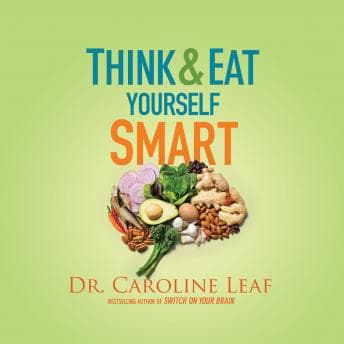

"Your thinking affects your eating, and your eating affects your thinking." That line hits somewhere around the 40-minute mark, and I remember pausing mid-pour of my third coffee of the day, staring at the cup like it had personally offended me. It's the kind of statement that sounds obvious until you realize you've spent your entire adult life ignoring it.
I was prepping for a strategy session with a health-tech startup - one of those companies trying to disrupt meal planning with AI - and figured I'd do some adjacent listening. Pulled up Dr. Caroline Leaf's Think and Eat Yourself Smart expecting another diet book dressed up in neuroscience buzzwords. What I got was... more interesting than that, but also more frustrating.
The 45 Minutes of Insight Problem, Diet Edition
Bottom line: There's a genuinely useful framework buried in here about the mind-food connection. Leaf's central argument - that your mental state before, during, and after eating shapes not just what you choose to eat but how your body processes it - is backed by real neuroscience and gut-brain axis research. She talks about how stress hormones alter digestion, how mindless eating bypasses your body's signaling systems, and how individual biochemistry means there's no universal "perfect diet." That last point alone is worth the listen, because it's the thing every diet book conveniently ignores while selling you their one-size-fits-all solution.
But here's the thing. This is a 7-hour-42-minute audiobook that could've been a killer 3-hour one. Leaf repeats her core concepts - neuroplasticity, the 21-day brain detox cycle, the gut-brain connection - with a persistence that would make my Korean mother proud. (My mom could tell you to wear a jacket seventeen different ways in one conversation. Similar energy.) By hour 5, I was at 2.0x speed and still feeling like I was running laps around the same track.
The strongest material is in the middle chapters where Leaf gets specific about how different types of thinking patterns create different hormonal cascades that affect food cravings. She breaks down the cortisol-insulin loop in a way that actually clicked for me - I've watched three startup founders stress-eat their way through Series A funding rounds, and Leaf's explanation of why that happens biochemically was the first time I thought, oh, that's not just weakness, that's chemistry. Useful. Genuinely useful.
What's less useful: the sections that veer into spiritual territory without clear signposting. Leaf is open about her faith background, and there are moments where the neuroscience and the theology blur together in ways that might not land for every listener. Not a dealbreaker, but worth knowing going in.
Teri Clark Linden's Narration: Professional to a Fault
Linden reads this the way a very competent newsreader delivers the evening broadcast. Clear diction, solid pacing, zero stumbles over the medical terminology - and that's not nothing when you're dealing with words like "psychoneuroimmunoendocrinology" (yes, that's a real word in this book, and yes, she nails it). The production is clean, no audio artifacts, no weird room echo.
But - and this is the gap - she narrates it like a textbook when the material sometimes calls for a coach. The sections about emotional eating and breaking destructive thought patterns need warmth, maybe even a little urgency. What you get instead is steady and measured. At 2.0x, it actually improved the experience because the increased tempo added energy that the delivery was missing. One listener nailed it when they said the narration felt "robotic" - I wouldn't go that far, but I'd say it's the difference between a really good GPS voice and someone who actually cares whether you make the turn.
Who Gets ROI Here
If you're a founder, executive, or anyone operating under chronic stress who's noticed their eating habits correlate with their anxiety levels - skip to the gut-brain chapters. Thank me later. If you're looking for a specific meal plan or grocery list, you'll be disappointed. Leaf is deliberately anti-prescription, which is both her strength and her commercial weakness. She wants you to think differently about food. She doesn't want to tell you what to eat on Tuesday.
This is what my parents did instinctively. Now it has a TED talk. My mom never read a neuroscience paper, but she understood that you sit down, you eat with family, you don't rush, and you don't eat angry. Leaf just gave that wisdom a bibliography. The brain-relationship research in Wired for Love traces a similar arc — neuroscience catching up to what people who actually loved each other well already knew intuitively.
If you're sensitive to repetition or want tight, no-fat content delivery, this will test your patience even at accelerated speed. If you're already deep into the gut health literature - Mayer's The Mind-Gut Connection covers similar territory with less padding.
The Consulting Recommendation
The key takeaway is worth the listen. The other 7 hours? Not so much. There's a 3-hour book in here that would be genuinely excellent - a concise argument for mindful eating grounded in neuroscience rather than Instagram wellness culture. The actual 7-hour-42-minute product dilutes its own best ideas. I'd recommend it the way I'd recommend a 90-page consulting deck to a CEO: read the executive summary, skim the appendix, and if something grabs you, go deep on that section. Jenny would say I'm being harsh. Jenny is right. But she'd also agree this needed an editor with a machete.