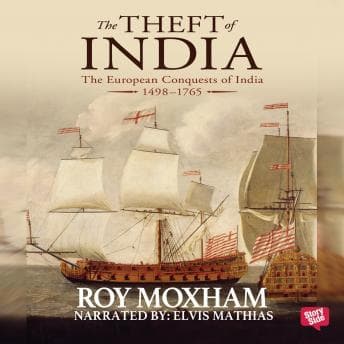

Let me cut to the chase. I picked this up while stuck in gridlock on Mopac—Austin traffic is its own kind of war zone—because I needed something gritty to keep my blood pressure down. The title doesn't pull punches. Theft of India. It tells you exactly what the mission parameters are. This isn't a romanticized view of the Raj or a polite history of trade routes. It's a crime log. Memories of Childhood's Slavery Days has that same unflinching quality—no sugar-coating, just the raw ledger of what happened.
A 300-Year Smash and Grab
Here's the thing. When we talk about military history, we usually focus on the battles. The tactics. The flanking maneuvers. But Moxham focuses on the logistics of looting. Brutal efficiency.
The book covers the Portuguese, Dutch, French, and British. It's like watching a group of sharks fighting over a carcass, except the carcass is a civilization that was doing just fine before they showed up. I've seen this scenario play out in modern consulting—hostile takeovers masked as "partnerships." The Portuguese show up with guns and religion, then the Dutch come in with better accountants, and finally the British take the whole pot.
It's not a dry academic paper, though. It moves fast. Maybe too fast for some. At seven and a half hours, it's a quick briefing, not a deep-dive operational study. If you're looking for the specific grain count of a sepoy's ration in 1750, you won't find it here. But for a high-level overview of how Europe drained the subcontinent? It hits the mark.
The Voice That Fits the Crime
Now, let's talk about the intel on the narrator. I saw some folks online complaining about Elvis Mathias having an Indian accent. Seriously? You pick up a book about the history of India, written from a perspective that highlights the exploitation of the region, and you want a British narrator? Give me a break.
To me, Mathias sounded authentic. He kept the pacing tight—I listened at my usual 1.25x, and he didn't stumble. His tone has this matter-of-fact quality that works. He's not being melodramatic about the atrocities; he's just reading the ledger. It makes the facts hit harder. (Ranger, my German Shepherd, slept through the Dutch East India Company section, but he perks up for anything involving cannons, so don't take his lack of interest personally.)
Is the accent thick? A little. If you're used to polished BBC narrators, it might take you five minutes to adjust. But honestly, it added to the immersion for me. Felt like getting the story from someone who had a stake in it.
The Operational Limitations
Here's where it lost me a bit. Because it covers 300 years in under 8 hours, you get some whiplash. We jump from Vasco da Gama to the Battle of Plassey pretty quick. As a guy who likes to analyze the "how" and not just the "what," I wanted more on the military tech disparities. How exactly did small European garrisons hold off massive local armies? Moxham touches on it, but he doesn't dig in.
Audiobooks for history can be tricky without maps. I found myself wanting to pull over and check a map of the Malabar Coast just to orient myself. That's not the book's fault, just the nature of the medium.
Who's This Briefing For?
If you want the strategic picture of European colonialism in India without getting bogged down in the weeds, this delivers. Good for a long drive or a few gym sessions. Skip it if you need detailed tactical breakdowns of every skirmish or if you're looking for a balanced "both sides" take—Moxham picked his side, and it's not the colonizers.
Mission Debrief
Look, if you think the British Empire was all stiff upper lips and railroads, this is going to be a rough listen. It strips the varnish off. Ugly history, told directly.






![Steve Jobs [unabridged audiobook] audiobook cover](/_next/image?url=https%3A%2F%2Fcovers.audiobooks.com%2Fimages%2Fcovers%2Ffull%2F9788499923406.jpg&w=1920&q=75)