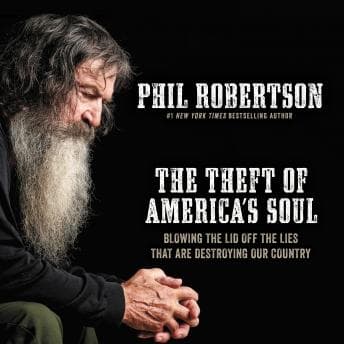

Look, I need to get something off my chest: I have a real problem with books that diagnose an entire nation's moral failings in under six hours. That's not enough time to properly season a biryani, let alone unpack the spiritual condition of 330 million people. But here I was, chopping onions for said biryani on a Saturday evening, Phil Robertson's unmistakable Southern drawl filling my kitchen, and I found myself genuinely trying to engage with this book as what it is - a case study in how one man constructs a moral framework and then projects it onto an entire culture.
The Duck Commander as Street-Corner Prophet
Phil Robertson narrates this himself, and honestly? That's both the book's greatest asset and its most limiting factor. His voice has this rough-hewn, front-porch-sermon quality - the kind of cadence that makes you feel like you're sitting in a Louisiana living room being told exactly what's wrong with you while he whittles something. There's an authenticity there that a professional narrator couldn't replicate. When Phil talks about his own past - the drinking, the violence, the years before his conversion - you hear the gravel of lived experience in his voice. That part I respect.
But here's where the psychology nerd in me starts twitching. The book is structured around ten "lies" that Robertson believes America has accepted, and he systematically replaces each with a biblical truth. The protagonist - because Phil absolutely positions himself as the protagonist in a spiritual war narrative - exhibits classic black-and-white thinking. Everything is binary. God's way or the devil's way. No middle ground, no gray area, no room for the kind of cognitive complexity that, you know, actual human moral reasoning involves.
The research actually shows that moral development (shoutout to Kohlberg, nobody's favorite dinner party topic) moves from rigid rule-following toward more principled, context-sensitive reasoning. Phil's framework actively resists that progression. He treats it as a feature, not a bug. And to his credit, he's completely transparent about it. He's not trying to be subtle.
When Conviction Becomes a Closed System
What makes this book a fascinating case study in confirmation bias is how Robertson handles disagreement. Anyone who holds an opposing view gets lumped into a vague category of "left-wingers" or people who've been deceived by the devil. I found myself asking: why does Phil really need the opposition to be not just wrong, but spiritually corrupted? Because if your opponents are merely mistaken, you have to engage with their arguments. If they're agents of cosmic evil, you just need to pray harder.
Psychologically, this doesn't track as genuine persuasion - it tracks as in-group reinforcement. Phil isn't trying to convince anyone who disagrees. He's giving people who already agree with him permission to stop feeling conflicted about it. That's a very different project than the one the subtitle promises. WOKE, INC. does something structurally similar from the opposite political direction - Vivek Ramaswamy is also preaching to a choir while packaging it as an exposé, and I found myself running the same psychological read on both authors.
The preacher-like tone is relentless. At 5 hours and 48 minutes, it's not a long listen, but the intensity doesn't modulate much. By hour three, my onions were done, the biryani was simmering, and I was pacing my kitchen because the book has one emotional gear: urgent moral alarm. No quiet moments of doubt. No wrestling. Just certainty delivered at volume.
Who This Is Actually For (And Who Should Run)
If you're already in Phil Robertson's camp - conservative, evangelical, nostalgic for an America you believe existed before the cultural shifts of the 1960s - this book will feel like a warm blanket and a strong cup of coffee. Phil's folksy delivery makes the medicine go down easy, and there's something genuinely comforting about a man who sounds like he's never second-guessed himself in his life.
If you're looking for intellectual rigor, engagement with opposing perspectives, or any acknowledgment that moral questions might be complicated - this is not your book. It's not trying to be. And I think it's fair to evaluate it on those terms.
My therapist would have thoughts about this character - specifically about the way Robertson's conversion narrative functions as an all-or-nothing identity reconstruction. Before God: bad. After God: good. No mess in between. It's psychologically clean in a way that real transformation rarely is. But it makes for a very effective sermon.
The author understands human nature - or at least, he understands the slice of it that responds to certainty in uncertain times. I just wish he'd extended that understanding to the people he disagrees with.
My Clinical Assessment
Phil Robertson wrote exactly the book he intended to write, and he narrated it with the conviction of a man who sleeps very well at night. As a piece of persuasive rhetoric aimed at its target audience, it's effective. As a diagnosis of American culture? It's about as sophisticated as diagnosing a headache by blaming demons. I didn't regret the listen - it gave me plenty to argue with over biryani - but I wouldn't spend a credit on it when your library app probably has it.