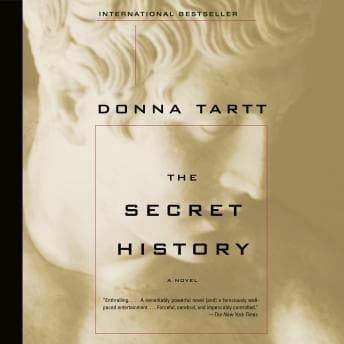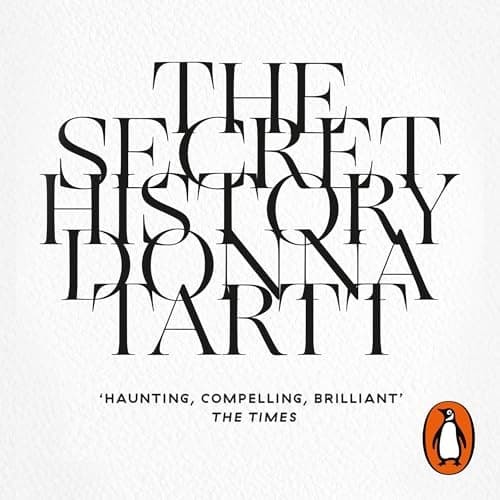

Denise and I were walking the lakefront last Saturday - one of those late October mornings where the wind off Lake Michigan makes you question every life choice that brought you to Chicago - and she had her own podcast going while I had Donna Tartt whispering murder into my left ear. We must have looked like every other middle-aged couple out there, except I kept stopping dead on the path because Tartt's prose demanded it. Denise learned to just keep walking. She'd circle back.
Here's the thing about The Secret History that my grad school self understood intellectually but my 47-year-old self finally felt: this is a book about the seduction of ideas. Not romance. Not thriller mechanics. Ideas. A group of classics students at a fictional Vermont college fall under the spell of their professor Julian Morrow, and through him, fall under the spell of ancient Greek thought - the Dionysian, the transcendent, the beautiful and terrible. And then they kill someone. You know this from page one. Tartt tells you in the prologue exactly who dies and roughly why. The mystery isn't whodunit. The mystery is how smart people convince themselves that murder is aesthetically justified.
This reminds me of what Hemingway said about writing - that the dignity of movement of an iceberg is due to only one-eighth of it being above water. Tartt gives you the surface narrative of Richard Papen, a kid from Plano, California who reinvents himself at Hampden College, but beneath that surface is this enormous, slow-moving examination of class performance, intellectual vanity, and moral decay. Twenty years of watching teenagers perform versions of themselves they saw on TikTok has given me a pretty sharp eye for performance, and Richard is performing from the first sentence. He's performing for Julian, for Henry, for the reader. Tartt knows this. She built the whole novel on it.
The Author Reading Her Own Confession
So let's talk about what the author is really saying - not just with the text, but with the decision to narrate it herself. Donna Tartt reading The Secret History is a strange choice. Richard Papen is a twenty-something male narrator, and Tartt's voice is unmistakably Southern, unmistakably female, with this soft, almost conspiratorial cadence. For the first hour or so, my brain kept flagging the disconnect. This doesn't sound like a young man from California. This sounds like someone telling you a secret at a dinner party in Mississippi.
But then something shifts. Because Richard was never really the point. Richard is a lens, a camera, a slightly unreliable window into this hothouse world of Greek and privilege and guilt. And who better to voice a lens than the person who ground it? Tartt's reading has this quality of - I don't know how else to describe it - authorized intimacy. She knows exactly where the irony lives in every sentence because she buried it there. When Richard describes Henry Winter's imperious calm, there's a flicker of something in Tartt's delivery, almost amusement, that tells you she sees through her own character in ways he can't see through himself.
Now, her voice for Bunny - Bunny Corcoran, the doomed, loud, casually bigoted rich kid whose murder opens the book - that's something else entirely. She gives him this nasal, slightly ridiculous voice that's genuinely weird. It shouldn't work. It does. Because Bunny IS weird. He's the one character who refuses to fit the aesthetic framework the others have built, and Tartt's odd vocal choice keeps reminding you of that friction. Every time Bunny opened his mouth, I could feel the group's irritation. That's performance as interpretation.
But I won't pretend the narration is perfect. At 22 hours, the pacing sags significantly in the second half - particularly the funeral scenes, which feel like Tartt is reading every word at the same measured tempo regardless of whether the scene demands it. The prose deserves to be savored, yes, but some passages needed a shift in energy that never comes. I found myself, around hour 15, grading sophomore essays and realizing I'd drifted away from the audio for ten minutes without missing anything essential. That's a problem.
Why We Still Read About Beautiful Terrible People
My students would hate this. I love it. They'd call every character "toxic" and "problematic" within the first three chapters and they wouldn't be wrong, but they'd be missing the point. Tartt isn't asking you to like these people. She's asking you to understand why Richard liked them, why he wanted to be them, why he'd help cover up a murder to stay in their orbit. The novel is an argument about the danger of aestheticizing life - of treating beauty and intellect as moral categories. It's Gatsby filtered through Euripides, and if you've ever watched a student completely lose themselves in trying to be someone they're not, it hits different.
The prose is dense, allusive, and self-consciously literary in ways that reward close attention. There's a passage early on where Richard describes the quality of light in Julian's office, and I swear Tartt's reading slowed down by half a beat, letting the description accumulate like dust in a sunbeam. That's the narrator understanding that pause is punctuation.
Who Should Listen (And Who Should Skip)
If you loved Brideshead Revisited or A Separate Peace, this is their spiritual successor - darker, more self-aware, but built from the same DNA of nostalgia and complicity. Pick this up if you want 22 hours of gorgeous, poisonous prose and you're willing to sit in discomfort with characters who deserve what's coming to them. Skip it if you need constant momentum or if an author's Southern drawl voicing a male protagonist is going to pull you out of the fiction every five minutes. That's a legitimate deal-breaker for some listeners, and I respect it. The narrator-as-unreliable-guide problem showed up differently in my read of Big Miss: My Years Coaching Tiger Woods, where the whole book hinges on whether you trust the person doing the telling - and I kept asking myself the same question I ask about Richard Papen: what is this narrator leaving out?
If you've already read it in print, the audiobook adds a layer of authorial intent that's genuinely interesting - like watching a director's cut with commentary baked into the performance. If you haven't read it at all, you're in for something. Just don't try to listen while multitasking. This one requires your full attention. Worth pausing the faculty meeting for.
The Grade I'd Put in the Gradebook
Twenty years of teaching has taught me that the books that matter most are usually the ones students resist hardest. The Secret History is that kind of book - difficult, slow in places, populated by people you wouldn't want to share a seminar table with. But it does something only great fiction can do: it makes you complicit. By the end, you understand the murder not because Tartt explains it, but because she's spent 22 hours making you want what these characters want. That's not a trick. That's art.