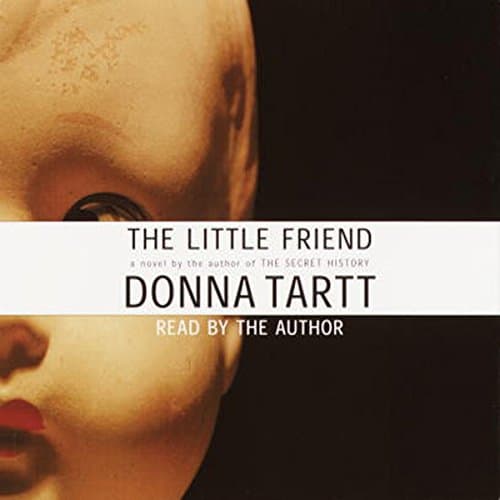

"Nobody could ever love a boy as much as she had loved Robin." Somewhere around the two-hour mark, Donna Tartt reads this line about Harriet's dead brother with such quiet devastation that I had to pause and sit with it. That sentence contains the entire engine of this novel — a family frozen in grief, a nine-year-old murder no one solved, and a twelve-year-old girl who decides she's going to fix what the adults couldn't.
I listened to this over two focused afternoons, headphones on, phone face-down, and I want to be direct: that's the only way to listen to this book. If you try it while commuting or folding laundry, you'll lose the thread within minutes. Tartt writes sentences that demand your full brain, and when she reads them aloud, they retain every ounce of that density.
Harriet Cleve Dufresnes is the reason to press play. She's twelve, raised in a Mississippi household still shattered by her brother Robin's murder — found hanged from a black-tupelo tree in their yard when she was a baby. Nobody was ever caught. Her mother retreated into pills and soap operas. Her father left for Nashville. Her grandmother and great-aunts circle the wound endlessly without healing it. Into this vacuum steps Harriet, who has essentially raised herself on Stevenson, Kipling, and Conan Doyle, and who decides with terrifying conviction that she will find the killer and deliver justice.
Tartt narrating her own character is the audiobook's great strength and its central tension. She reads Harriet with the authority of someone who built her from the ground up — you hear the stubbornness, the loneliness, the intelligence that's slightly too sharp for a kid her age. That same authorial intimacy comes through in her reading of The Secret History — when Tartt narrates her own work, there's a quality of possession in her voice that no hired narrator could fake. She has a genuine ear for Southern voices that makes the Mississippi setting feel like a place you've been sweating in, not a place described to you. One listener compared Harriet to Scout Finch, and that comparison holds: same precocious clarity, same child's-eye view of adult rot.
But Tartt the narrator occasionally fights Tartt the writer. Her prose is so architecturally complex that reading it aloud produces sentences you can hear the punctuation in. A professional narrator might smooth those edges into something more conversational. Tartt reads them with precision and care, which means you sometimes feel the craft rather than forgetting it. It's the difference between hearing a story told and hearing beautiful writing performed. Both have value. They're not the same experience.
The pacing is where this audiobook will either hold you or lose you, and I want to be specific about why. At six hours, this is an abridged version of a substantial novel, and it still feels like it wanders. Tartt will build genuine tension — Harriet and her friend Hely stumbling into the orbit of a dangerous local family, a drug operation that has nothing to do with childhood adventure games — and then the narrative drifts into a passage about the quality of light on a Delta afternoon or the particular sadness of a photograph album. These digressions are often the best writing in the book. They're also where the mystery's momentum goes to die.
The ending is the most polarizing element, and I'll be straight with you: if you need a solved case, don't start. Tartt is not interested in tying the bow. She's interested in what happens to a family when the bow can never be tied — how grief calcifies into identity, how a child's determination to impose narrative order on senseless violence is both heroic and doomed. That's a legitimate artistic choice. It's also the kind of choice that makes listeners feel cheated after investing hours in a pursuit that was never going to deliver the payoff it promised.
What the audiobook does extraordinarily well is atmosphere. Tartt's Mississippi is thick with heat, class resentment, and racial tension that isn't backdrop but load-bearing structure. The world feels dangerous the way real small towns feel dangerous to a child — not because of lurking evil but because the adults are broken in ways they won't examine, and the systems they maintain are built on fault lines they refuse to acknowledge.
Who Should Listen (And Who Should Skip): Buy this if you can give it your undivided attention and care more about mood, grief, and extraordinary prose than a solved-case payoff. Skip it if you need clean mystery mechanics, listen while multitasking, or want a narrator who disappears completely into the text.
Harriet herself is the reason I don't regret a minute of listening. That fierce, lonely kid marching into danger armed with nothing but library books and the conviction that courage should be enough — she's the kind of character who stays in your chest long after the audio ends. Mattie Ross in True Grit is the closest comparison I can reach for — another girl that age who refuses to accept what the adults around her have decided to leave unfinished, and Tartt reads that one too, with the same unsettling precision. The book around her doesn't always match her intensity, but she burns bright enough to carry it.