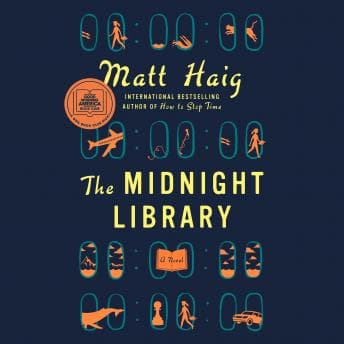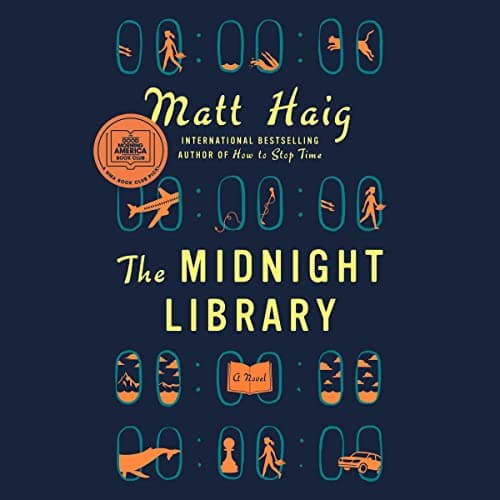

"Between life and death there is a library." That line has been rattling around in my head for two days.
I listened to The Midnight Library while walking the lakefront after dinner, the city doing that gray-blue thing Chicago does when it wants to look like a novel. And this was the right kind of book for that mood - not because it's cozy, exactly, but because it asks the sort of dangerous questions that get louder when you're alone with your own footsteps. What if I'd chosen differently? What if the life I call mine is just the rough draft of something better?
Matt Haig knows that regret is basically fan fiction we write about ourselves. And this book turns that idea into an actual structure: Nora Seed, suspended between life and death, enters a library where each book contains a version of the life she might have lived if she'd made one different choice. Not abstract choices either. Concrete, painfully human ones. The old breakup. The abandoned dream of becoming a glaciologist. The life where she stayed in the band. The life where she said yes instead of no. My students would hate this. I love it. Though I'll say — I've watched students surprise me before, usually when a book refuses to flatter them, the way Things Fall Apart does when they realize Okonkwo isn't going to become who they want him to be.
What makes the premise work is that Haig doesn't treat alternate lives like cute little thought experiments. He treats them like consequences with better lighting.
A shelf full of regrets
Nora is not a puzzle box heroine. She's depressed, exhausted, ashamed, and convinced she has become a burden in her own life. That matters. A lot. Because the novel doesn't begin with whimsical portal fantasy energy. It begins in despair. Some of those early scenes hit hard enough that I had to stop walking and stare out at the water like a man in a BBC adaptation. If you're sensitive to material involving suicide ideation, self-harm, and severe mental health struggles, take that warning seriously. This isn't decorative sadness.
And yet the book is not interested in wallowing. It's interested in interrogation. Each new life Nora tries reveals something uncomfortable: the fantasy version of ourselves is usually edited within an inch of its life. We imagine the Olympic self, the famous self, the happily married self, the self who never disappointed anyone. Then reality barges in and says, yes, but you still have to be a person there too.
That's where the novel earns its popularity. Not in the mechanics of the library — though the image of infinite books of unlived lives is undeniably catnip for readers — but in the slow dismantling of the lie that one perfect choice would've solved everything. This reminds me of what Hemingway said about gradually and then suddenly. Regret works that way. So does self-forgiveness.
I also appreciated that the library itself has an emotional logic rather than a hard sci-fi one. If you want airtight metaphysical rules, this may frustrate you. If you're willing to accept the place as a moral and psychological landscape, it lands much better. Mrs. Elm, the librarian from Nora's childhood, is central here — part guide, part conscience, part high school counselor if high school counselors were allowed to say the things students actually need to hear.
Carey Mulligan knows when not to push
This is a very smart bit of casting.
Carey Mulligan reads Nora with a bruised restraint that fits the material. In the early sections especially, she captures the flatness of depression without making Nora sound lifeless. That's a difficult balance. Pain, amazement, confusion — she moves through those states with subtle shifts in tone rather than big theatrical swings. She understands that pause is punctuation. And in a book like this, where so much depends on reflection and emotional hesitation, that matters more than flashy character work.
Her British accent also keeps the novel grounded. There's a steadiness to her voice that helps sell the stranger elements of the premise. No music, no sound effects, no production tricks. Just one clear voice in your ear saying, stay with this. For most of the book, that's enough.
Not perfect, though. A few listeners complained about monotone stretches later on, and I can see why. Once the structure becomes episodic — Nora trying one life, then another, then another — Mulligan's reserved style occasionally flattens moments that need a little more lift. And yes, there's that odd mispronunciation of "grasshopper" during an Australian accent attempt. Tiny thing. But it's the kind of tiny thing your brain snags on in an otherwise polished performance. There's also the recurring countdown at chapter openings, which some people find ominous and others find a little too on-the-nose. I'm somewhere in the middle. It didn't ruin anything for me, but it did occasionally announce emotion instead of letting the scene earn it.
Still, this is good audiobook acting. Humane. Controlled. Better than some reviews suggest.
Who Should Listen (And Who Should Skip)
If you loved The Humans or How To Stop Time, this is obviously in Haig's wheelhouse — the same accessible philosophical fiction, the same concern with loneliness and how to remain alive to your own life. If you loved The Invisible Life of Addie LaRue, this is its spiritual cousin in the sense that both books use speculative devices to get at human ache, though Haig is simpler and more direct. Less velvet, more clarity.
But let me be plain: if you need dense prose or deep stylistic experimentation, this isn't that book. The writing is clean and purposeful, not lush. The ideas are stated clearly — sometimes very clearly. A few readers will find that moving; a few will find it heavy-handed. Both reactions are fair. Skip it, too, if episodic structure frustrates you — the middle section's rhythm of life-after-life can feel repetitive if you're craving forward momentum.
I'd recommend this most to listeners in a reflective season. People circling old decisions. People who need a gentle argument against the idea that their life is already ruined. Not as background while answering emails. Not really. This one asks you to sit with it.
Worth pausing the faculty meeting for.
The audiobook succeeds because it understands the assignment: this is less about plot twists than about whether a voice can carry you through despair toward possibility without sounding smug about either. Mulligan mostly does. And Haig, for all his earnestness, gets at something true — that the life we mourn from afar is usually an illusion, and the one we have still contains unread chapters.