
"Who am I now?"
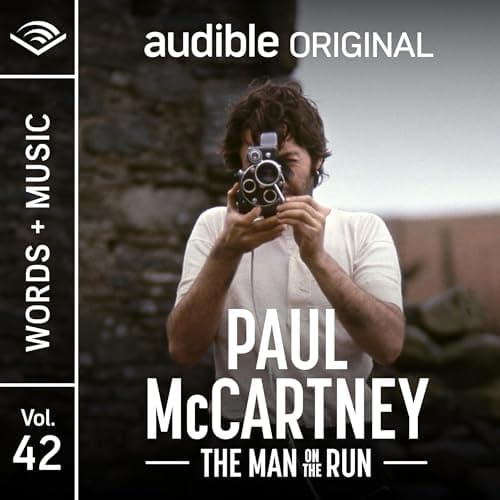
Somewhere around the forty-minute mark, McCartney asks himself that question — not dramatically, not performing vulnerability for the microphone, but the way you'd say it to yourself while staring at a kitchen wall at 2 AM. I was walking the lakefront with Denise, late Sunday morning, wind coming off Lake Michigan hard enough to make my eyes water, and that question stopped me mid-stride. Because I've heard a hundred documentaries about the Beatles breakup. I've taught the cultural context. I've assigned essays about it. But I'd never heard a 27-year-old Paul McCartney sound genuinely lost before.
That's what this Audible Original does that nothing else in the McCartney catalog quite manages.
The Space Between the Legend and the Man
Morgan Neville — and look, the guy won an Oscar for 20 Feet from Stardom, he knows how to let subjects breathe — structures this as a conversation, not an interrogation. You hear him ask a question occasionally, but mostly it's Paul talking. And here's the thing that surprised me: McCartney at 80-something reflecting on McCartney at 27 doesn't sound nostalgic. He sounds like he's still slightly bewildered by it all. The retreat to that crumbling Scottish farmhouse with Linda, no running water some days, learning to be a dad while the entire music press is writing his creative obituary — he describes it with this understated wonder, like he can't quite believe he chose that path either.
The Nigeria section is where the audio earns its keep. Paul recounting the armed robbery in Lagos — where someone stole the demo tapes for Band on the Run — and then just... going back into the studio the next day to re-record everything from memory. He tells it almost casually, the way people describe genuinely traumatic things when they've processed them for fifty years. No dramatic music swell. Just Paul's voice and the weight of the story.
Paul's Voice Is the Instrument Here
Let's talk about what you're actually hearing for three hours. This isn't a polished celebrity narration with a studio sheen. McCartney's voice has age in it — a slight rasp, the Scouse accent softened by decades of everywhere — and it works because you're not listening to Sir Paul McCartney, cultural icon. You're listening to a guy remembering what it felt like to be terrified and pretending he wasn't. When he talks about calling John Lennon after years of not speaking, there's a pause before he describes John's voice on the phone. The narrator understands that pause is punctuation. Neville understood it too, because he left it in.
The snippets of actual recordings woven through — "Maybe I'm Amazed," bits of Ram sessions — aren't just decoration. They land at moments where Paul's description of making the music meets the music itself, and your brain connects the vulnerable guy talking to the confident artist playing. It's a smart production choice.
But here's my honest gripe: at two hours and fifty-five minutes, this is a sprint through an entire decade. The formation of Wings gets maybe fifteen minutes. The creative process behind Band on the Run — arguably the best post-Beatles album by any Beatle — deserves twice the space it gets. I wanted McCartney to sit with the making of "Let Me Roll It" the way he sits with the Beatles dissolution. The ratio feels off. The painful stuff gets room; the joyful creative work gets compressed.
Who Should Listen (And Who Should Skip)
If you already know every Beatles biography, you won't learn much new factually. That's not the point. The point is tone — hearing McCartney frame his own decade without the usual media filter. If you're the kind of listener who needs narrative momentum and dramatic structure, this'll feel loose and conversational in a way that might frustrate you — skip it. It's an old man remembering, not a thriller.
But if you've ever had to rebuild yourself after the thing that defined you ended — a career, a relationship, an identity — the way Paul describes choosing to start from zero will hit different. This reminds me of what Hemingway said about courage being grace under pressure. The question of what it means to rebuild an identity after creative collapse is something I kept turning over in Inheritors too — different context, same gutting honesty about who you become when the old version of you is gone. McCartney's version of grace was loading his family into a van and playing university cafeterias after selling out Shea Stadium.
Worth Pausing the Faculty Meeting For
My students would hate this. Too slow, too reflective, no hooks in the first thirty seconds. I love it. Not because it's perfect — it's too short for its ambitions and Neville's presence could've been more active as an interviewer. But because Paul McCartney at his most honest sounds like someone who figured out that losing everything was the best thing that happened to him, and he tells you that without a single moment of self-pity. The spoken word here deserves to be savored. Keep it at 1.0x. The author chose those words.