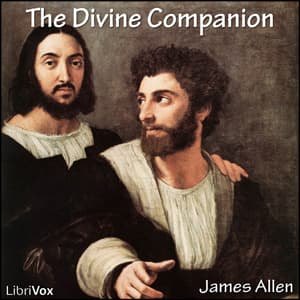

What happens when an author considers a book the spiritual autobiography of his entire life's work? James Allen's The Divine Companion arrives with that weighty designation—his own wish that readers encounter it last, after absorbing everything else he wrote. It's a curious instruction, almost like being told to read the epilogue before you've earned it.
I came to this audiobook during a stretch of early morning walks, that liminal hour when the world feels quieter and philosophical musings actually land differently than they would over lunch. And honestly? That context matters here. The Divine Companion isn't a book that grabs you by the collar. It's one that assumes you're already sitting still, already receptive, already willing to let abstract spiritual concepts wash over you without demanding immediate practical application.
Allen wrote this across many years, according to his wife Lily's introduction, and you can feel that accumulation in the text. This isn't a tightly structured self-help manual with actionable steps. It's closer to extended meditation, philosophical poetry dressed in prose, the kind of writing that rewards patience and punishes skimming. The themes circle around divine presence, inner peace, and the cultivation of a spiritual life—territory Allen explored throughout his career, but here rendered with what feels like personal urgency.
Andrea Fiore's Measured Reading
The LibriVox production, narrated by Andrea Fiore in Version 2, matches this contemplative energy with a clear, measured delivery. Fiore reads faithfully, maintaining consistent pacing that never rushes the material. For content this introspective, that restraint works. You're not listening for plot twists or character revelations. You're listening for phrases that might lodge somewhere useful in your thinking.
But here's where expectations matter enormously. If you're coming from audiobooks with dynamic performances—voice actors who shift between characters, who modulate emotion, who treat narration as theater—this will feel flat. Some listeners have called it monotone, and they're not wrong in a technical sense. The reading lacks dramatic variation. No vocal fireworks, no moments designed to make you gasp or laugh or cry. Whether that's a flaw depends entirely on what you're seeking.
I found myself adjusting. The first twenty minutes, I kept waiting for something to happen, some shift in energy. By the second hour, I'd recalibrated. The steadiness became almost hypnotic, suitable for the material's meditative nature. It's the audio equivalent of a quiet room versus a concert hall—different purposes, different merits.
The production quality itself is clean, which isn't always guaranteed with volunteer recordings. No distracting background noise, no jarring volume shifts, no technical issues that pulled me out of the experience. LibriVox does solid work here, and for a free audiobook, the professionalism is appreciated.
A Book That Divides Listeners
What surprised me, digging into listener responses, was how polarized reactions tend to be. Fans of Allen's broader catalog—particularly those who've already absorbed As a Man Thinketh and his other works—approach The Divine Companion with reverence. They're reading it as intended, as a capstone, and they find genuine spiritual nourishment. Others bounce off hard, finding the narration too sedate and the content too abstract for their taste. That same divide shows up with Sense and Sensibility—some listeners love the measured classical narration, others find it puts them to sleep.
At just under two and a half hours, this isn't a significant time investment. But it does require a particular mood. I wouldn't recommend this for your gym session or a high-energy commute. It belongs to quieter moments—early mornings, late evenings, long walks where you're already inclined toward reflection.
Who Should Press Play (And Who Shouldn't)
If you're already invested in Allen's philosophy, this audiobook delivers exactly what it promises: a faithful rendering of his most personal work, presented without embellishment. For newcomers, I'd actually suggest starting elsewhere—As a Man Thinketh remains more accessible—and returning here once you've developed a feel for his style. Skip this if you need dynamic narration or practical takeaways; it won't give you either.
A Century-Old Soul, Still Speaking
Allen died in 1912, and there's something poignant about encountering what he considered his soul's story more than a century later. The language feels of its era—philosophical, earnest, unironic in ways contemporary self-help rarely manages. Whether that registers as refreshingly sincere or hopelessly dated will vary by listener.
The narration won't convert anyone skeptical of straightforward readings, but it won't betray the material either. Sometimes that's enough. Sometimes a book just needs to be spoken clearly and allowed to do its own work.