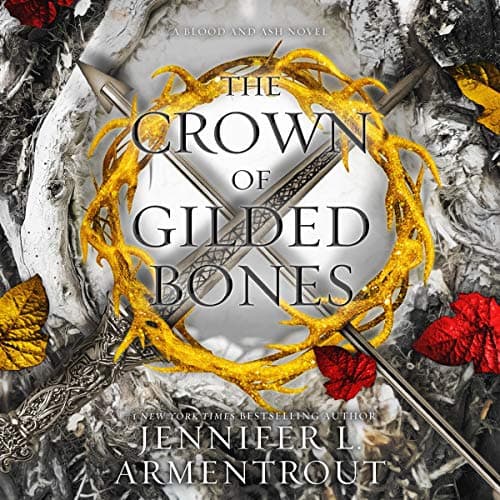

When does a fantasy series stop being fantasy and start being something closer to a gothic romance wearing fantasy's skin? Because twenty-five hours into The Crown of Gilded Bones, I'm still not entirely sure what genre I'm occupying — and I mean that as both a compliment and a warning.
I started this one on a rainy Saturday at the library after closing, lights off except for the desk lamp in the back office, Shirley Jackson shelving guides spread out in front of me that I was absolutely not reading. I'd been putting off book three because the series had already asked a lot of me — emotionally, temporally, in terms of sheer willingness to sit through Poppy's internal processing. But the rain was doing that Oregon thing where it sounds like the building is slowly dissolving, and I thought: fine. Let's do this.
The Dread of Becoming Something You Didn't Choose
Here's what Armentrout gets right that a lot of fantasy authors fumble: the horror of power. Not power as a cool upgrade or a badass moment — power as a thing that alienates you from everyone you love and rewrites your identity without your consent. Poppy carries the blood of the King of Gods, and the book doesn't let you forget that this is terrifying. The opening chapters hit hard — there's an intensity to the discoveries Poppy makes about herself that genuinely unsettled me. Not horror in the traditional sense, but that body-horror-adjacent feeling of realizing you are not what you thought you were. The book understands that horror isn't about gore — it's about dread. And Poppy's dread is real.
But — and this is where I started wrestling with the book — the middle sags. Significantly. There are stretches where Poppy's inner monologue loops in on itself, rehashing the same anxieties about her birthright, her relationship with Casteel, whether she's worthy of the crown. Some listeners called this boring. I wouldn't go that far, but I will say that around hour twelve I caught myself reorganizing the audiobook shelf instead of actively listening, which is never a great sign. The pacing asks for patience that it doesn't always reward.
And then there are the sex scenes. Look, I'm not a prude — I grew up in a household where holding hands in a PG movie was scandalous, so I've more than compensated as an adult. But the frequency here tips from "this relationship is passionate" into "are we padding the runtime?" territory. At twenty-five hours, you feel every minute that doesn't push the plot forward.
Stina Nielsen Carries What the Plot Sometimes Drops
The narrator commits. That's rare. Nielsen's performance is the reason I stuck with this through the slower stretches. Her Poppy is fierce and vulnerable in equal measure — there's a scene where Poppy confronts the reality of what she is, and Nielsen's voice cracks in this way that doesn't feel performed. It feels lived in. The emotional delivery during the intense moments is genuinely arresting. I had to pause during one particularly brutal revelation because Nielsen sold it so completely that I needed a second to sit with it.
Where she falters — and this is a recurring issue across the series — is the male voices. Casteel and the other male characters blend together in a way that undercuts the worldbuilding. When you've got Atlantian politics and competing factions and brothers with different loyalties, you need vocal distinction to keep the players straight. Nielsen gives you that with the women. With the men? Less so. It's not bad. It's just not as sharp, and in a twenty-five-hour listen, that ambiguity compounds.
Some listeners have called Nielsen the best audiobook narrator they've ever heard. I wouldn't go that far — I've listened to too many narrators who terrified me at 2 AM to hand out that crown easily — but she's working at a level that elevates material that might otherwise lose you in the middle act. Her work in A Kingdom of Flesh and Fire showed the same quality — that rare ability to make you forget you're listening to one person doing all the voices.
Who Should Listen (And Who Should Skip)
If you've been with the Blood and Ash series since book one, you already know whether you're in or out. My review of From Blood and Ash covers whether the series is worth that initial investment — because if you're arriving here cold, book three is absolutely not the place to start. The worldbuilding expands significantly here — Atlantia gets texture, the mythology deepens, and the cliffhanger ending is genuinely cruel in the best way. But if you bounced off the pacing in earlier books, this one won't convert you. It doubles down on everything Armentrout does — the romance, the internal processing, the slow reveals — and your tolerance for that will determine your experience. Skip this if slow-burn romance wrapped in fantasy politics makes you itch, or if you need tight pacing to stay locked in. Stick around if you're already invested in Poppy and Casteel and want the mythology blown wide open.
I listened in the dark. Mistake? Maybe. Worth it? Absolutely. Not because this is horror — it's not, despite what my genre-obsessed brain wants — but because the atmosphere of Poppy's transformation deserves that kind of focused attention. This isn't a background listen. This is a commitment.
Shelving This One Next to the Guilty Pleasures
My podcast listeners are going to love this — not because it's perfect, but because it's the kind of book that generates arguments. Is it too long? Yes. Does the middle need tightening? Absolutely. But the emotional core is solid, Nielsen's performance carries the weight, and that ending? That ending earns its place. Shirley (my cat) was unimpressed. I was invested. There's a difference between scared and invested, and this book firmly lands on invested.