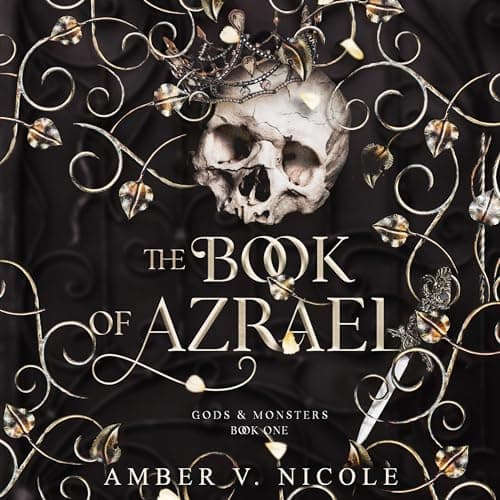

I was outside checking the guy lines on my winter tent, pitched near the cabin for a gear test, when Dianna’s bargain started occupying more of my attention than the weather. Save your sister, surrender your freedom. The Book of Azrael has gods, an ancient relic, and threatened worlds, but that ugly exchange was my first foothold. I paused the audio to finish checking the anchors. Some jobs deserve both ears.
My initial interest wasn’t really in the romance. It was in the difference between having power and being allowed to use it for yourself. Dianna can be dangerous and still be trapped. That’s a much better starting point than simply telling me she’s a formidable heroine.
Dianna’s strength doesn’t cancel Kaden’s ownership
Centuries before the main conflict, Dianna bargains with Kaden to save her dying sister. Her continuing servitude includes hunting an ancient relic held by enemies associated with Samkiel, the World Ender. Those specifics matter: her predicament isn’t an unfortunate misunderstanding that a sufficiently handsome god can clear up. Love for her sister has become leverage someone else keeps applying.
That gives the enemies-to-lovers setup something substantial to work against. Dianna and Samkiel aren’t just two sharp tongues waiting for an excuse to kiss. Their allegiances put them on opposing sides before a larger threat forces cooperation. I’m more interested in what that cooperation costs than in how quickly hostility becomes attraction.
And Samkiel has his own uncomfortable contradiction. After the Gods War, he abandons his crown and his people; an attack on those he loves pulls him back. A reluctant ruler can be appealing, certainly. But withdrawal has consequences for everyone who cannot withdraw with him. That tension interests me more than his destructive title. Being exhausted by responsibility doesn’t make the responsibility disappear.
The reported banter between Dianna and this withdrawn god helps explain the book’s appeal. When I do want a pair of wits circling each other until one of them admits the obvious, Darynda Jones's Third Grave Dead Ahead runs that play at full speed—Lorelei King lands Charley Davidson's wisecracks while the slowest fuse in urban fantasy keeps burning. Still, I wouldn’t buy it expecting the romantic payoff to arrive quickly. Slow-burn tension is one of the strongest recurring listener responses, and this first installment runs twenty-one hours and fifteen minutes. Bring patience, not a stopwatch.
The Etherworld is large; that isn’t an ecological claim
Here’s where my enthusiasm gets more particular. A thousand years of peace in the Etherworld, the aftermath of a divine war, and danger extending across worlds promise considerable scope. They don’t, by themselves, establish a convincing living environment.
I want to distinguish those things because “expansive worldbuilding” gets used as though it automatically means a world functions. Names, powers, histories, and political divisions can make excellent fantasy architecture. They aren’t the same as showing what populations eat, how damaged country recovers, or who bears the material cost when gods fight. The available research doesn’t give enough environmental detail to judge Nicole on that ground. I won’t invent an ecological triumph—or a failure.
What does emerge clearly is a world organized around power, obligation, and old conflict. Approach The Book of Azrael for that, rather than for close observation of landscape. My own interest kept returning to the smaller stakes inside the enormous ones: one sister’s survival, one woman’s constrained choices, one absent ruler’s obligations. “Every world” is difficult to hold in your mind. A debt that never ends is not.
Sample Bowles before spending a winter’s credit
Ruthie Bowles is the sole narrator of this unabridged edition. That distinction matters because a separate full-cast adaptation exists; comments about one production shouldn’t be borrowed to sell the other.
The most useful discovery in the reception research was also the least tidy: listeners disagree about precisely the same feature. Some enjoy Bowles’s character voices, while others find the differentiation overly theatrical. Clear delivery and a performance you enjoy aren’t necessarily the same thing. For a book this long, I’d sample an exchange between characters, not just the opening exposition.
There are also listener complaints about pronunciation, but no identified words. That’s insufficient evidence for me to repeat a specific error or declare a persistent technical problem. The research likewise supplies no verified detail about effects, music, or editing. My narrator score stays unassigned rather than pretending those gaps are firsthand findings.
So my buying advice is a sale, after a sample. You get a heroine whose strength coexists with coercion, an enemy alliance built around consequential loyalties, and a substantial slow-burn commitment. You give up a quick romantic resolution and take on the opening volume of Gods & Monsters, not a self-contained evening’s entertainment.
Dianna’s bargain is the reason I’d keep following. The size of Samkiel’s power matters less to me than whether either of them can finally choose what to do with it.