
What happens to a man who's spent twenty years teaching Faulkner and Fitzgerald when the grid goes down and his iPhone becomes a $1,200 paperweight?
I'll tell you what happens. He stands in his garage holding a $25 Baofeng radio he bought off Amazon two years ago, pressing buttons like a chimp trying to operate a microwave. That was me, roughly six months ago, after a nasty storm knocked out cell service on the South Side for almost two full days. Denise and I couldn't reach each other for hours. The radio sat in a drawer the whole time. I didn't even know which channel to set it to.
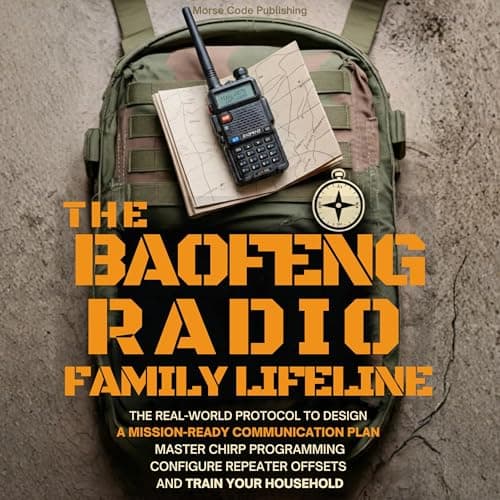
So when I stumbled across The Baofeng Radio Family Lifeline, I figured it was time to stop being the English teacher who preaches preparation through literature but can't figure out a two-way radio. I loaded it up on a Saturday afternoon while pretending to organize the garage - the same garage where that useless radio sat judging me.
The Book Hemingway Would've Wanted (If Hemingway Had a Baofeng)
Let's be clear about what this is: a practical manual dressed in survival-prepper language, delivered as an audiobook. And honestly? The format works better than I expected. At four hours, it's lean. No bloat. The book is structured around what they call "Real-World Protocol" - basically a systematic framework for turning your cheap Chinese radio into something your family can actually use when nothing else works.
The strongest sections are the ones dealing with the nuts and bolts of setup. The "Zero-Pain" Setup chapter walks through five specific menu settings - Squelch, CTCSS/DCS tones, power output, frequency step, and VOX - and explains why each one trips people up. The Squelch explanation alone was worth my time. I had mine set too low, which is apparently why I kept getting nothing but white noise and gave up. The book frames these as the source of "80% of communication failures," and while I can't verify that stat, I can verify that fixing my squelch setting was the difference between hearing static and hearing Denise's voice from three blocks away during our test run.
The "3-Layer Plan" - Simplex, Repeater, and Travel zones - is the kind of systematic thinking I appreciate as someone who builds lesson plans for a living. It's not just "here's a frequency, go talk." It's "here's how you architect a communication plan so your spouse knows Channel 1 is for the house, Channel 5 is for the neighborhood, and Channel 9 is for when you're driving home from work during an emergency." That's genuinely useful. I wrote our family plan on a notecard and taped it inside the kitchen cabinet.
The CHIRP software chapter - about cloning your radio settings to backups - is where the audio format strains a bit. This is inherently visual material. Listening to someone describe menu navigation in software you can't see is like listening to someone describe a painting. You get the gist, but you're going to need the screen in front of you to actually do it. Not the book's fault, exactly, but worth knowing.
Luke Oldham and the Challenge of Making Radio Manuals Sound Human
Here's where I have to be honest about my limited data. Luke Oldham delivers a clean, steady read. No dramatic interpretation needed here - this isn't Middlemarch. His pacing is appropriate for instructional content: measured enough that you can absorb technical details, but not so slow that you zone out during the antenna specifications. He sounds like a competent instructor, which is exactly what this material needs.
I've been thinking a lot lately about what narration owes its material—Kokoro is a completely different beast, a quiet Japanese novel about guilt and isolation, but the narrator there showed me how much a voice can elevate text beyond mere competence.But I can't tell you he brought any particular magic to it. The narration is functional. Professional. A bit like a well-organized lecture from a teacher who knows the material but isn't trying to win any personality contests. For a four-hour technical manual, that's fine. I wasn't looking for theater.
Who Should Crack Open the Garage Drawer (And Who Shouldn't Bother)
If you already own a Baofeng and it's sitting in a drawer (or a bug-out bag you've never opened), this book exists specifically for you. It assumes you have the hardware and zero confidence. The tone leans heavily into "head of household" prepper language, which might feel dated or exclusionary to some - Denise rolled her eyes at a couple of those passages - but the technical content underneath is gender-neutral and genuinely practical.
If you're an amateur radio hobbyist who already programs repeaters in your sleep, skip this - you'll find it too basic. And if you don't own a Baofeng and aren't planning to buy one, this is four hours of instructions for equipment you don't have.
The Grade I'd Put in the Gradebook
This is the kind of book that doesn't belong in the same conversation as literature, and I mean that as a compliment. It's not trying to be art. It's trying to keep your family connected when everything falls apart, and it does that job with surprising clarity for an audio format. The antenna chapter alone - explaining why your stock rubber duck antenna is basically a decoration and which aftermarket options actually gain you decibels through terrain - convinced me to spend another $15 on a Nagoya NA-771. Tested it. The difference was immediate and obvious.
I took off points for the inherently awkward fit between audio delivery and software tutorials, and for the occasionally aggressive prepper marketing tone that creeps in. But the substance is real. My family now has a communication plan that doesn't depend on Verizon. That's worth more than most novels I've assigned this semester. (Don't tell my students I said that.)