
There's a delicious irony here that I can't stop thinking about.
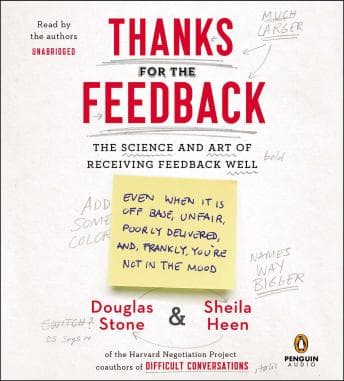
I was chopping onions for a biryani I had no business attempting on a Tuesday night when Douglas Stone started explaining why we get defensive about feedback. And I found myself getting defensive about his narration. The man was mumbling. Actually mumbling. In an audiobook about receiving criticism with grace.
Someone should have given these authors honest feedback about their audio performance. (Yes, I know other reviewers have made this joke. It's still true.)
The Framework That Made Me Stop Chopping
Here's what frustrates me: the content of this book is genuinely excellent. Stone and Heen identify three types of feedback—appreciation, coaching, and evaluation—and explain why we conflate them constantly. You're hungry for appreciation, but someone offers coaching instead. Suddenly you're defensive, and you don't even know why. This is a fascinating case study in how our identity gets tangled up in every piece of input we receive.
The research shows we have "triggers" that block feedback: truth triggers (the feedback seems wrong), relationship triggers (we dismiss it because of who's giving it), and identity triggers (it threatens our sense of self). As someone who studies why people do what they do, I found myself nodding along. These categories are useful. They're the kind of framework you can actually apply when your mother calls to suggest you're not eating enough vegetables.
What makes this book compelling is the Harvard Law School lens—Stone and Heen teach negotiation, and they approach feedback as a negotiation with yourself. You're trying to reconcile your internal story with external data. That's genuinely insightful.
The Mumbling Problem
I'm not being cruel here. I'm being honest. Stone's delivery is quiet and under-articulated to the point where I had to rewind multiple sections. Sheila Heen sounds a bit rehearsed—like she's reading from a teleprompter at a corporate training—but she's listenable. Stone, though? He put me to sleep twice. During the onion-chopping and again the next morning during my jog through Cambridge.
My therapist would have thoughts about this: the authors clearly know their material but lack the self-awareness to recognize they're not professional narrators. The irony writes itself. A book about receiving feedback well, narrated by people who apparently didn't receive feedback about their narration.
They spent fifteen years studying why feedback is hard to hear. Did no one at the publisher gently suggest a professional voice actor?
Who Should Press Play (And Who Shouldn't)
If you can push through at 1.25x or 1.5x speed, the content is worth the struggle. Managers will find the coaching vs. evaluation distinction immediately applicable. Anyone in therapy (hi) will recognize the identity trigger patterns. Couples who fight about "constructive criticism" will see themselves clearly. If you're navigating relationship dynamics more broadly, Never Chase Men Again offers a different lens on communication patterns—though it's less research-driven and more prescriptive.
But if you're the type who falls asleep during podcasts? Skip the audio. Get the print version. I mean it.
A Researcher's Reluctant Recommendation
I kept asking myself: why does this audiobook fail where the content succeeds? The answer is simple. Stone and Heen are teachers, not performers. Their framework for understanding feedback is genuinely useful—I've already applied the "truth trigger" concept to my own research reviews. But the delivery undermines the message.
At nearly ten hours, this is a significant time investment. The ideas are worth it. The execution is not. Borrow it from your library's digital collection, or better yet, read the physical book. The irony of a feedback book that needed better feedback on its audio production will stay with me for a while.
C'est la vie audiobook.