
When's the last time you actually thought about the phrases you use on autopilot? Not the code review comments or the Slack messages, but the real ones — the "I don't know" you mumble to your partner, the "no" you can't seem to say to your manager, the "I was wrong" that gets stuck somewhere between your brain and your mouth?
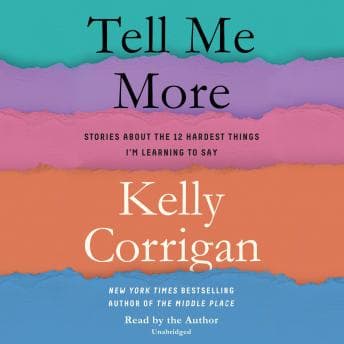
I wasn't expecting to get wrecked by a 4.5-hour essay collection on a Wednesday morning. I'd queued this up as filler between finishing the latest Murderbot novella and starting a longer sci-fi series. Light commute snack, right? Then Kelly Corrigan hit me with her essay on "I Was Wrong" — about how she completely botched a family conflict and had to reckon with the fact that saying sorry isn't actually the same as accountability — and I missed my stop. Actually missed my stop. Mountain View sailed right past me while I sat there like an idiot processing my own relationship with apologies.
The Engineering of Saying Hard Things
The premise is deceptively simple: twelve phrases, twelve essays. "I don't know." "No." "Tell me more." "I was wrong." "I love you." Each one gets unpacked through Corrigan's own life — her marriage to a husband she describes as preoccupied (relatable), her two teenage daughters who are, by her own admission, mercurial (also relatable, I was one), and her friendships that have weathered some genuinely hard stuff including cancer and infertility.
What surprised me is that the structure actually works as an organizational framework rather than feeling gimmicky. It's like... okay, tech metaphor incoming... it's basically an API for human communication. Each phrase is an endpoint, and Corrigan's showing you what happens when you actually call it correctly versus when you've been sending malformed requests your whole life. The essay on "No" — where she studies her mother's almost supernatural ability to set boundaries and be completely fine with being unpopular — genuinely changed how I think about my own inability to decline code review requests at 9 PM.
The "Tell Me More" essay is the one that gives the book its title, and it's quietly the best piece in the collection. Corrigan learns something fundamental about listening from her facialist named Tish. A facialist. Not a therapist, not a guru. The woman who does her face. There's something so perfectly honest about that — the idea that wisdom about human connection shows up in the most mundane places.
Author-Narrated and It Actually Works
So here's the thing about author-narrated audiobooks: they're a coin flip. Half the time you get someone reading their own book like they're presenting quarterly earnings. Corrigan is the other half. Her delivery has this quality where she sounds like she's telling you these stories over wine at her kitchen table, and she keeps catching herself mid-thought, adding little asides that feel genuinely spontaneous even though they're obviously written. There's a self-deprecating humor to her timing that a professional narrator might've polished right out of existence.
She doesn't do voices or dramatic shifts. This isn't a Ray Porter situation (obviously). But for personal essays? The warmth is the performance. You can hear when she's choking up slightly during the harder passages about grief and loss, and it doesn't feel manufactured. It feels like someone who's still processing this stuff in real time.
At 4 hours 26 minutes, I finished this in exactly 2 commutes. Which is both a pro and a con — I wanted more from some essays and felt like she was just scratching the surface. The one about uncertainty ("I Don't Know") moves between uninvited party snubs and a friend's infertility struggle, and the tonal shift gave me whiplash. Like she had too much to say and not enough runway.
Who This Is Actually For (And Who Should Hard Pass)
Perfect for: train, gym. Skip for: deep work. This is comfort listening with actual substance underneath — not a business book pretending to have 12 chapters of insight when it has one. (Looking at you, every startup book ever.) Each essay genuinely earns its spot.
But if you need plot, conflict arcs, or anything resembling a traditional narrative structure, you're going to be frustrated. This is a memoir-in-fragments, not a story. And if you're allergic to sincerity — like, if earnest reflection on marriage and parenthood makes you want to skip ahead — this will feel like being trapped at brunch with someone's very emotionally available mom.
Kevin heard me laughing at the "No" essay and asked what I was listening to. I tried to explain it and he gave me the look he gives when I recommend optimization podcasts. But honestly? The ROI on this audiobook is better than most self-help books three times its length. Corrigan identifies a real problem — we're terrible at saying the things that matter most — and actually gives you something to work with. Cry Like a Man is working the same problem from a completely different angle — less kitchen-table warmth, more raw reckoning — and the two back-to-back would make a genuinely uncomfortable but worthwhile commute double feature.
I put it at 1.25x speed, which felt right. Any faster and you lose the conversational pacing that makes it work. Any slower and you'll notice the thinner essays dragging.
Not life-changing. But life-nudging, in the best way. And sometimes that's exactly what a Tuesday 6 AM train ride needs.