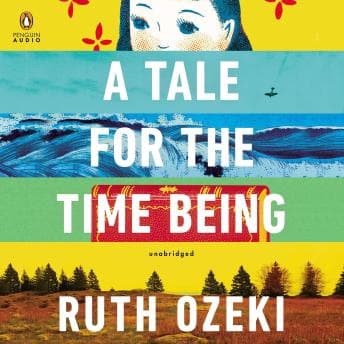

There's something almost transgressive about an author reading their own novel. Most of the time, it's a disaster—writers are writers, not performers, and the result sounds like someone reading their grocery list with slightly more emotion. But Ruth Ozeki? She's the exception that makes me rethink the whole rule.
I started this one during my evening walks along the lakefront with Denise. Fourteen hours is a commitment, and I'll be honest—I wasn't sure a story split between a suicidal Tokyo teenager and a novelist finding mysterious debris on a Pacific island was going to hold together. The premise sounds like a creative writing workshop pitch that should've been talked out of. I was wrong. Spectacularly wrong.
When the Author Becomes the Text
Ozeki reading her own work isn't just narration—it's interpretation in the truest sense. She wrote these sentences knowing exactly where the weight should fall, and you can hear it. Nao's voice—this sixteen-year-old Japanese girl documenting her great-grandmother's life before she plans to end her own—could've been a disaster in the wrong hands. Too precious. Too performative. Instead, Ozeki gives her this cheeky, wounded quality that made me stop grading papers more than once just to listen.
The Japanese phrases land perfectly, obviously. But it's more than pronunciation. There's a musicality to how she moves between English and Japanese that feels like code-switching rather than translation. My students do this constantly—slipping between languages mid-sentence—and Ozeki captures that rhythm exactly.
And Ruth the character—yes, there's a novelist named Ruth in this novel written by Ruth, and no, it's not as precious as it sounds—she reads with this dry, self-aware humor that keeps the metafictional elements from becoming insufferable. (Don't tell my AP Lit class I said "metafictional elements." They already think I'm pretentious enough.)
The Slow Burn That Earns Its Length
Fourteen hours. That's a lot of audiobook. I've listened to shorter Dickens adaptations. But here's the thing—this book earns every minute because it's actually about time. Not in a gimmicky way, but structurally. Nao's diary entries. Ruth's present-day discovery. A Buddhist nun who's lived over a century. The 2011 tsunami that connects them across the Pacific.
Ozeki weaves in quantum physics and Zen Buddhism and World War II kamikaze pilots, and somehow it never feels like she's showing off. It feels like she's genuinely trying to understand something about how moments connect across decades and oceans. The pacing is deliberate—some might say slow—but I'd argue it's meditative. There's a difference.
I listened to the bullying scenes while walking past the high school where I teach. Nao's classmates do things to her that made my stomach turn, and Ozeki's narration doesn't flinch from it. She doesn't dramatize it either. Just reads it with this quiet devastation that's somehow worse. I had to pause and watch the waves for a while after one particular section.
Who Should Listen (And Who Should Keep Walking)
Look, if you need plot to happen every five minutes, this isn't your book. If ambiguity frustrates you, if you want neat endings tied with bows, skip it. My students who only read "for the vibes" would probably zone out. My students who actually engage with texts? They'd love this.
This is for people who read Murakami and wanted something with more emotional anchor. My Confession has that same grounded quality—surreal elements that never float away from real human stakes. For anyone who's ever wondered how a stranger's story becomes part of your own. In Pieces does something similar with how we inherit other people's pain and make it meaningful. For listeners who understand that sometimes a book about loneliness is the least lonely thing you can experience.
The production is clean—no weird audio artifacts, no background noise, just Ozeki's honey-smooth voice and the occasional moment where you can almost hear her smiling at her own jokes.
Worth the Faculty Meeting Cover
I finished this during one of Principal Martinez's budget presentations. (Sorry, Principal Martinez. The literacy initiative discussion was very important, I'm sure.) And I sat there thinking about how Nao's diary, floating across an ocean in a Hello Kitty lunchbox, somehow felt more real than the spreadsheet on the projector.
Ozeki was a Booker Prize finalist for this, and you can hear why. It's not a perfect book—the quantum physics tangents occasionally feel like they're reaching—but it's a deeply human one. And her narration doesn't just serve the text. It illuminates it.
This is why we still read. This is why we still listen. Some stories need to be savored at 1.0x, every pause earning its silence.