
"Your cervical fluid is not discharge. It's a biological signal."
Somewhere around hour two, Melissa Costea says this line with such calm conviction that I actually paused mid-step on my walk from Caltrain to the office and just... stood there. In Mountain View. At 8:47 AM. Processing the fact that I'm a 29-year-old woman with a CS degree who has been casually misinformed about her own body for her entire adult life.
Look, I picked this up for reasons that are between me and Kevin and our future timeline, but I was not prepared for this book to make me genuinely angry — not at the author, but at the entire system that somehow never taught me any of this.
Your Body Is a Distributed System and Nobody Gave You the Docs
TL;DR: Worth your commute — but maybe not at 6AM on a packed train.
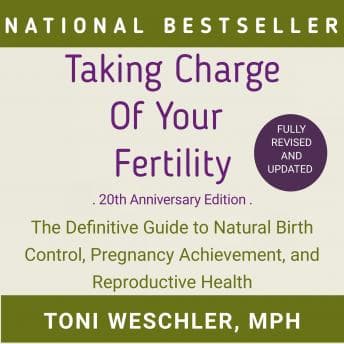
Here's the thing. Toni Weschler basically wrote the missing documentation for the human reproductive system. And I mean that in the most complimentary way possible. This is the equivalent of someone finally writing clear, comprehensive API docs for a system that half the world's population runs on, and the other half interacts with daily, and somehow nobody had properly documented it until 1995.
The Fertility Awareness Method (FAM) she teaches is surprisingly systematic — you're tracking three primary biomarkers (waking temperature, cervical fluid, cervical position) and cross-referencing them to understand where you are in your cycle. As someone who debugs distributed systems for a living, I genuinely respect the methodology here. It's observational, data-driven, and reproducible. She walks through the rules for both avoiding and achieving pregnancy with the kind of specificity I wish more tech documentation had.
The six new chapters in this 20th anniversary edition cover PCOS, endometriosis, ovarian cysts, hormone balancing, miscarriages, and idiopathic infertility. That's a lot of ground. And Weschler handles the heavier topics — particularly the miscarriage chapter — with a directness that I appreciated. She doesn't sugarcoat, but she also doesn't catastrophize. It's clinical without being cold.
The Audiobook Problem (And It's a Real One)
Okay, here's where I have to be honest. This book has charts. Lots of charts. Temperature charts, cervical fluid pattern charts, sample cycles, annotated examples. The print edition is apparently loaded with visual aids that are — from what I gather — pretty essential to actually learning FAM correctly.
You don't get those on audio. You just don't.
Melissa Costea does her best. Her narration is warm, steady, and she reads through the data-heavy sections without making them feel like a terms-of-service agreement. She's got this approachable-professor energy that keeps you engaged even when the content is dense. But there are stretches — particularly in the chapters explaining how to read your own charts — where I felt like I was trying to learn Kubernetes from a podcast. You can absorb the concepts, but you're going to want the visual reference material to actually implement.
I'd rate Costea a solid performer here, not flashy, but well-suited to the material. She doesn't try to make it dramatic or overly enthusiastic. It's health education delivered like health education should be — clear, confident, and respectful of your intelligence.
Who This Is Actually For (And Who Should Grab the Print Version Instead)
Perfect for: A first pass if you want to understand the framework, the philosophy, and the science behind FAM. Also genuinely useful for anyone who just wants to understand how reproductive health actually works — whether you're trying to conceive, trying not to, or just tired of not understanding your own body.
Skip for: Actually learning to chart. I'm serious. Get the audiobook AND the print copy (or at minimum, download the companion materials). Trying to learn temperature charting purely through audio is like trying to learn git rebase from someone describing it over the phone.
The ROI on this audiobook is high if you treat it as the lecture component of a course where the textbook is the print edition. On its own? You'll come away informed and probably a little outraged at your sex-ed curriculum, but you won't be fully equipped to practice FAM independently.
I listened at 1.25x — this is not a 1.75x business book situation. The medical terminology and methodology sections need a bit more breathing room. Costea's pacing is already efficient; speeding her up much more turns the detailed sections into a blur.
Committing This One to Long-Term Memory
I finished this across about five commutes and one very late Sunday night where Kevin fell asleep and I kept listening in bed, getting progressively more frustrated that nobody teaches this stuff in school. This book has been in print for 20 years. That same frustration with how little we're taught about our own bodies — and how much we absorb instead from cultural noise — is at the center of Intuitive Eating, which I had a similarly late-to-the-party reckoning with. Twenty. And most of the women I know have never heard of it.
It's not perfect as an audiobook — the format genuinely limits it. But the content? The content is essential. Weschler built something that should be standard reading, and the fact that it took me until almost 30 to find it says more about our health education system than it does about me.
Get the audio for the knowledge. Get the print for the practice. Do both.









