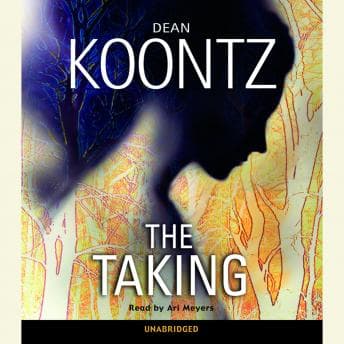
I was reshelving the horror section at the library last Tuesday - after close, obviously, because that's when the building gets properly atmospheric - when I decided to finally give The Taking a real listen. Earbuds in, fluorescent lights off except for the emergency exit glow, just me and Koontz and the sound of rain starting up outside like the universe had read the back cover.
That opening sequence. The luminous silver rain, the wrong smell hanging in the air, the way Molly and Niel can't articulate what's off but know - bone-deep know - that something has ended. This understands that horror isn't about gore - it's about dread. Koontz builds the first act the way a good ghost story should be built: slowly, with fog, with the particular terror of a world that looks almost normal but isn't. The small California mountain town losing its connections one by one - TV, radio, phone, internet - is more unsettling than any jump scare I've ever encountered, because it's the silence that gets you. The absence of the world. That creeping sense of isolation - the world going quiet before something terrible fills the silence - is something I kept thinking about when I reviewed Wife Between Us, which builds its dread through a different kind of absence: the things a narrator refuses to say.
Where Koontz Gets It Right (And He Really Does)
The fog-as-labyrinth is the book's best idea. Familiar streets becoming a ghostly maze is such an old horror move, and Koontz knows it, and he does it anyway because he knows why it works. The alien-possessed zombie sequences hit differently than standard invasion fiction - there's something about the specific wrongness of a known face with something else behind the eyes that Koontz leans into hard. And the decision to keep the scope intimate - this isn't a global disaster novel, it's a neighborhood disaster novel - is smart. You feel the apocalypse at human scale, which is the only scale that actually frightens anyone.
The religious undertones are doing real work here too. Koontz is unsubtle about it, but unsubtle isn't always wrong. The children-as-protected element, the sense that something is being sorted and judged - it creates a specific flavor of cosmic dread that I found genuinely unsettling. My podcast listeners are going to love this, or at least the first two-thirds of it.
Ariadne Meyers and the Silly Voices Problem
Here's where I have to be honest with you. Meyers won an Earphones Award for this, and I can hear why - her handling of the post-apocalyptic atmosphere is genuinely good. The narration during the fog sequences has this muted, gray-purple quality that matches the prose. She gets the dread. She understands what Koontz is doing with the rain and the silence.
But. Some of the character voices. The townspeople, the neighbors Molly and Niel gather around themselves - a few of them tip into something that broke the spell for me, this slightly theatrical quality that pulled me out of the library's emergency-exit glow and back into my own head. It's not consistent - the alien-possessed characters she handles with appropriate wrongness, and Molly's internal voice stays grounded throughout. But the moment a secondary character opened their mouth and I thought 'that's a voice,' rather than just hearing a person, something was lost. Good horror narration should be invisible. Meyers is visible in spots.
Not a dealbreaker. But if you're coming from other Koontz audiobooks with smoother ensemble work, calibrate your expectations.
For the Catalog and the Skeptics
The weak character development complaints I've seen floating around are... not wrong, exactly, but I think they're missing what kind of book this is. Molly and Niel are vessels for the experience more than they're fully realized people. Koontz is interested in what humans do when the world ends, not in who those humans were before. If you need deep interiority, this isn't your book. If you need the fog and the lights in the trees and the specific horror of a community trying to hold itself together while something hunts it - this delivers.
If you scare easily, skip. If you don't, you need this. Shirley (my cat) was unimpressed. I was terrified. I also turned my phone flashlight on at some point while standing in the dark library stacks, which is exactly the coward behavior I've accepted as part of my relationship with good horror audio.