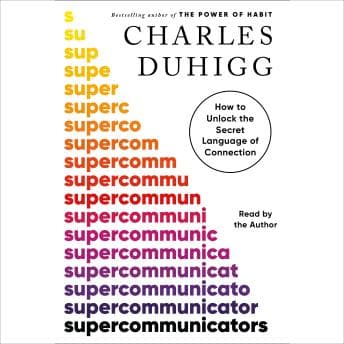

This book could've been a blog post. But it's a pretty good blog post, stretched across 7.5 hours.
Look, I actually like Duhigg. The Power of Habit lived on my phone for a full year because I kept recommending it to people and re-listening to the habit loop sections. So when Supercommunicators dropped, I queued it up for a Monday morning Caltrain ride expecting that same dopamine hit of "oh, THAT'S why humans do that weird thing."
What I got was... fine. Genuinely fine. Not bad. Not life-changing. The audiobook equivalent of a well-seasoned chicken breast.
The Three-Conversation Framework Is Actually Useful
TL;DR on the core idea: every conversation is one of three types — practical ("What's this really about?"), emotional ("How do we feel?"), and social ("Who are we?"). Miscommunication happens when you're having an emotional conversation and the other person is trying to solve a practical problem. This is basically the "are you venting or do you want a solution" meme, but formalized with actual research behind it.
And honestly? The framework stuck with me. Kevin and I had a fight last Tuesday about whether we should move closer to Mountain View (practical conversation) that was actually about whether I'm prioritizing work over us (emotional conversation). I literally paused mid-argument and said "wait, we're having two different conversations right now" and he looked at me like I'd grown a second head. But it worked. So... ROI confirmed, I guess.
The jury room story that opens the book is genuinely good storytelling — one juror methodically brings a divided group to consensus not by arguing harder but by matching the type of conversation each person needs. And the section about a CIA officer recruiting a foreign agent by reading conversational cues had me leaning forward in my seat at 6:47 AM, which is saying something.
Duhigg Narrating Duhigg: Competent But Not Ray Porter
Here's the thing about author-narrated nonfiction: when the author genuinely cares about the material, you can hear it. Duhigg sounds curious. He sounds like a guy who finds this stuff fascinating and wants you to find it fascinating too, and that sincerity carries the narration further than vocal range ever could.
But — and I say this with love — the man is not a voice actor. There's no differentiation when he's voicing different people in the anecdotes. The surgeon trying to convince a cancer patient to take the less risky treatment sounds exactly like the Big Bang Theory writers' room conversation, which sounds exactly like the marriage counselor segment. It all kind of blurs together into "Charles Duhigg speaking earnestly about interpersonal dynamics."
At 1.5x speed (my default), the pacing felt right. I bumped to 1.75x during some of the more padded middle sections where he's belaboring a point that landed two examples ago. You know the pattern — business nonfiction authors who nail a concept in one story but then give you three more Just To Be Sure. I don't need four case studies to understand "match the conversation type." I got it after two.
The Padding Problem
This is my core frustration. Molecule of More had the same over-explanation problem in its middle third, except the underlying science was dense enough that I forgave the padding — here, the core idea is simple enough that the repetition just stings. The actual actionable content here is maybe 3 hours of material. The framework is clean. The research is solid (he cites real studies, not just "Harvard researchers found..."). The Big Bang Theory writers' room stuff about how the show's creators learned to have better creative arguments? Genuinely interesting and specific enough that I'd share it at a dinner party.
But between those gems, there's a lot of repetition dressed up as new anecdotes. By hour 5, I was on autopilot, and not the good kind where you're absorbed — the kind where you realize you've been staring at someone's laptop screen for three stops and can't remember the last ten minutes of audio.
I finished it in 3 commutes. Could've done 2 if the middle didn't sag.
Who Gets the Most Out of This
Perfect for: train, gym. Skip for: deep work (you won't need that much focus). If you're an engineer or anyone who defaults to problem-solving mode when someone just wants to be heard — and let's be honest, that's like 80% of us in tech — the three-conversation framework alone justifies the listen. If you've already read a shelf of communication books (Crucial Conversations, Nonviolent Communication, etc.), this will feel like a remix of ideas you've encountered before, just with better stories wrapped around them.
Kevin would probably get more out of this than I did, but he'll never listen to it because the title sounds like a LinkedIn influencer's brand. Fair.
The Commit Message
Solid framework, good stories, too much padding. The ROI on this audiobook is positive but not spectacular — you'll walk away with one genuinely useful mental model and a handful of anecdotes worth retelling. Just don't expect the same hit as The Power of Habit. That book rewired how I think. This one gave me a decent debugging tool for arguments with my boyfriend.