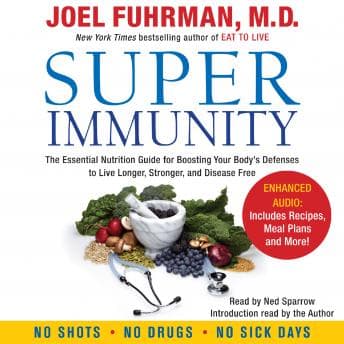

"Eat more micronutrients per calorie, not more calories with micronutrients." That line hit me around the 45-minute mark, and honestly, it's the sentence that justifies the entire listen. The rest of the book? It's Fuhrman unpacking that idea from every possible angle for another five hours.
Bottom line: This is a solid 3.5-star health book with maybe 90 minutes of genuinely useful nutritional science stretched across six hours. At 2.0x speed, I got through it during a Sunday meal prep session - which felt weirdly appropriate since half the book is telling you to eat more cruciferous vegetables while I'm literally chopping broccoli.
My Parents' Immune System Was Kimchi and Stubbornness
Here's what got me about Fuhrman's core thesis. He argues that the standard American diet suppresses immune function at a cellular level, and that a nutrient-dense, plant-heavy diet can essentially supercharge your body's ability to fight off infections and even cancer. The science he cites - studies on green cruciferous vegetables increasing natural killer cell activity, data on mushrooms (specifically white button and shiitake) enhancing immune surveillance - this stuff is genuinely interesting. He walks through the mechanisms of how phytochemicals in berries, onions, and seeds interact with immune pathways in ways that go beyond the usual "eat your vegetables" handwaving.
But here's the thing. My parents ate tons of vegetables. Fermented foods, garlic by the fistful, greens at every meal. They didn't need a nutritarian food pyramid or Fuhrman's H=N/C formula (health equals nutrients divided by calories). They just ate the way their parents ate, worked brutally hard, and rarely got sick. This is what my parents did instinctively. Now it has a TED talk.
That said - and I'll give Fuhrman credit here - the specific research on how cooking methods affect nutrient bioavailability, why raw and cooked greens serve different immune functions, and the data on reducing antibiotic use through diet... that's where the book earns its keep. Chapter 4's breakdown of studies comparing flu incidence in plant-heavy vs. standard American diet groups is the kind of data I actually want from a health book.
The Fuhrman Sales Funnel Problem
Where this book loses me is where most diet books lose me: it reads like a conversion pitch. Fuhrman is selling "nutritarianism" as a lifestyle brand. Every anecdote is a patient who was sick, adopted his protocol, and now runs marathons. Every study conveniently supports his thesis. There's zero acknowledgment of limitations, edge cases, or the massive compliance problem with plant-based diets in the real world. The execution gap between knowing and doing is something 4 Disciplines of Execution actually takes seriously — and reading it alongside a book like this one makes Fuhrman's hand-waving on implementation feel even thinner by comparison.
I've consulted with three health-adjacent startups. The ones that survived understood that behavior change is the hard part, not the science. Fuhrman gives you the science (sometimes repetitively - I lost count of how many times he referenced the ANDI scoring system) but basically hand-waves the implementation challenge with a two-week meal plan and 85 recipes that assume you have unlimited time and a Whole Foods next door. My parents worked 14-hour days. They weren't making cashew cream dressings.
The recipe section, by the way, is genuinely less useful in audio format. Listening to someone read ingredient lists at any speed is painful. Skip to chapter 5. Thank me later. That's where the actual immune science lives, not the lifestyle marketing.
Ned Sparrow Does Exactly What This Book Needs
Ned Sparrow's narration is - and I mean this as a compliment - boring in the right way. His voice is warm, clear, low-key. He doesn't try to make a paragraph about oxidative stress sound exciting. He reads it like your smart friend explaining something over coffee. For a prescriptive health book, that's exactly the energy you want. No dramatic pauses before revealing that blueberries are good for you. No breathless urgency about kale. Just steady, inviting delivery that makes dense nutritional data feel accessible rather than preachy.
The production is clean and straightforward. No sound effects, no music, no frills. Just Sparrow and Fuhrman's words. At 1.5x, it's the sweet spot - fast enough to cut the padding, slow enough to catch the study citations when they matter.
Who Gets ROI on This Listen
If you're already eating well and want the scientific backing for why - this is your book. If you're a startup founder surviving on Soylent and cortisol, chapters 3 through 6 might genuinely change how you think about food and immune function. If you're looking for a practical day-one meal plan in audio form, you're going to be frustrated.
The key takeaway is worth the listen. The other 7 hours? Not so much. But that takeaway - that immune function is dietary, not pharmaceutical - is worth sitting with. Especially right now.
Jenny would say I'm being harsh. Jenny is right. But she'd also agree the recipe chapters should've been a PDF companion, not narrated content.