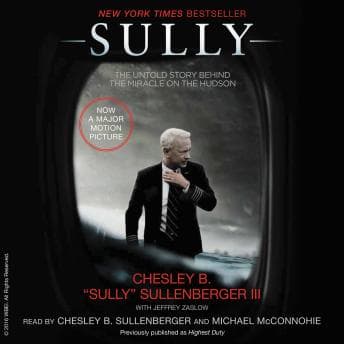

"I had forty-two seconds."
That's roughly how long Chesley Sullenberger had to decide the fate of 155 people after both engines on US Airways Flight 1549 ingested a flock of Canada geese at 2,818 feet over the Bronx. Forty-two seconds. I was listening to this at midnight, sitting in my home office after a strategy deck that took me eleven hours to build for a client who'll probably ignore half of it. And I'm thinking: I spent more time choosing the font for my executive summary than this man had to choose a river.
That kind of perspective adjustment is what makes this audiobook worth your time. Most of it, anyway.
A Dry Cleaner's Son Recognizes That Work Ethic
Here's what surprised me. The Hudson River landing gets maybe 15-20% of this book. The rest is Sully's life story - growing up in Denison, Texas, learning to fly at age sixteen, his Air Force career, the decades of commercial aviation that preceded January 15, 2009. And this is where I found myself nodding along at 2.0x speed because this man is basically describing my parents' operating philosophy without knowing it.
Sully talks about how he studied every crash report he could find. How he mentally rehearsed emergency scenarios during routine flights. How he maintained his skills with an almost obsessive discipline long after most pilots would've coasted on seniority. My mother ironed shirts for thirty years and could spot a collar crease at six feet. Different industry, same principle: mastery comes from showing up with full attention every single day, even when no one's watching. Especially when no one's watching.
The book jumps around in time - childhood memories woven between the NTSB investigation, his marriage to Lorrie, the aftermath of sudden fame. Some listeners find this structure frustrating. I didn't. It actually mirrors how a consultant thinks about case studies. You don't just analyze the crisis event. You analyze the decades of preparation that made the right decision possible in forty-two seconds.
But let me be real: the middle sections drag. His reflections on airline industry deregulation and pilot pay cuts are important context - stuff I care about as someone who's consulted for transportation companies - but they read like a white paper inserted into a memoir. At 1.0x, I'd have bailed. At 2.0x, they're tolerable. At 1.5x, probably the sweet spot for most people.
Two Narrators, One Problem
Michael McConnohie handles the bulk of the narration, and he's competent. Professional. Clear diction, good pacing. But here's the thing - he reads Sully's deeply personal memories with the same register he'd use for an annual report. When Sully describes watching his father struggle with depression, or the quiet erosion of his marriage under the weight of an airline pilot's schedule, McConnohie delivers it all at the same emotional altitude. Flat and level. Which I guess is appropriate for a pilot book, but it kept me at arm's length for hours.
Then the last forty minutes happen.
Sully narrates the final section himself, and it's like someone switched the audio from a corporate training video to a real conversation. His voice cracks slightly when talking about what the experience meant to him. You hear the pauses where he's choosing words carefully - not because someone wrote them for him, but because he's genuinely searching for the right ones. It's the difference between reading someone's memoir and sitting across from them at a bar.
I actually slowed down to 1.5x for that section. That's the highest compliment I can give.
The Consulting Framework Nobody Asked For
Bottom line: this book is a case study in what I'd call "preparation ROI." Every dollar Sully invested in studying, every hour he spent in simulators, every crash report he read - it all compounded into 208 seconds of perfect execution on the Hudson River. The return was infinite. 155 lives.
The key takeaway is worth the listen. The other 7 hours? Not so much. There's a solid four-hour book buried in here. Jeffrey Zaslow (who co-authored The Last Lecture, another book about legacy) clearly helped structure the narrative, but the padding shows. The self-made-through-relentless-discipline arc reminded me of Benjamin Franklin: Made in America, another biography where the decades of quiet preparation matter far more than the famous moments everyone actually remembers. We didn't need three chapters on the media circus aftermath. We got it. America loved Sully. Move on.
Who should listen: Anyone in a high-stakes role where preparation is the product - pilots, surgeons, crisis managers, or frankly anyone who needs a reminder that competence isn't accidental. Also, if you saw the Hanks movie and want the real version without Hollywood's need to turn the NTSB into villains.
Who should skip: If you're looking for a page-turner about the landing itself, watch the movie. This is a slow build about a life, not an action sequence.
Skip to the Last 40 Minutes. Then Listen to the Whole Thing.
I know that sounds contradictory. But hear me out. Listen to Sully's own narration at the end first. Get his voice in your head. Then go back to the beginning with McConnohie and let the full story fill in around it. Jenny says I overcomplicate everything. Jenny is right. But it works.



![Steve Jobs [unabridged audiobook] audiobook cover](/_next/image?url=https%3A%2F%2Fcovers.audiobooks.com%2Fimages%2Fcovers%2Ffull%2F9788499923406.jpg&w=1920&q=75)