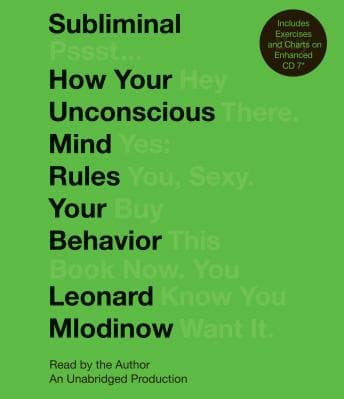

A theoretical physicist has no business being this good at explaining psychology. And yet here we are.
I picked up Subliminal during one of those late-night cooking sessions where I'm making dal that nobody asked for and nobody else will eat, and I needed something that would keep my brain engaged while I monitored the tempering of cumin seeds. The last book that kept me company through a solo kitchen project was No Animal Food and Nutrition and Diet with Vegetable Recipes, which is a very different kind of read but shares that same quality of being genuinely engaging without demanding your full visual attention. Mlodinow's book about the unconscious mind turned out to be the perfect companion — dense enough to chew on, light enough that I didn't burn the tadka.
The Physicist Who Reads Minds Better Than Most Psychologists
Here's what makes Mlodinow unusual in the pop-psychology space: he's not a psychologist. He's a theoretical physicist from Caltech who co-wrote a book with Stephen Hawking. And somehow, that outsider perspective is exactly what makes Subliminal work. He approaches unconscious cognition the way a physicist approaches a problem — with genuine curiosity about mechanism, not just phenomenon. Where a lot of popular psychology authors (cough Malcolm Gladwell cough) cherry-pick studies to support a sexy thesis, Mlodinow is more interested in the actual architecture of how your subliminal mind operates.
The research he covers spans roughly two decades of neuroscience and cognitive psychology — implicit bias, confabulation, memory distortion, the ways we construct narratives about our own motivations that are essentially fiction. I found myself asking: why does this feel fresher than books by actual psychologists covering the same territory? And I think the answer is that Mlodinow doesn't have disciplinary loyalty. He'll pull from social psychology, neuroscience, evolutionary biology, even marketing research, and treat them all as equal evidence. For someone like me who lives in the psychology department and sees the territorial turf wars up close — refreshing doesn't begin to cover it.
One example that stuck with me: his discussion of how we unconsciously adjust our tipping behavior based on factors we'd swear don't influence us — the weather, whether the server touched our arm, the shape of the check presenter. The research actually shows that people will confidently explain their tipping decisions with post-hoc rationalizations that have nothing to do with the actual drivers. This is a fascinating case study in what psychologists call confabulation, and Mlodinow explains it with the precision of someone who understands that the math matters but the story is what you remember.
When the Author Is the Narrator (And It Actually Works)
Let me be honest: author-narrated audiobooks are a gamble. Most academics sound like they're reading their grocery list with vague resentment. Mlodinow is... not that. His delivery has this dry, almost deadpan quality that mirrors the wit in his writing. He sounds like a very smart person telling you something interesting at a dinner party — not performing, just talking. There's a warmth there that you wouldn't necessarily expect from a physics PhD.
That said, he's not a professional voice actor. The pacing is sometimes a touch flat during the more data-heavy sections, and there's a sameness to his cadence that made me drift during a couple of chapters on visual perception. I bumped it up to 1.25x around hour three, and honestly that felt like the sweet spot — enough momentum to carry through the denser material without losing the conversational quality.
At just under eight hours, it's a reasonable commitment. Not a weekend binge, but not a two-week slog either. The kind of book where you think "one more chapter" and then it's midnight and you're googling implicit association tests.
The Comparison That Matters
If you've read The Drunkard's Walk — Mlodinow's book on randomness and probability — you already know his style. Subliminal is the natural companion piece. Where Drunkard's Walk asks "why do you think you understand chance?" this one asks "why do you think you understand yourself?" Same intellectual energy, same accessible prose, different target. I'd actually recommend reading Drunkard's Walk first if you're new to Mlodinow, not because it's prerequisite material but because it calibrates your expectations for his voice. You go in knowing he's a physicist playing in your sandbox, and you're less likely to bristle when he simplifies something you know is more complex.
Compared to Kahneman's Thinking, Fast and Slow — the obvious shelf neighbor — Mlodinow is lighter, shorter, and more narrative-driven. Less comprehensive, yes. But also less likely to make you feel like you're doing homework. The protagonist exhibits classic "gateway drug" energy: this is the book you give someone before Kahneman.
Who This Is For (And Who Should Skip)
If you're a psychology researcher, you probably know most of this material already. But Mlodinow's framing might still give you something — a new way to explain these concepts to your students, or to your mother who keeps asking what you actually study. If you're a general listener interested in why you do the things you do, this is genuinely one of the better entry points. It won the PEN/E.O. Wilson Literary Science Writing Award, which — speaking as someone whose papers win exactly zero awards — actually means something.
Skip it if you want prescriptive self-help. Mlodinow is describing the machinery, not handing you a wrench. My therapist would have thoughts about this book, mostly positive, but she'd note that knowing about your biases doesn't automatically fix them. (Believe me, I know.)
My Case Notes
Psychologically, this tracks. The science is solid, the writing is sharp, and the author-narration adds an intimacy that a hired voice wouldn't replicate. It's not perfect — some chapters blur together, and I wanted more on cross-cultural differences in unconscious processing — but it's the rare pop-science book that respects both the research and the reader. The dal turned out great, too.