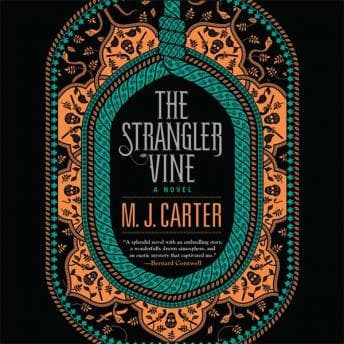

Look, I have a complaint. I've spent twenty years trying to get teenagers to care about colonialism as a literary subject - the power dynamics, the moral rot, the way empire eats people from the inside out - and M.J. Carter just waltzed in and made it thrilling. Where was this book when I was trying to teach Heart of Darkness to thirty-two kids who'd rather be on their phones? I could've assigned this instead and actually seen some heads lift off desks.
I finished The Strangler Vine during a Saturday morning walk along the lakefront with Denise, who kept asking why I was muttering "oh come on" at the water. She thought I was upset about the geese again. I was not upset about the geese. I was upset because Carter kept yanking the rug out from under me just when I thought I'd figured out where Blake and Avery were headed.
Kipling's Buddy Cop Novel (With Better Politics)
Here's what Carter does that I genuinely admire: she takes the bones of a Victorian detective story and fills them with something darker and more honest than the genre usually allows. William Avery is our entry point - young, broke, naive, the kind of Englishman abroad who still believes the imperial project is basically decent. Jeremiah Blake is his opposite in every way that matters: older, disillusioned, gone so far native that the British establishment doesn't quite trust him anymore. Carter knows colonial India so thoroughly that the details don't feel like research, they feel like weather. The sticky heat of Calcutta, the way the British social hierarchy reproduces itself thousands of miles from home with even more vicious precision.
The missing writer they're hunting - Xavier Doyle, who's been documenting Calcutta's hypocrisies - functions less as a mystery and more as a mirror. Everyone Blake and Avery talk to reflects a different face of what the Empire actually does to people. The Thuggee subplot could've been cheap exoticism, and I was bracing for it, but Carter treats it as something more complicated: a real phenomenon tangled up with British paranoia and political convenience.
The book does drag in spots - there's a stretch in the middle where Avery's internal hand-wringing about his loyalties circles back on itself one too many times. And that ending. I understand why some listeners feel shortchanged. Carter builds this elaborate, suffocating web of colonial conspiracy and then resolves it with a quickness that doesn't quite match the slow, deliberate burn of everything before it. It's like a Faulkner sentence that just... stops. Not the worst sin, but you feel the truncation.
Alex Wyndham Earns His Rupees
Here's where I have to give credit where it's due, and I mean substantial credit. Alex Wyndham doesn't just narrate this book - he populates it. We're talking a dozen-plus distinct voices, and the man draws a clear vocal line between every stratum of 1837 India. His Avery is all clipped, earnest Englishness, the kind of voice that still believes in playing fair. His Blake drops lower, rougher, with something restless underneath - you can hear the man who's seen too much to be polite about it anymore. Wyndham uses silence the way a good actor uses stillness - to let tension build without overselling it.
The Indian characters get their own distinct treatment, and this is where things could've gone badly wrong. But Wyndham handles the accents with what sounds like genuine care rather than caricature. The shift between a Calcutta merchant and a British colonel's wife happens without any awkward gear-grinding. Ten hours and forty-six minutes of this, and I never once lost track of who was speaking. At 1.0x, naturally - Wyndham's pacing is exactly why I gave it that patience.
Who Gets the Assignment
If you loved Patrick O'Brian's Aubrey-Maturin novels - that same odd-couple dynamic set against the machinery of empire - this is its spiritual successor, transplanted from the sea to the subcontinent. Fans of Amitav Ghosh's Sea of Poppies will find familiar ground in the colonial setting, though Carter's approach is more thriller than epic. Listeners who need constant action might get restless during the investigative stretches. This is a book that trusts you to pay attention, to pick up on the political undercurrents rather than having them spelled out. (Principal Martinez, if you're reading this: this is the kind of attention I was not giving your budget presentation last Tuesday.)
Skip it if you want a clean resolution. The ending earns maybe a B-minus, and I say that as someone who's generous with his grading. Though I'll say this: Book of Delights ruined me in a similar way — built up so much warmth and then just ended, like the author got up from the table mid-meal.
Worth the Lakefront Walk
An Edgar-nominated debut that takes colonial India seriously as both setting and subject, performed by a narrator who clearly did the work. It's not perfect - that ending still bugs me, and Avery can be a bit of a wet blanket before he grows into himself - but it's smart, atmospheric, and honest about the ugliness underneath the pith helmets. I'm already queued up for The Infidel Stain. Denise says I can listen on tomorrow's walk, as long as I stop muttering at the geese.