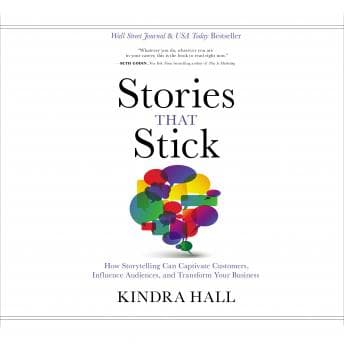

"Every business has stories. You're just not telling them."
That line hit me somewhere around hour two, crammed into a window seat on the 6:47 Caltrain, and I actually paused the audiobook to think about it. Not because it's some profound revelation - it's honestly kind of obvious - but because Kindra Hall delivers it with this calm certainty that made me realize I'd been guilty of exactly what she's describing. I spent last quarter writing a 40-page design doc for a distributed caching system, and the part that actually got leadership buy-in? A two-paragraph story about a customer who rage-quit our app during a 3-second timeout. The data was in the appendix. Nobody read the appendix.
So yeah. This book gets something right.
Four Stories, One Framework, Zero Fluff (Mostly)
TL;DR: Worth your commute, but at 1.75x.
Here's the deal. Hall breaks business storytelling into four categories: Value Story, Founder Story, Purpose Story, and Customer Story. Each gets its own section with a clear definition, examples, and a formula for constructing one. The Value Story section is the strongest - she walks through how a real estate company stopped leading with square footage and started leading with a story about a family finding their "forever kitchen," and the conversion difference was genuinely impressive. The Founder Story section uses examples from brands like Drift and others where the origin myth isn't just marketing fluff but actually shapes product decisions.
The framework itself is simple: every story needs an identifiable character, authentic emotion, a significant moment, and specific details. She calls it the "story gap" - the distance between where someone is and where they want to be. If you've done any product work, this maps directly to user journey thinking, which is probably why it clicked for me so fast.
But here's where I have to be honest. Around hour five, I started feeling the business-book-that-could've-been-a-blog-post itch. Not the whole thing - the core framework is solid and genuinely useful. But some of the case studies run long, and there's this pattern where she'll introduce a concept, give an example, reinforce the concept, give another example, and by the third pass I'm like okay, I get it, stories work. The ROI on this audiobook is high for the first 70%, then you're getting diminishing returns.
Kindra Narrating Kindra Actually Works
Author-narrated business books are a coin flip. Half the time you get someone who clearly should've hired a pro (looking at you, every tech CEO who thinks talking to an audience of 5,000 is the same as narrating for headphones). Hall is a professional speaker though, and it shows. Her delivery has this conversational warmth - like she's sitting across from you at a coffee shop explaining something she's genuinely excited about. It never feels like she's reading. The pacing is natural, she lands her punchlines, and when she tells the personal stories - especially the one about her early career struggles with selling - there's a vulnerability that a hired narrator couldn't have replicated.
That said, she's not Ray Porter. (Nobody is. This is my cross to bear.) Her range is essentially "enthusiastic Kindra" and "slightly more enthusiastic Kindra." For a business book, that's fine. You're not here for character voices. You're here for the content, and her energy keeps you locked in even at 1.75x.
The Part That Actually Changed How I Work
I wasn't expecting a practical takeaway from this, but the "specific details" principle stuck with me. Hall argues that the difference between a forgettable story and one that sticks (see what she did there) is granularity. Not "I was nervous before the presentation" but "I was gripping a lukewarm coffee so hard the lid popped off." She backs this up with her own research data on recall and persuasion, which - okay, it's not exactly peer-reviewed science, but the logic tracks. I've already started applying this to my sprint retros and incident postmortems. Kevin says I'm "weaponizing narrative" and I told him that's literally what the book recommends.
Compared to something like Made to Stick by the Heath brothers (which covers similar territory from an academic angle), Hall's book is more immediately actionable but less rigorous. If you want the research, go Heath. If you want to write a better Value Story by Friday, go Hall. I've found a similar divide with mindset-heavy reads like Psychology of Winning in the 21st Century — lots of conviction, not always the sharpest receipts, but the practical instincts hold up in the field.
Who Gets the Most Out of This
Perfect for: anyone who has to sell anything - products, ideas, budget requests, themselves. If you're in marketing, sales, or honestly any IC role where you need to influence without authority, this is genuinely useful. Also great for founders who are still leading pitches with TAM slides.
Skip for: deep work or bedtime. Not because it's bad, but because the value is in the frameworks, and you'll want to actually remember them. Also skip if you've already read five business storytelling books - you'll recognize the concepts.
I finished this in 3 commutes at 1.75x, and I've already gone back to re-listen to the Value Story section once. That's more than I can say for most business audiobooks cluttering my library.