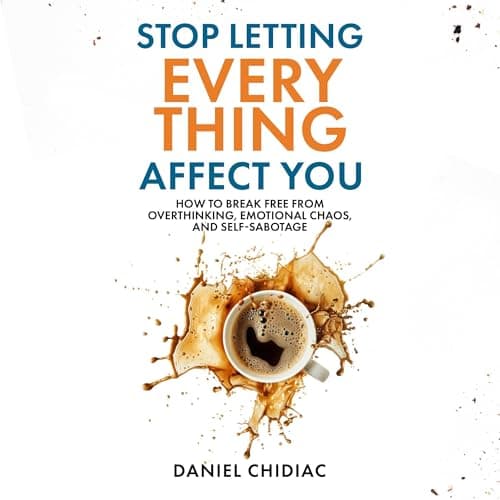

Look, I have a complaint. The title of this book is Stop Letting Everything Affect You, and I'm listening to it at 11 PM while stress-chopping onions for a chana masala that absolutely no one asked me to make at this hour - and the irony of being emotionally reactive about a book on emotional reactivity is not lost on me. My therapist would have thoughts.
Here's the thing about self-help books that target overthinkers: they have to walk an impossibly thin line. Too prescriptive, and you trigger the very analytical spiral you're trying to calm. Too vague, and the reader's brain goes, "Okay but how?" Daniel Chidiac lands somewhere in the middle, which is both his strength and his limitation.
The Psychology Actually Tracks (Mostly)
I went in skeptical. I always go in skeptical with self-help - occupational hazard of studying why humans do what they do for a living. But Chidiac's framework around emotional reactivity isn't pulled from thin air. The distinction he draws between real guilt and manipulation? That's straight out of the literature on cognitive distortions and boundary-setting. The research actually shows that people with high trait empathy do confuse manufactured guilt with genuine moral signals, and Chidiac articulates this in a way that doesn't require a psych degree to process.
What makes this book work where similar titles stumble is that Chidiac treats emotional detachment not as coldness but as a skill - something you practice, not a personality transplant. He explicitly addresses the fear that setting boundaries makes you a bad person, which is the exact cognitive trap that keeps people stuck. I found myself asking: why does this particular framing land better than, say, Mark Manson's take in The Subtle Art of Not Giving a Fck*? And I think it's because Chidiac doesn't perform irreverence. He's genuinely earnest. Almost disarmingly so.
That said - and this is where my researcher brain gets itchy - some of his claims about "proven strategies" lack the kind of sourcing I'd want. He'll state something about how the brain processes rejection or how overthinking physically manifests, and I'm sitting there with onion tears running down my face thinking, citation needed. It reads as wisdom-adjacent rather than evidence-based in places. Not wrong, necessarily. Just... unanchored.
Author-as-Narrator: The Wise Friend Problem
Chidiac narrates his own book, and at 3 hours and 44 minutes, it's a compact listen. His delivery is conversational - genuinely so, not the performative casualness you get from professional narrators trying to sound relatable. He talks to you like someone who's been through it and came out the other side, which works for this kind of content.
But here's where the "wise friend" energy becomes a double-edged sword. There's a sameness to his tone throughout. When he's discussing toxic relationship patterns versus mindset shifts versus boundary-setting, the emotional register barely changes. For a book about the full spectrum of emotional chaos, the delivery stays remarkably level. It's soothing, sure. But by hour two I caught my attention drifting - not because the content was bad, but because there wasn't enough vocal variation to signal "hey, this part matters more."
No sound effects, no music, no production tricks. Just Chidiac talking. Which is fine for focused listening but means you really do need to be paying attention. This isn't a background-while-doing-dishes audiobook (I tried, the chana masala suffered).
Where It Gets Stuck in Its Own Loop
The book covers a LOT of territory - overthinking, self-sabotage, boundaries, toxic relationships, victimhood mentality, emotional detachment - in under four hours. The protagonist of any self-help book is the reader, and Chidiac seems to be writing for someone who is everything at once: the people-pleaser, the overthinker, the boundary-less, the self-sabotager. That's... a lot of case studies collapsed into one person.
Psychologically, this doesn't entirely track. The person who struggles with boundaries and the person trapped in overthinking spirals may overlap, but they're not the same clinical profile. By trying to speak to everyone drowning in emotional reactivity, Chidiac occasionally sacrifices depth for breadth. I wanted him to sit with the manipulation-versus-guilt distinction for another twenty minutes. I wanted more on what "walking away without regret" actually looks like six months later, when the adrenaline of self-empowerment wears off and you're just... alone with your choices.
This is a fascinating case study in the self-help paradox: the books that reach the widest audience often can't go deep enough for the people who need the depth most.
Who Gets the Most Out of This
If you're early in your journey of figuring out why you absorb other people's emotions like a sponge, this is a solid starting point. Chidiac names patterns that many people haven't had language for, and there's real power in that. If you've already read The Mountain Is You or worked through boundary-setting with a therapist, you'll find the concepts familiar - not wrong, but not new.
If you need rigorous evidence-based techniques with citations and clinical frameworks, look elsewhere. If you want someone to clearly and calmly tell you it's okay to stop explaining yourself to people who don't deserve the explanation? Chidiac's your guy.
The Prescription
At 3 hours 44 minutes, this is essentially a long therapy session priced as a book. It won't restructure your entire cognitive framework, but it might give you the specific phrase or reframe you needed to hear at exactly this point in your life. And sometimes that's enough. My chana masala turned out fine, by the way. A little overdone. Much like my emotional processing at midnight on a Tuesday. I did briefly consider stress-reading the Keto Diet book next, because apparently midnight is when I make all my best decisions about self-improvement.