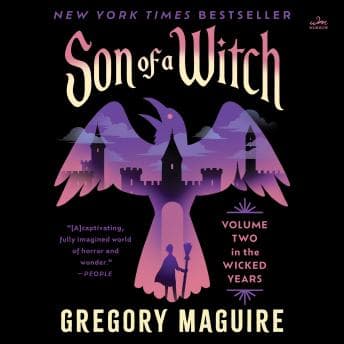

I was sitting in the darkest corner of the Georgia Tech library at 2 AM, ostensibly debugging a procedural terrain generation script that keeps spawning rivers flowing uphill. But really? I was listening to Son of a Witch. My thesis advisor, Dr. Patel, would not be impressed. But honestly, the mood in the lab—cold, sterile, slightly hopeless—was the perfect backdrop for this book.
Let's just get this out of the way immediately.
When the Creator Takes the Mic
It's narrated by the author, Gregory Maguire. Now, usually, when I see "Narrated by Author," I get nervous. Unless your name is Neil Gaiman, you should probably stay out of the recording booth. (Steven Pacey walked so you could sit down, Gregory.)
At first, I was literally checking my headphone connection. Maguire is soft. Like, library whisper soft. And monotone. If you're coming off a high-octane Sanderson avalanche or a theatrical Star Wars audio drama, this is going to feel like hitting a brick wall at 10 mph.
But—and this is where I surprised myself—about three hours in, while I was mindlessly refactoring code, it clicked. The protagonist, Liir, is depressed. He's detached. He's kind of a mess. And Maguire's delivery? It's detached. It's heavy. It sounds like a guy telling a story he's not sure he wants to remember.
So, is it a "good" performance in the traditional sense? No. He does this weird backwards-masking voice effect for some characters that sounds like my audio driver crashing. But is it the right vibe for a grim, gray journey through a broken Oz? Weirdly, yes. It felt authentic to the misery. (Though, pro-tip: Crank the speed to 1.25x. Trust me. You're welcome.)
Oz, But Make It a D&D Campaign Where the DM is Sad
If Wicked was the high-level campaign where the party fights the BBEG, Son of a Witch is the session after the campaign imploded. The world-building here is still chef's kiss. We're seeing the fallout of the first book—political imprisonment, dragons, the gritty underbelly of the Emerald City. It's deep lore. I live for deep lore.
That same commitment to detailed world-building shows up in Court of Thorns and Roses, though Maas keeps the momentum way tighter.
But the pacing? It rambles. It wanders. It's like that one player at the table who spends forty-five minutes investigating a chair while the rest of the party wants to slay the dragon.
There were moments I zoned out, focused on my thesis (shocking, I know), and realized I hadn't missed any plot points. Just a lot of walking and introspection. It's a slow burn. Like, glacial burn. If you're here for the musical's "Defying Gravity" energy, you are in the wrong dungeon. This is grimdark fairy tale stuff. It's messy and political and doesn't hold your hand.
Who's Rolling Initiative (And Who Should Sit This One Out)
Listen if: You love the Wicked universe and want the pure, unfiltered vision of the author. You've got patience for slow, melancholic fantasy and don't need distinct character voices to stay engaged.
Skip if: You need a narrator who keeps the energy up, or you're expecting anything close to the musical's vibe. This is grimdark introspection, not show tunes.
Closing the Laptop at 4 AM
Look, I finished it. I enjoyed the world. I liked seeing Liir try to figure out who he is (maybe Elphaba's son? maybe not?). But I think I would've enjoyed this way more as a physical book.
The narration is just... it's a hurdle. A big one. It requires a specific kind of patience I usually reserve for waiting on render times. I'm glad I listened to it, mostly because it gave me an excuse to ignore my own writing for 14 hours. But next time, I'm picking something with explosions. Or at least a professional voice actor.