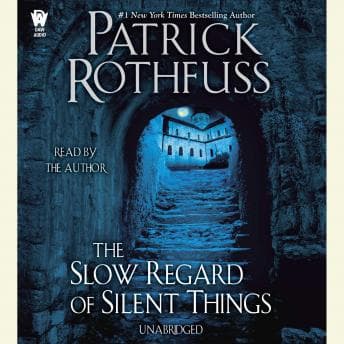

Okay, let's get the elephant out of the room first. I am supposed to be fixing a massive memory leak in my procedural terrain generation code. My thesis defense is looming like a Tarrasque on the horizon. Instead? I spent nearly four hours listening to Patrick Rothfuss whisper about soap-making and gear placement in a sewer.
(My advisor Dr. Patel, if you're reading this... actually, never mind, you definitely don't read fantasy side-novellas.)
Here's the thing about The Slow Regard of Silent Things. It is weird. Wonderfully, frustratingly, beautifully weird. If you go into this expecting Kvothe doing cool sympathy magic or fighting the Chandrian like in The Name of the Wind, you are going to be so mad. Literally nothing happens. And I mean that in the best way possible.
The Anti-D&D Adventure
So, usually in fantasy—and definitely in my Thursday night D&D group—we're all about the loot, the XP, the progression. We want the stat blocks to go up. Auri, the main character here, is basically the opposite of that. She lives in the Underthing (the spooky tunnels under the University), and her entire existence is just... putting things where they belong.
It sounds boring. On paper, it is boring. "Girl finds a gear. Girl worries the gear is sad. Girl moves the gear to a shelf."
But the way Rothfuss writes this? It's like watching someone debug the universe. Auri sees the world in a way that feels like pure, raw magic before it gets codified into a system. It's intimate. It feels like walking around inside someone's anxiety disorder, but making it magical. As someone who organizes his bookshelf by color and genre (don't judge me), I felt seen. It's a dungeon crawl where the monster is "disorder" and the loot is "inner peace."
That same focus on the philosophical side of magic—where the system matters less than the feeling—shows up in Elantris, though Sanderson obviously goes way harder on the actual mechanics.
When the Author Grabs the Mic
Usually, when I see "Narrated by the Author," I cringe. Writing and acting are different skill trees, people. You don't see Steven Pacey trying to write grimdark fantasy (actually, he might be good at that, never mind).
But here? It works. Because this book is so fragile.
Rothfuss has this deep, rumbly, soothing voice. It's like a warm blanket. Or a warm bath. Super chill. Maybe too chill. I'm not gonna lie—I cranked this up to 1.25x speed because otherwise, I might've fallen asleep at my desk. Not out of boredom, just out of sheer relaxation.
He knows exactly where the emotional beats are because he wrote them. When Auri gets panicked about a candle being in the wrong spot, Rothfuss sells it. You believe the panic. The production quality helps too—there are these subtle musical cues that just... fit. Atmospheric as hell.
Roll for Recommendation
Look, this isn't for everyone. If my buddy Dave from the D&D group listened to this, he'd hate it. He'd be asking where the combat is. Skip this if you need plot momentum, action beats, or anything resembling a traditional narrative arc.
But if you like the idea of magic—the philosophy of it—more than the fireballs, this is a gem. It's a short, weird little prose poem that I listened to while staring at my broken code, and somehow, it made me feel better about the chaos in my own life.
Now, if we could just get The Doors of Stone to finally wrap up The Kingkiller Chronicle sometime before I turn 40, that would be great. But for now, Auri's little world is a nice place to hide.